









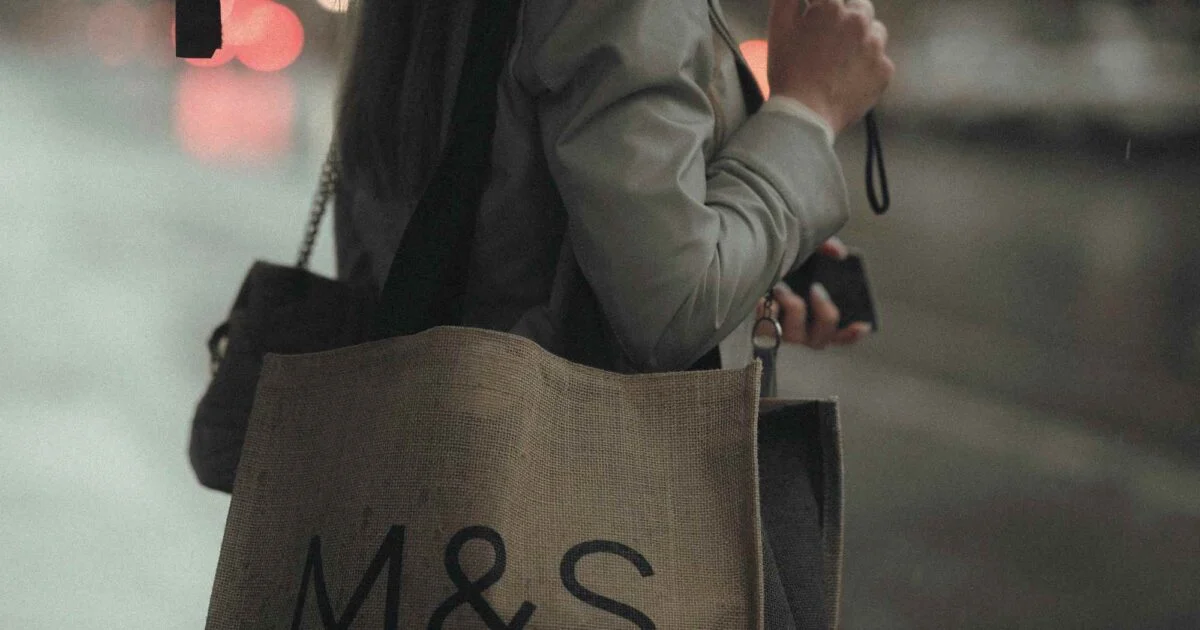
British high-street stalwart Marks & Spencer (M&S) made headlines with its historic debut at London Fashion Week, introducing a fast-paced "see now, buy now" runway format that caught industry watchers by surprise. While the retail giant continues to report robust financial results and command consumer loyalty for its food, fashion, and homeware offerings, its environmental and ethical footprint remains under intense scrutiny. According to recent sustainability evaluations from ethical fashion ratings platform Good On You, M&S currently holds a middling "It’s a Start" rating. This evaluation underscores a complex corporate reality: despite commendable transparency initiatives and targeted material shifts, the retailer continues to drive mass production cycles that critics argue run counter to true ecological and social sustainability.
Founded in 1884, Marks & Spencer has evolved far beyond its humble origins into a cornerstone of British commerce and culture. For generations, the company has operated as a reliable barometer of the United Kingdom’s economic health, with its biannual financial reports serving as a closely watched indicator of consumer confidence. Domestically, the brand is synonymous with quality—a cultural footprint cemented by iconic marketing campaigns such as its famous food tagline. However, as the global fashion industry faces an existential reckoning over overconsumption, carbon emissions, and supply chain transparency, the retailer’s clothing division is confronting difficult questions regarding its business model.
The core tension lies in the scale of M&S operations. Operating vast retail spaces packed with extensive inventories of apparel, the company relies on high-volume production to maintain competitive pricing. Analysts examining the brand note a fundamental paradox: maintaining rigorous quality standards while mass-producing garments on a global scale inevitably strains ecological boundaries. Despite years of corporate social responsibility (CSR) pledges, the fundamental volume of manufactured goods raises critical concerns regarding waste generation, resource depletion, and labor justice across the international supply chain.
Environmental Performance: Material Shifts Versus Production Realities
In evaluating its environmental impact, Good On You awarded Marks & Spencer an "It’s a Start" score, reflecting a mixed performance across material sourcing, greenhouse gas emissions, and waste management. On the positive side, M&S has introduced lower-impact materials and outlined ambitious timelines to transition away from virgin plastics. The company has asserted that it remains on track to completely replace virgin polyester with recycled alternatives within its clothing lines.
Nevertheless, environmental advocates point out that recycled polyester is still a fossil-fuel-derived synthetic material that sheds microplastics into water systems during every domestic wash cycle. Given that polyester ranks as the brand’s second most-utilized textile, critics argue that phasing out the material entirely or significantly reducing reliance on synthetic fibers is imperative for long-term ecological health. Furthermore, while M&S has established science-based targets to curb greenhouse gas emissions across its direct operations and manufacturing supply chain, broader systemic waste challenges persist.
The brand’s garments have occasionally surfaced in international textile waste audits. Investigations by organizations such as Changing Markets and Greenpeace have identified UK retail waste within dumping sites and vulnerable ecosystems in the Global South, including Kenya and Ghana. Although M&S has explicitly maintained that it does not intentionally export excess unsold inventory, the sheer volume of global clothing waste indicates that post-consumer disposal remains a critical blind spot. To its credit, the retailer has implemented producer responsibility frameworks, including clothing take-back schemes in partnership with charitable organizations like Oxfam, dedicated in-store repair services, and a one-year durability guarantee on children’s apparel. However, sustainability experts maintain that these localized circularity measures cannot offset the systemic impacts of high-volume mass production.
A Shift Toward Accelerated Fashion Cycles
The debate surrounding the company’s environmental trajectory intensified following strategic adjustments to its fashion business model. M&S introduced "Love That Drop," a monthly, trend-led capsule collection initiative designed to accelerate market delivery times, turning designs into finished retail products in as little as two weeks. Industry analysts have categorized this strategy as a pivot toward fast-fashion mechanics, a model traditionally criticized for encouraging rapid overconsumption and placing unsustainable operational pressure on garment-manufacturing suppliers.
This strategic pivot was further emphasized by the brand’s September runway debut at London Fashion Week. By adopting a "see now, buy now" framework—where consumers can purchase runway items immediately rather than waiting the traditional six-month industry standard—M&S signaled a deeper embrace of instant gratification retail. While commercially savvy, this approach directly challenges slow-fashion paradigms that advocate for seasonal restraint and reduced consumption.
Labor Rights and Supply Chain Transparency
In the domain of labor rights, Marks & Spencer achieves a comparable "It’s a Start" evaluation, reflecting notable progress tempered by persistent industry-wide challenges. The brand demonstrates commendable transparency compared to many high-street competitors. More than half of its final-stage production facilities are certified by the Sedex Members Ethical Trade Audit (SMETA) Best Practice Guidance. Furthermore, M&S publicly discloses its complete tier-one fashion supplier network through an active collaboration with the Open Supply Hub, providing unprecedented visibility into where its garments are assembled.
During the global health disruptions caused by the COVID-19 pandemic, the retailer drew praise for establishing robust protective policies for factory workers. Industry observers noted that these protective measures were largely facilitated by long-standing, collaborative relationships between M&S and its manufacturing partners—a preferred model for fostering stability within international supply chains. Additionally, the brand has instituted various social programs aimed at supporting vulnerable women and girls within its production communities.
Despite these achievements, a glaring omission remains: the absence of verified living wages for workers throughout the entire supply chain. Good On You analysts point out that M&S has not provided empirical evidence confirming that all garment makers receive a living wage, nor has the corporation formally adopted a recognized living wage benchmark. Given the extensive scale of the brand’s apparel manufacturing, hundreds of thousands of workers are involved in its production pipeline, making wage equity a critical pillar of social justice that the company has yet to fully secure.
Animal Welfare Commitments and Ongoing Usage
Marks & Spencer’s animal welfare policies similarly earn a middling "It’s a Start" rating. The corporation maintains a formal animal welfare policy aligned with the internationally recognized Five Domains framework. Key sourcing metrics include commitments to purchasing wool exclusively from non-mulesed sheep and ensuring that all leather is sourced from tanneries certified by the Leather Working Group (WG). Additionally, M&S has pledged to source all animal fibers—including wool, mohair, alpaca, and recycled down—from preferred, certified standards such as the Responsible Wool Standard (RWS) by 2030.
Yet, despite these governance structures, the retailer continues to market substantial volumes of animal-derived products, including leather, shearling, cashmere, and alpaca wool. Ethical groups argue that while certification standards minimize direct cruelty, the large-scale commodification of animals inherently carries ecological and welfare risks. Industry watchdogs have encouraged M&S to leverage its substantial market capital to pioneer and scale emerging, non-plastic, plant-based material alternatives.
Strategic Implications and the Path Forward
The overarching evaluation of Marks & Spencer reveals a corporate entity caught between traditional heritage retail values and the pressures of modern mass-market commerce. While its public disclosures, supplier mapping, and material recycling targets set a relatively high standard among conventional high-street retailers, its recent acceleration toward rapid-fire fashion drops and runway-to-consumer models moves the brand in a contradictory direction.
To advance toward higher sustainability tiers such as "Good" or "Great," analysts suggest that M&S must fundamentally decouple revenue growth from volume expansion. This would require scaling back total production quantities to combat the root causes of global textile waste. Furthermore, deepening supply chain traceability beyond tier-one factories down to raw material producers, significantly curbing reliance on animal-derived fibers, and committing to audited living wages across the entire manufacturing ecosystem remain essential benchmarks for future progress.
For consumers seeking alternatives that align more closely with comprehensive ethical standards, the sustainable marketplace offers several verified options spanning apparel, children’s wear, and home goods. Brands such as Toad&Co, Harvest & Mill, Colorful Standard, Q for Quinn, Sheep Inc., SeamsFriendly, Printfresh, Pop My Way, Oobi, and Disruptor London demonstrate alternative business models rooted in circular design, organic materials, and transparent labor practices. As Marks & Spencer navigates its new chapter on the global fashion stage, the tension between commercial growth and planetary boundaries will undoubtedly remain a defining narrative of its corporate evolution.