








For most watch enthusiasts, understanding how a mechanical movement works is largely an exercise in observation. Exhibition casebacks reveal the intricate dance of bridges, wheels, gears, and balance wheels, while secondary literature provides the theoretical framework for these components. However, the transition from passive observer to active participant—the act of disassembling and successfully reassembling a movement—has historically been reserved for professional watchmakers or those enrolled in multi-year trade programs. With the launch and rapid expansion of the First Hand workshop in Chicago, Hampden Watch has effectively dismantled this barrier to entry, allowing horological enthusiasts to transition from collectors to creators in a single, high-intensity day.
The Origins of an Experiential Experiment
Hampden Watch launched the First Hand program in December 2025. The initiative began as a bold, speculative question within the company’s leadership team: Could individuals with zero prior technical experience be taught to reliably disassemble, service, and reassemble a Swiss mechanical movement, install a dial and handset, case the movement, and produce a fully functional, water-resistant wristwatch in under eight hours?

The project was led by the Wein family, which has been a pillar of the American watch industry for over a century. The family’s involvement in Chicago’s horological landscape dates back to 1922. Over four generations, the family has either founded or acquired a legacy of six distinct brands, including the historic Hampden Watch, which traces its roots to 1877. Today, the business is steered by third-generation CEO Joseph Wein and fourth-generation Brand Director Daniel Wein. The First Hand program serves as both a public outreach initiative and a celebration of this deep-rooted, 150-year legacy.
Program Methodology and Technical Infrastructure
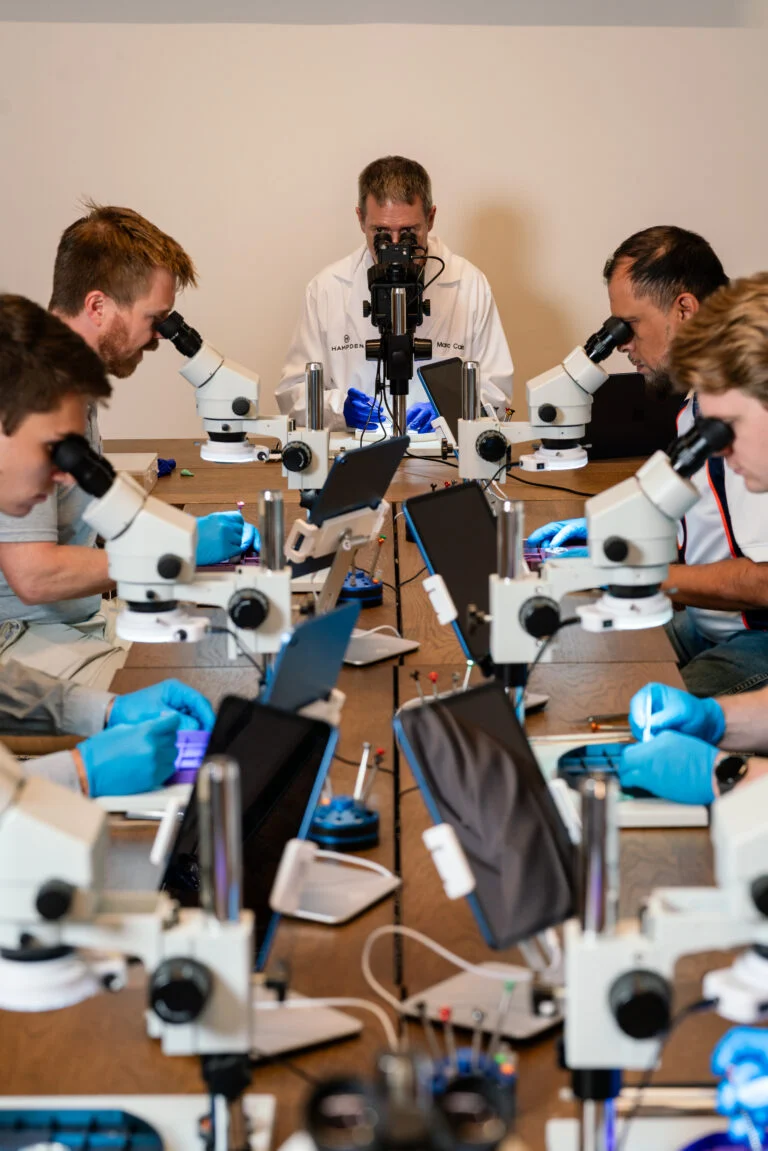
The success of the program is rooted in a highly structured, intimate educational environment. Each session is limited to just six students, ensuring a low instructor-to-student ratio of 1:2. This proximity allows for granular oversight, which is critical when working with delicate Swiss components. The sessions run from 9:00 AM to 4:00 PM, beginning with an essential foundation in movement theory and the ergonomics of professional bench tools.
Rather than relying on traditional watchmaker’s loupes, which can cause significant eye strain for beginners, Hampden provides high-quality binocular microscopes. This technology shift is pivotal, as it enhances precision and mitigates the frustration often associated with learning fine-motor tasks. Furthermore, the company has deployed proprietary workshop software on iPads located at every bench. This digital interface provides step-by-step graphical instructions that synchronize with the instructor’s demonstration. This ensures that even if students progress at different speeds, no individual feels "stranded" or overwhelmed, as they can review procedures independently without disrupting the class.

The focal point of the workshop is the Unitas 6498 manual-wind movement. Originally designed approximately 75 years ago for pocket watches, the 6498 is prized in education for its large, robust architecture. Its layout—featuring a distinct small-seconds display at the 6 o’clock position—makes the interaction between its gear train and balance assembly easily observable, serving as the perfect "textbook" for novice watchmakers.
Growth and Public Response
Since its inception in late 2025, the program has achieved significant commercial and educational milestones. Within less than a year, Hampden has hosted 30 consecutive sold-out sessions, accommodating more than 200 participants. The program has maintained a flawless 5.0-star rating across 60 verified reviews, with 100% of participants stating they would recommend the experience to others.
This demand has transcended regional boundaries. While the workshops are held at Hampden’s headquarters at 1550 W Carroll Ave. in Chicago, roughly 40% of the participants are visitors from outside the Chicago metropolitan area. This cohort includes enthusiasts from both the East and West Coasts, and in one notable instance, a student traveled from Utqiagvik, Alaska. This geographic diversity underscores a growing trend in luxury consumer behavior: the shift toward "experiential retail," where the value of a product is derived not just from ownership, but from the process of creation.

The Curated Experience and Archive Integration
The workshop is designed as a holistic immersion into the history and mechanics of timekeeping. Beyond the technical assembly, the day includes a chef-catered lunch and a private, curated tour of the Hampden historical archives. This collection comprises hundreds of timepieces and documents spanning 150 years of American watchmaking.
For the seasoned collector, the archive tour is frequently cited as a highlight of the program, providing a vital context to the modern mechanical work they perform at the bench. By connecting the 6498 movement they are assembling to the broader history of the industry, participants develop a deeper appreciation for the evolution of horology.
Upon completion of the technical portion, participants transition to the final assembly of their bespoke watch. They select from eight exclusive dials—named after Chicago landmarks and industrial motifs such as "Forged Orange," "Harbor Blue," and "Stockyard Green." The resulting 42mm watch is a unique piece of horological craftsmanship, complete with an exhibition caseback and an engraving of the student’s initials and the year of assembly.

Future Implications and Scalability
The overwhelming success of the First Hand program has prompted significant infrastructure investment. Hampden is currently constructing a 1,700-square-foot facility dedicated exclusively to the workshop, slated to open in the winter months. This expansion is designed to accommodate the growing waiting list and provide a more specialized learning environment.
Furthermore, the company is preparing to launch an "Advanced Workshop" for First Hand alumni in October 2026. This follow-up course will shift focus to the Sellita SW200 automatic movement, which presents a more complex engineering challenge and is housed in a more compact 37mm case. This tiered educational model suggests that Hampden is building a long-term community of "graduate" watchmakers.
Economic and Industry Context
Priced at $2,100 USD—which includes the workshop, all tools, materials, the archive experience, and the finished watch—the program is positioned as a premium luxury experience. However, when analyzed against the cost of independent horological training or the price of comparable Swiss-made timepieces, the value proposition is high.

The implications for the wider watch industry are notable. Brands are increasingly struggling to maintain relevance with a younger or more digitally-focused demographic. By offering a tangible, manual connection to the product, Hampden is fostering deep brand loyalty that traditional marketing cannot replicate. The fact that these watches are not available for direct purchase—they can only be acquired by building them—adds an element of exclusivity and personal narrative that is highly coveted by modern collectors.
As the industry moves further into an era of mass production and digital smartwatches, the success of the First Hand program serves as a case study for the resurgence of traditional craftsmanship. By removing the veil of mystery from mechanical watchmaking and providing the tools for self-sufficiency, Hampden Watch is not just selling a product; it is cultivating a new generation of informed, capable horological enthusiasts who understand the "how" and "why" of the ticking machines on their wrists. For those who have spent years admiring movements through sapphire casebacks, the First Hand workshop offers a rare, definitive opportunity to cross the line from observer to artisan.