








The horological landscape has seen a persistent trend toward the revival of mid-century design, a movement characterized by the reintroduction of archival models updated for contemporary sensibilities. Movado, a brand historically synonymous with the minimalist Museum Dial and its association with the Bauhaus movement, has formally entered this space with the launch of the Heritage Kingmatic. This release signifies a departure from the brand’s recent focus on entry-level quartz timepieces, signaling an attempt to reclaim its reputation as a significant player in mechanical watchmaking. The Heritage Kingmatic, which draws direct inspiration from the company’s 1956 catalog, serves as a bridge between the brand’s mid-century innovation and current market demands for vintage-inspired design.

Historical Context and the Origins of the Kingmatic
The original Movado Kingmatic was first introduced in 1956, during a period when the brand was at the forefront of technical advancement. At the time of its debut, the Kingmatic was notable for being one of the first full-rotor automatic movements developed by the company, succeeding the "bumper" automatic movements that defined the early era of self-winding technology. The name "Kingmatic" itself was a branding effort intended to emphasize the reliability and self-winding efficiency of the movement.
For nearly three decades, the Kingmatic remained a staple in the Movado portfolio. During the 1950s and 60s, Movado was widely regarded as a manufacture of substance, often compared to the industry’s premier names in terms of finishing and movement complexity. However, the subsequent decades, marked by the industry-wide shift toward quartz technology, saw the brand pivot toward fashion-forward, quartz-driven designs. This shift ultimately alienated a segment of traditional horological enthusiasts. The current Heritage collection represents a conscious, multi-year effort to pivot back to these roots, as evidenced by the 1917 collection and now the expanded Kingmatic range.

Design Specifications and Modern Adaptations
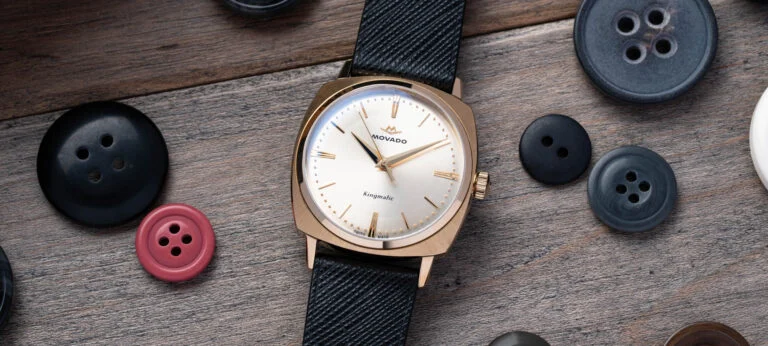
The newly released Heritage Kingmatic line features a 35mm cushion-style case, a dimension that aligns with modern preferences for more compact, wearable dress watches. The lug-to-lug distance is 42.4mm, with a slim profile of 9.8mm, ensuring a comfortable fit on the wrist. While the original 1956 models were often sized closer to 29mm, current market analysis suggests that a 35mm case represents a "sweet spot" for unisex appeal and historical accuracy without compromising modern utility.
The case architecture has been subtly modified from the original design. Whereas the 1956 iteration featured sharp, almost aggressive corners and straightforward, unrefined lugs, the new Heritage edition incorporates a more fluid cushion shape with chamfered lugs. This update improves the visual flow of the watch and adds a layer of depth to the finishing. The case construction utilizes stainless steel throughout, with select models offering an ion-plated gold-tone finish to emulate the aesthetic of the original 1950s gold-cased versions.

The dial design demonstrates a high level of restraint. Movado has opted to exclude luminous material, a choice that avoids the common pitfall of "faux-patina" or poorly applied lume that often plagues modern vintage reissues. Instead, the watch relies on a sunray-finished dial with applied gold-tone markers, including doubled markers at the cardinal positions. The dauphine-style hands are polished to match, providing high legibility and a cohesive aesthetic.
Technical Composition and Movement Choice
The Heritage Kingmatic is powered by the Sellita SW200-1 automatic movement. This caliber is a standard, workhorse movement within the industry, operating at a frequency of 28,800 vibrations per hour (vph) and offering a power reserve of approximately 38 hours. While some collectors may argue that a boutique or in-house movement would better serve a "heritage" product, the selection of the Sellita movement ensures serviceability and cost-efficiency for a broader consumer base.

The movement is visible through a sapphire crystal caseback, allowing the wearer to observe the mechanical heart of the timepiece. This transparency is a feature notably absent from many of the brand’s quartz-heavy catalog, reinforcing the distinction between the Heritage line and the standard Movado retail experience. The watch features a domed sapphire crystal to mimic the acrylic crystals of the 1950s, while the water resistance is rated at 50 meters, appropriate for a dress-oriented timepiece.
Market Positioning and Strategic Implications
The release of the Kingmatic is priced at $1,495 USD for the leather strap configuration, $1,595 USD for the stainless steel mesh version, and $1,695 USD for the ion-plated gold-tone model. This pricing structure places the watch in a competitive segment occupied by brands like Tissot, Hamilton, and Longines.

From a strategic standpoint, this pricing reflects a significant adjustment for Movado. The brand’s historical dominance in the department store retail channel, dominated by quartz watches with a high volume of sales at a lower price point, has created a challenge regarding brand perception. For a consumer base accustomed to paying $400 to $600 for a Movado Museum watch, a jump to a $1,500 mechanical offering requires a re-education of the brand’s value proposition.
Market analysts point out that this "upmarket" push is a common strategy for established heritage brands seeking to stabilize their standing against the rise of micro-brands and the renewed interest in history. By leveraging the Kingmatic name, Movado is attempting to signal to the watch community that it is capable of producing products that satisfy technical standards as well as aesthetic ones.

Potential Challenges and Criticisms
Despite the positive reception of the dial design and case finishing, there are areas of friction. The absence of quick-release spring bars on the leather straps has been noted as a minor oversight, particularly given that the target demographic for this watch often rotates straps frequently. In an era where tool-less strap changes are becoming standard even for entry-level luxury watches, this design choice is seen by some as a missed opportunity for user-friendliness.
Furthermore, the brand must navigate the "quartz stigma." Because Movado is so strongly associated with its entry-level quartz products, there is an inherent difficulty in convincing skeptical collectors that the brand offers comparable quality to established Swiss mechanical houses. However, the consistent release of the Heritage series—each model showing higher attention to detail than the last—suggests a long-term commitment to this transition.

Future Outlook
The Heritage Kingmatic is not merely an isolated product launch; it is a indicator of the brand’s broader objective to diversify its portfolio. By mining its archives, Movado is effectively diversifying its consumer base, moving beyond the casual fashion-watch buyer toward the "enthusiast" market.
Industry reactions have been largely measured. Analysts suggest that if Movado continues to execute these reissues with the same level of restraint—specifically regarding the omission of unnecessary modern additives like date windows or excessive branding—the Heritage line could succeed in rehabilitating the brand’s reputation. The success of the Kingmatic will be measured not only in sales units but in the brand’s ability to maintain a presence in authorized dealers that cater specifically to watch collectors.

For the time being, the Heritage Kingmatic stands as a testament to the fact that even for a brand defined by the simplicity of the Museum Dot, there is significant value in revisiting the complexities of its own past. As the market for mechanical watches continues to reward provenance and historical design, Movado’s decision to re-examine the Kingmatic appears to be a calculated and timely response to the evolving preferences of global watch consumers.