








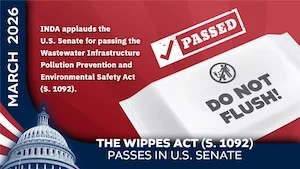
In a significant move to safeguard municipal infrastructure and harmonize consumer product labeling, the United States Senate officially passed the Wastewater Infrastructure Pollution Prevention and Environmental Safety (WIPPES) Act (S. 1092) on March 22, 2026. The legislation, which received broad bipartisan support, aims to mitigate the escalating costs and operational challenges faced by wastewater treatment facilities across the nation. INDA, the Association of the Nonwoven Fabrics Industry, which has spearheaded advocacy for the bill for several years, formally applauded the Senate’s decision on March 25, 2026, marking a pivotal moment in the industry’s effort to promote responsible disposal habits among consumers.
The WIPPES Act seeks to establish a uniform national standard for "Do Not Flush" labeling on non-flushable wipes, ensuring that products not designed to break down in sewer systems are clearly marked for disposal in trash receptacles. This federal action follows the successful passage of a companion bill, H.R. 2269, which cleared the U.S. House of Representatives via a voice vote in June 2025. With the Senate version now approved, the legislation returns to the House for final alignment before it can be sent to the President’s desk for signing into law.
The Scope and Purpose of the WIPPES Act
The primary objective of the WIPPES Act is to address the "fatberg" phenomenon and chronic sewer blockages that have plagued urban and rural wastewater systems for decades. While many wipes are engineered to be flushable and compatible with existing plumbing, a significant portion of the market consists of non-flushable products, such as baby wipes, disinfecting wipes, and cosmetic wipes. These products are often made from synthetic fibers or reinforced materials that do not disperse in water. When consumers mistakenly flush these items, they entangle with fats, oils, and grease (FOG) in the sewer lines, creating massive obstructions that require expensive manual removal.
The WIPPES Act mandates that manufacturers of non-flushable wipes include a prominent, standardized "Do Not Flush" symbol and warning message on all packaging. By creating a federal requirement, the act eliminates the confusion caused by a patchwork of varying state-level labeling laws, providing both consumers and manufacturers with a single, clear set of expectations.
A Chronology of Legislative Advocacy and Industry Collaboration
The passage of the WIPPES Act in the Senate is the culmination of nearly a decade of intensive collaboration between the nonwoven fabrics industry and the wastewater management sector. Historically, these two groups were often at odds regarding the impact of wipes on infrastructure. However, a turning point occurred through the development of the "Flushability Guidelines" (GD4 and GD5) by INDA and EDANA (the European disposables and nonwovens association), which established rigorous scientific testing methods to distinguish truly flushable products from those that are not.
The legislative timeline reflects a steady momentum toward federal intervention:
- 2018–2020: Initial discussions between INDA and the National Association of Clean Water Agencies (NACWA) led to a consensus on the need for better labeling rather than outright bans on products.
- 2021–2024: Seven states—including California, Washington, Oregon, Illinois, and others—passed their own versions of "Do Not Flush" labeling laws. These state laws served as the blueprint for the WIPPES Act.
- June 2025: The U.S. House of Representatives passed H.R. 2269, demonstrating strong bipartisan appetite for a federal solution.
- March 22, 2026: The U.S. Senate passed S. 1092, bringing the nation one step closer to a unified labeling standard.
Wes Fisher, Director of Government Affairs at INDA, highlighted the importance of this progress, stating, "INDA has championed this legislation for the past several years, and we are encouraged to see it pass out of the Senate. With the House having passed its version of the bill last year, we now have more momentum behind this legislation than ever. We extend our thanks to the bill sponsors, our industry and wastewater partners, and INDA members as we take another step forward to make ‘Do Not Flush’ labeling nationwide."
Supporting Data: The Economic and Technical Burden
The necessity of the WIPPES Act is underscored by the staggering financial burden placed on taxpayers and municipalities due to improper wipe disposal. According to data from the National Association of Clean Water Agencies (NACWA), U.S. wastewater utilities spend an estimated $441 million annually to respond to clogs caused by non-flushable items. These costs include emergency labor, the repair and replacement of damaged pumps, and the disposal of tons of debris removed from screens and settling tanks.
In major metropolitan areas, the problem is even more acute. For example, New York City’s Department of Environmental Protection has previously reported spending millions of dollars a year specifically on "wipe-related" maintenance. Beyond the direct financial impact, these clogs pose significant environmental risks, including sanitary sewer overflows (SSOs) that can discharge untreated waste into local waterways, leading to public health hazards and violations of the Clean Water Act.
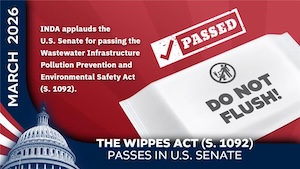
Technical analysis of "fatbergs" frequently reveals that while "flushable" wipes—which are designed to lose strength and disperse upon agitation in water—are rarely the culprit, non-flushable baby wipes and cleaning wipes constitute the vast majority of the solid mass in these blockages. By standardizing the "Do Not Flush" logo (the recognizable icon of a person disposing of a wipe in a trash can next to a toilet with a red strike-through), the WIPPES Act targets the root cause of consumer confusion.
Official Responses and Political Leadership
The WIPPES Act stands as a rare example of successful bipartisan cooperation in a polarized political climate. The bill’s lead sponsors in the Senate, Senator Jeff Merkley (D-OR) and Senator Susan Collins (R-ME), represent a cross-aisle partnership focused on practical infrastructure solutions. In the House, the companion bill was introduced by Representative Lisa McClain (R-MI) and Representative Kevin Mullin (D-CA), further demonstrating the geographic and political breadth of support for the measure.
Senator Merkley has long advocated for the bill, citing the environmental impact on Oregon’s coastal and river ecosystems. Senator Collins has emphasized the economic relief the bill provides to small-town wastewater districts that lack the budget for frequent, high-cost equipment repairs.
Stakeholders from the wastewater sector have also expressed relief. Representatives from the Water Environment Federation (WEF) and the American Public Works Association (APWA) have noted that a federal standard is much easier to communicate to the public than a series of differing local ordinances. For manufacturers, a single national standard simplifies supply chain logistics and packaging design, ensuring that a product sold in Maine meets the same requirements as one sold in California.
Broader Implications for the Nonwoven Industry
The nonwoven fabrics industry is a massive global market, valued at over $50 billion and growing. Wipes represent one of the largest consumer-facing segments of this industry. The passage of the WIPPES Act is expected to provide long-term stability for the sector by reinforcing the distinction between flushable and non-flushable categories.
Furthermore, the act is likely to catalyze further innovation in material science. As "Do Not Flush" labels become more prominent, there is an anticipated increase in consumer demand for products that are safely flushable. This may drive investment into cellulosic fibers and other biodegradable materials that meet the "Flushability Guidelines" (GD5) while maintaining the performance characteristics consumers expect from cleaning and personal care products.
The legislation also sets a potential global precedent. As the United States moves toward a national standard, other regions, including the European Union and parts of Asia, may look to the WIPPES Act as a model for their own regulatory frameworks. Standardizing these symbols internationally would further assist global manufacturers and enhance consumer education across borders.
Future Outlook and Implementation
Following the Senate’s passage of S. 1092, the bill will undergo a final review process in the House to reconcile any minor technical differences between the two versions. Given the overwhelming support previously shown in the House, analysts expect a swift resolution. Once signed into law, the Environmental Protection Agency (EPA) or a designated regulatory body will likely oversee the implementation phase, providing manufacturers with a grace period to update their packaging designs.
The success of the WIPPES Act will ultimately be measured by its impact on the ground—or rather, under it. Municipalities will be monitoring sewer maintenance data closely in the coming years to determine if the increased visibility of "Do Not Flush" labels leads to a measurable decrease in blockages.
While the WIPPES Act is a critical legislative victory, INDA and its partners emphasize that public education remains a continuous effort. Standardized labeling is a powerful tool, but it must be accompanied by ongoing awareness campaigns to ensure that "Protect Your Pipes" remains a priority for households across the country. With the Senate’s recent action, the U.S. is now firmly on a path toward a more resilient and cost-effective wastewater infrastructure, supported by an industry committed to environmental stewardship and consumer clarity.