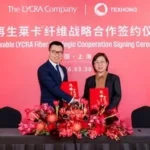






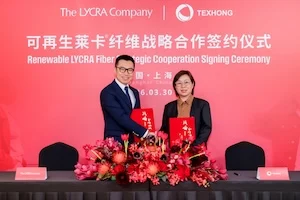


In a move that signals a significant shift toward bio-derived materials within the global textile supply chain, The LYCRA Company and Texhong International Group Limited officially entered into a strategic partnership agreement on April 2, 2026. The signing ceremony, held in the industrial and financial hub of Shanghai, establishes a framework for the exclusive integration of renewable, plant-based fibers into the core-spun cotton textile sector. This collaboration is designed to address the increasing demand for sustainable apparel solutions while maintaining the high-performance standards associated with premium stretch fabrics.
The agreement specifies that Texhong, recognized as one of the world’s largest suppliers of core-spun yarn, will be the exclusive partner for The LYCRA Company in bringing Renewable LYCRA fiber—containing 30 percent plant-based content—to the core-spun yarn market in China. This move is expected to have a cascading effect on the global apparel industry, as China remains a primary manufacturing base for international fashion brands and retailers seeking to lower their Scope 3 emissions.
Technical Innovation and Environmental Impact
The centerpiece of this partnership is the newly developed Renewable LYCRA fiber. Unlike traditional spandex, which is almost entirely derived from fossil-fuel-based raw materials, this iteration utilizes a significant portion of bio-derived inputs. Specifically, the fiber incorporates a polymer made from dent corn, a variety of field corn primarily used for industrial and livestock purposes rather than direct human consumption.
The transition to bio-derived raw materials does not come at the expense of performance. According to technical specifications released by The LYCRA Company, the 30 percent plant-based fiber is engineered to mirror the physical properties of standard LYCRA fiber. This includes its signature elasticity, recovery power, and durability. For manufacturers like Texhong, this "drop-in" capability is crucial, as it allows for the adoption of sustainable materials without requiring extensive modifications to existing machinery or yarn-spinning processes.
Supporting the environmental claims of the new fiber is a comprehensive Cradle-to-Gate Life Cycle Assessment (LCA) conducted by Ramboll in early 2026. The assessment compared LYCRA fiber made with bio-derived PTMEG (polytetramethylene ether glycol) against its fossil-derived counterpart. The findings indicated that the renewable version can achieve a reduction in carbon emissions of up to 32 percent. This data point is particularly relevant for apparel brands that have committed to Science Based Targets (SBTi) and are under pressure to decarbonize their material sourcing.
A Legacy of Collaboration: The Evolution of a 20-Year Relationship
The partnership announced in Shanghai is not an isolated event but rather the culmination of a two-decade-long relationship between The LYCRA Company and Texhong. Over the last twenty years, the two entities have collaborated on several industry-shaping technologies. One notable milestone in their shared history was the development and commercialization of patented LYCRA dualFX fabric technology. This technology combines two different stretch fibers into a single yarn, providing high stretch with excellent recovery and shape retention—a standard now widely used in the premium denim industry.
The deepening of this relationship into the realm of renewable materials reflects a shared evolution in corporate strategy. As the textile industry faces mounting regulatory pressure regarding environmental impact and waste, major suppliers are moving beyond performance-only metrics to prioritize circularity and carbon reduction.
Jason Wang, Vice President for Asia at The LYCRA Company, highlighted the maturity of the technology during the signing ceremony. "This strategic partnership fully underscores The LYCRA Company’s leading capabilities in sustainable fiber innovation and industrial application," Wang stated. He further noted that the partnership with Texhong provides the necessary industrial scale to move renewable spandex from a niche, experimental product to a mainstream industrial standard.
Texhong’s Strategic Role in the Value Chain
As a dominant force in the core-spun yarn market, Texhong International Group plays a vital role in the mid-stream of the textile value chain. Core-spun yarn is created by wrapping a sheath of fibers—most commonly cotton—around a central core of elastane (spandex). This construction is essential for a vast array of garments, including stretch denim, chinos, and knitwear.
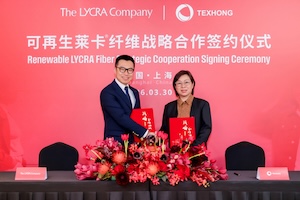
By securing the exclusive rights to use Renewable LYCRA fiber in this sector in China, Texhong positions itself as a primary gateway for brands looking to enhance the sustainability profile of their cotton-rich garments. Zhou Xia, Chief Operating Officer of Texhong International Group, emphasized that the company’s long-standing dedication to research and development in high-value-added cotton textiles made this partnership a logical next step.
"Partnering with The LYCRA Company will bring new breakthroughs in bio-based material applications and further improve product sustainability," Zhou said. "Together, we will jointly accelerate the innovation and market penetration of bio-derived core-spun yarn solutions."
Texhong’s extensive manufacturing footprint, which includes significant operations in both China and Southeast Asia, ensures that the resulting yarns can be distributed efficiently to garment manufacturers worldwide. The company’s ability to offer customized core-spun products using the new renewable fiber provides a turnkey solution for retailers who are often caught between the desire for sustainability and the need for reliable, high-volume supply chains.
Market Context: China’s Green Transition and Global Demand
The timing of this announcement is significant within the context of China’s broader economic and environmental goals. The Chinese government’s "Double Carbon" goals—aiming for a peak in carbon emissions by 2030 and carbon neutrality by 2060—have placed immense pressure on the industrial sector to modernize. The textile industry, traditionally a heavy consumer of energy and resources, is a focal point of this transition.
Furthermore, consumer sentiment in major markets, including Europe and North America, is increasingly favoring transparency and eco-friendly materials. Regulatory frameworks, such as the EU’s Strategy for Sustainable and Circular Textiles, are mandating more rigorous reporting on the environmental footprint of clothing. By introducing a fiber that offers a 32 percent reduction in carbon emissions, The LYCRA Company and Texhong are providing the industry with a quantifiable tool to meet these emerging requirements.
Industry analysts suggest that the "30 percent plant-based" threshold is a strategic starting point. While the industry ultimate aims for 100 percent bio-based or recycled content, the 30 percent mark allows for immediate commercial scalability without compromising the structural integrity of the spandex—a challenge that has historically hindered the adoption of bio-polymers in high-stress applications like activewear and denim.
Implications for the Textile Industry and Beyond
The partnership between The LYCRA Company and Texhong is expected to catalyze several shifts in the textile landscape:
- De-risking Bio-Materials: By proving that bio-derived spandex can function at scale in core-spun yarns, the partnership reduces the perceived risk for other manufacturers and brands to adopt similar technologies.
- Supply Chain Verticality: The collaboration emphasizes a "value chain" approach, where the fiber producer and the yarn spinner work in tandem. This reduces the time-to-market for new innovations and ensures that the final product meets the specific needs of brand end-users.
- Standardization of Sustainability Metrics: The reliance on third-party verified LCAs (like the Ramboll study) sets a precedent for how environmental claims should be communicated in the textile sector, moving away from vague "green" marketing toward data-driven reporting.
- Agricultural Integration: The use of dent corn as a feedstock highlights the growing intersection between industrial agriculture and the fashion industry. As the demand for bio-derived fibers grows, the sourcing and sustainability of these agricultural inputs will likely become the next frontier of supply chain scrutiny.
Future Outlook and Collaborative Innovation
Moving forward, The LYCRA Company and Texhong have committed to a roadmap of joint innovation. This includes not only the immediate rollout of the renewable core-spun yarns but also ongoing research into the next generation of bio-derived materials. The companies plan to work closely with downstream brands to develop end-use applications that showcase the benefits of the new fiber, ranging from high-performance athletic apparel to everyday casual wear.
The partnership also serves as a defensive strategy against the volatility of fossil fuel markets. As oil prices fluctuate and carbon taxes become more prevalent in global trade, shifting toward renewable, plant-based feedstocks provides a level of long-term economic resilience for both the fiber producer and the textile manufacturer.
In conclusion, the strategic agreement signed in Shanghai represents more than just a commercial contract; it is a blueprint for the future of the textile industry. By combining The LYCRA Company’s expertise in polymer science with Texhong’s massive manufacturing and distribution capabilities, the partnership is set to accelerate the transition from a petroleum-dependent industry to one rooted in renewable resources. As the first shipments of these renewable core-spun yarns begin to reach garment factories, the global apparel market will be watching closely to see how quickly "bio-derived" becomes the new standard for quality and sustainability.