







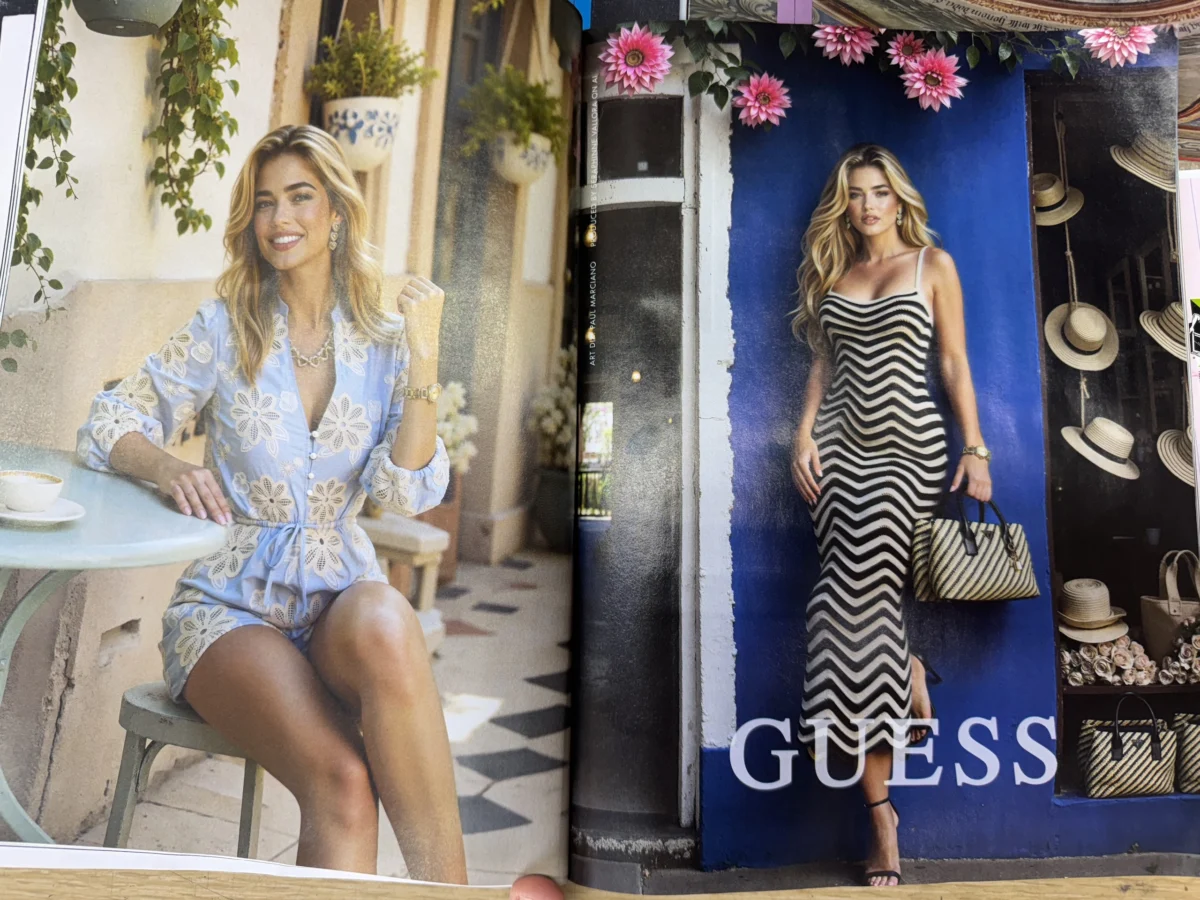
The intersection of high fashion and generative artificial intelligence reached a critical flashpoint this year when Vogue’s July print edition featured a full-page advertisement for Guess that appeared, at first glance, to be a standard campaign. The model depicted—thin, blonde, and possessing the pouty aesthetic typical of North American beauty standards—seemed unremarkable for the brand until closer inspection revealed a startling truth: she was entirely AI-generated. The ensuing controversy has reignited a fierce debate over the displacement of human workers, the ethics of "artificial diversity," and the future of creative labor in an era where silicon-based perfection is becoming cheaper than human reality.
This incident is not an isolated event but rather the latest escalation in a trend that began to gain mainstream traction in 2023. At that time, Sarah Murray, a professional commercial model, first encountered the technology when Levi Strauss & Co. announced a partnership with the AI studio Lalaland.ai. The collaboration aimed to create "diverse" digital fashion models to supplement human talent, ostensibly to improve the online shopping experience by showing clothes on a wider range of body types and skin tones. However, the backlash was immediate. Critics, including New York Magazine, labeled the move "artificial diversity," arguing that the company was using technology to bypass the need to hire and pay actual diverse human models. For professionals like Murray, the shift felt like an existential threat to an already grueling industry.

The Economic Imperative: Why Brands Are Turning to AI
The primary driver behind the adoption of AI models is a fundamental shift in the volume of content required by the modern retail landscape. According to PJ Pereira, co-founder of the AI advertising firm Silverside AI, the traditional fashion marketing model was designed for a world where a brand might produce four major campaigns per year. Today’s digital-first economy, fueled by social media platforms like TikTok and Instagram alongside massive e-commerce catalogs, requires a vastly different scale. Brands now find themselves needing anywhere from 400 to 400,000 unique pieces of content annually to remain relevant and competitive.
Meeting this demand through traditional photography is prohibitively expensive. A standard photoshoot involves not just the model, but a photographer, stylist, hair and makeup artists, set designers, and assistants. When scaled to thousands of garments, the costs of logistics, studio rentals, and day rates become unsustainable for many brands, particularly smaller enterprises. Paul Mouginot, an art technologist and consultant for luxury brands, notes that AI allows companies to take a simple "flat-lay" product shot and project it onto a photorealistic virtual model in a coherent setting. This process produces images that rival high-end editorial spreads at a fraction of the time and cost.
Major global retailers have already begun integrating these tools. H&M, Mango, and Calvin Klein have all experimented with AI-generated models to streamline their digital storefronts. The French retailer Veepee has utilized virtual mannequins for over a decade, but the current generation of generative AI offers a level of realism that was previously impossible. As fashion writer Amy Odell observes, if a brand can save money on its print ads or social feeds by eliminating the need for human crews, the financial incentive is often too great to ignore.

A Chronology of the AI Encroachment in Fashion
The timeline of AI integration in fashion reveals a steady progression from experimental niche technology to mainstream adoption:
- 2013–2018: Early adoption of virtual mannequins and CGI models. Brands like Veepee begin using basic digital representations to display clothing.
- 2019: CGI models like Miquela and Shudu become social media sensations, proving that digital personas can secure brand endorsements and "interact" with audiences.
- 2023: Levi’s announces its partnership with Lalaland.ai to generate diverse models. The move sparks a global conversation about the ethics of using AI to simulate inclusivity.
- 2024: Generative AI tools like Midjourney and Flux reach a level of photorealism that makes it difficult for the average consumer to distinguish between human and digital subjects.
- 2025: The July issue of Vogue features an AI-generated model in a Guess ad, signaling a potential "stamp of approval" from the industry’s most influential publication.
The Impact on Human Talent and Financial Security
While high-fashion "supermodels" who walk the runways of Paris and Milan may currently remain insulated by their celebrity status, the vast majority of the modeling workforce operates in the e-commerce sector. Sinead Bovell, a model and founder of the WAYE organization, describes e-commerce as the "bread and butter" of the industry. These jobs provide the financial security that allows models to maintain their careers. If AI automates this segment of the market, the foundational income for thousands of professionals could vanish.
Beyond the immediate loss of jobs, there are growing concerns regarding the "robot cultural appropriation" of diverse identities. When brands generate AI models of color instead of hiring human models of color, they are essentially profiting from the appearance of diversity without providing the economic opportunities that should accompany it. Sarah Murray points out that there is no shortage of diverse human talent; models wait in line for hours at open casting calls for the very opportunities that are now being "supplemented" by algorithms.

Furthermore, the legal landscape is struggling to keep pace with technological advancements. Models are increasingly finding clauses in their contracts that may inadvertently grant brands the rights to use their likeness to train future AI systems. This has led to legislative efforts like the Fashion Workers Act in New York. Spearheaded by Sara Ziff and the Model Alliance, the bill seeks to require brands to obtain clear consent and provide fair compensation whenever a model’s digital replica is used.
The Role of the "AI Artisan" and the Quest for Imperfection
Despite the push toward automation, some industry experts argue that the human element cannot be entirely replaced. Sandrine Decorde, CEO of the creative studio Artcare, describes her team as "AI artisans." Rather than relying on generic, homogenous outputs, they use advanced tools to fine-tune digital models, adding the subtle "imperfections"—the slight asymmetry of a gaze or a unique attitude—that create a sense of human connection.
Decorde also highlights an ethical application for the technology: the children’s fashion market. The use of minors in fashion has long been a gray area fraught with potential for exploitation and labor violations. By using AI-generated children to model garments, brands can meet market demand while avoiding the ethical complexities and legal hurdles associated with child labor.

However, the risk of bias remains a significant hurdle. If the datasets used to train these AI models are not curated with intention, the technology will simply reflect and amplify existing societal biases. PJ Pereira emphasizes that prompting for a wide range of appearances is essential to prevent the industry from reverting to a singular, digitized standard of perfection.
Future Implications: Normalization or Resistance?
The industry is currently in a state of flux. While some brands are leaning into fully artificial campaigns, others are wary of alienating audiences who value authenticity. Data from Silverside AI suggests that while negative comments often accompany AI-generated content, the "silent majority" of consumers may be less bothered. In one test, an AI-generated product video saw a click-through rate 30 times higher than the number of complaints, resulting in a significant sales spike.
The role of Vogue in this transition cannot be overstated. As the "fashion bible," Vogue’s advertising and editorial standards often dictate what becomes acceptable for the rest of the industry. If the magazine continues to feature AI models, it may normalize the technology in the same way it once normalized reality television stars and influencers.

For human models, the path forward may require a shift in strategy. Sinead Bovell suggests that models must now focus on building unique personal brands and telling human stories that an algorithm cannot replicate. "AI will never have a unique human story," she says, echoing a sentiment that is becoming common across many creative industries currently facing automation.
As the fashion world grapples with these silicon fingers touching every aspect of production—from design to the final print ad—the central question remains: In a world of digital perfection, what is the value of the human touch? For now, the industry appears to be testing the limits of how much "artificiality" its consumers are willing to wear.