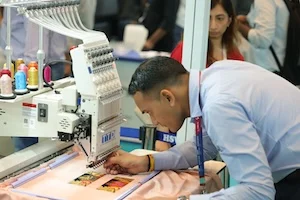










European Union defense spending reached an unprecedented milestone of approximately €381 billion in 2025, signaling a profound shift in the continent’s strategic priorities and industrial focus. This surge in capital allocation toward security and defense has catalyzed a renewed emphasis on the textile value chain, particularly in the development of high-performance protective materials. As the European Defence Fund’s (EDF) 2026 Work Programme officially designates “smart and multifunctional textiles” as a primary priority area, the upcoming Techtextil trade fair in Frankfurt am Main is set to serve as the global nexus for this industrial evolution. Scheduled to take place from April 21 to 24, 2026, the event will feature more than 1,500 exhibitors, with over 10 percent of the floor space dedicated exclusively to material innovations in the protective textiles sector.
The integration of advanced textiles into modern defense systems reflects a broader transition toward the "soldier-as-a-system" philosophy, where clothing and equipment are no longer viewed as passive gear but as active components of operational capability. For product developers, original equipment manufacturers (OEMs), and procurement leads, the challenge lies in balancing extreme protective requirements—such as ballistic resistance, flame retardancy, and chemical protection—with the physiological needs of the wearer, including ergonomics, breathability, and weight reduction. Techtextil 2026, alongside its co-located event Texprocess, aims to address these complexities by bridging the gap between raw fiber innovation and industrial-scale manufacturing.
The Geopolitical and Economic Drivers of Textile Innovation
The record-breaking defense expenditure of 2025 serves as the economic backdrop for the 2026 textile cycle. This financial influx is not merely a response to immediate security concerns but represents a long-term commitment to technological sovereignty within the European Union. The EDF’s inclusion of smart textiles in its Work Programme underscores the strategic importance of materials that can monitor vital signs, change camouflage patterns, or provide integrated communication pathways.
For procurement managers and technical leads at major defense system providers, the focus has shifted toward industrial feasibility. The market requires materials that are not only innovative in a laboratory setting but are also reproducible at scale, compliant with rigorous international standards, and resistant to supply chain volatility. This demand for market-ready solutions is a driving force behind the 150 specialized exhibitors at Techtextil who form the technological backbone of the protective textiles segment. These companies provide the essential fibers, yarns, and fabrics that eventually become ballistic protection systems or Chemical, Biological, Radiological, and Nuclear (CBRN) protective suits.
Strategic Material Shifts: PFAS Restrictions and Sustainability
A critical challenge facing the industry in 2026 is the tightening of environmental regulations, particularly regarding Per- and Polyfluoroalkyl Substances (PFAS). Historically, PFAS have been the gold standard for achieving water-, oil-, and dirt-repellent finishes in protective clothing. However, as global restrictions on these "forever chemicals" intensify, the industry is under immense pressure to find high-performance alternatives that do not compromise the safety of the end-user.
This regulatory landscape is driving a surge in research into fluorine-free coatings and inherently resistant fibers. At Techtextil, the new "Textile Chemicals & Dyes" segment in Hall 9.0 will feature more than 30 exhibitors specifically focused on these chemical transitions. By connecting chemical engineering directly with textile application, the event provides a platform for developers to source finishes that meet both environmental standards and the grueling performance requirements of the defense and emergency services sectors.
Key Players and Technological Milestones
The participation of global industry leaders highlights the high stakes of the 2026 event. The Lenzing Group, a pioneer in wood-based specialty fibers, is expected to showcase its latest developments in inherently flame-retardant cellulose fibers. Unlike treated fabrics, these fibers embed protection directly into the molecular structure, ensuring that the flame-retardant properties do not wash out or degrade over time—a vital feature for long-term durability in combat or industrial fire environments.
Similarly, HS Hyosung Advanced Materials will present high-performance yarns engineered from synthetic polymers designed for extreme tensile strength and thermal stability. These yarns are the building blocks for ballistic vests and reinforced structural textiles used in military infrastructure.
The mechanical integrity of protective gear is further supported by specialists in narrow textiles and components. Companies such as Güth & Wolf GmbH, JUMBO-Textil GmbH & Co. KG, and Otto Stockmayer & Sohn GmbH provide the essential webbings, elastics, and high-performance knitted fabrics that ensure protective systems remain functional under physical stress. The role of these components is often overlooked but remains critical for the ergonomics and reliability of the final garment.
Bridging the Gap: The Synergy Between Techtextil and Texprocess
One of the unique value propositions of the Frankfurt event is the co-location of Techtextil and Texprocess. While Techtextil focuses on the "what"—the materials and functional properties—Texprocess focuses on the "how"—the machinery, software, and processes required to turn those materials into finished products. In 2026, around 200 exhibitors in Hall 8.0 of Texprocess will demonstrate the latest in automated cutting, sewing, and bonding technologies.
This synergy is essential for the defense sector, where the transition from a high-performance fiber to a finished ballistic vest involves complex assembly techniques that must maintain the integrity of the protective layers. Lotje Oosterlinck, Product Manager for Workwear at Concordia Textiles, emphasizes that the requirements for protective fabrics are converging across different fields, from military use to heavy industry. According to Oosterlinck, the ability to develop material solutions that work across different protection domains and transfer them into application-specific industrial processes is the current benchmark for success.
Industrial Scalability and Reproducibility
A recurring theme for the 2026 edition is the move from "innovation for innovation’s sake" to "industrial scalability." Dr. Heike Illing-Günther, Managing Director of the Saxon Textile Research Institute (STFI), notes that market relevance in the current climate is determined by more than just a new fiber or finish. The true test of innovation lies in testability, reproducibility, and the reliable transfer of technology into mass production.
For defense contractors, a material that performs well in a prototype but cannot be manufactured with 100% consistency across 100,000 units is a liability. The Techtextil Forum will address these operational needs through a series of lectures and workshops. Notably, the 2026 forum will feature insights from NASA experts, who will discuss the parallels between space-grade textiles and terrestrial protective systems, focusing on "Textile Intelligence" and "Resilient Textiles." These sessions are designed to provide decision-makers with the technological framework needed to scale smart functionalities from concept to field-ready applications.
Performance Apparel on Stage: Live Demonstrations
To illustrate the practical application of these innovations, the "Performance Apparel Textiles" area in Hall 9.0 will host the "Performance Apparels on Stage" format. This live demonstration allows buyers and procurement officers to see protective clothing in motion, highlighting the balance between protection and wearer comfort. In the context of the €381 billion EU defense budget, these demonstrations provide a tangible look at how taxpayer investments are being translated into physical protection for personnel.
The focus on "Performance Apparel" also reflects the growing trend of dual-use technology. Innovations originally developed for elite military units are increasingly finding their way into civilian workwear, emergency services, and even high-performance sportswear. This cross-pollination of technology ensures a broader market for exhibitors and drives down the cost of advanced materials through economies of scale.
Broader Impact and Industry Implications
The implications of Techtextil 2026 extend far beyond the exhibition halls. The event serves as a barometer for the health of the global technical textile industry, which is increasingly reliant on high-value, specialized segments to offset the commoditization of standard fabrics.
From a strategic perspective, the focus on multifunctional textiles aligns with the European Union’s goal of reducing dependence on external suppliers for critical safety equipment. By fostering a domestic ecosystem of fiber producers, chemical suppliers, and garment manufacturers, the EU is building a more resilient defense industrial base. The €381 billion spent in 2025 is not just an expenditure on hardware; it is an investment in the materials science that will define the next generation of safety and performance.
Furthermore, the emphasis on sustainability—even within the defense sector—marks a significant cultural shift. The drive for PFAS-free materials and recyclable high-performance fibers suggests that "green" initiatives are no longer seen as secondary to performance but as a core requirement of modern procurement.
Conclusion
As the countdown to April 2026 begins, the textile industry is preparing for a period of intense activity driven by geopolitical necessity and technological breakthroughs. Techtextil and Texprocess 2026 will provide the necessary platform for over 1,700 exhibitors to demonstrate how they can meet the rigorous demands of a well-funded but highly demanding defense and security market. For decision-makers, the event offers a comprehensive market overview, ensuring that the materials of tomorrow are ready for the industrial challenges of today. The focus on scalability, reproducibility, and multifunctional protection ensures that the innovations showcased in Frankfurt will play a pivotal role in the safety and efficiency of personnel across the globe for years to come.