









The spring-summer collections presented during Paris Fashion Week frequently establish distinct aesthetic directions for the upcoming season, but rarely do two competing powerhouse maisons arrive at the exact same conceptual doorstep on the same afternoon. On September 29, the fashion world witnessed an extraordinary convergence of creative thought when Dior and Maison Margiela presented collections that shared not only a thematic vocabulary but an explicit technical dialogue. While operating from their respective design codes, both houses centered their narratives on the tension between "flou" and "tailleur"—the foundational dualities of French haute couture. This unexpected intersection dominated industry conversations, framing a day where structural paradoxes and historical tributes converged on the Parisian runways.
The dichotomy of atelier craftsmanship provided the intellectual bedrock for the afternoon presentations. In traditional French tailoring terminology, the "tailleur" workshop handles rigid, highly constructed garments requiring heavy interfacings, such as structured coats, blazers, and trousers. Conversely, the "flou" division specializes in soft, fluid, and unconstructed silhouettes, traditionally responsible for draped dresses and bias-cut gowns. The conceptual friction generated by blurring the lines between these two distinct disciplines formed the core of the day’s most anticipated shows, revealing a shared industry-wide fascination with deconstruction, hybridization, and the subversion of traditional garment engineering.
Dior’s Fluidity Meets Structural Rigor
At Dior, creative direction under Jonathan Anderson steered the legendary house into uncharted conceptual waters by dismantling the very definitions of atelier categorization. Anderson chose to apply the techniques typically reserved for the "tailleur" workshop—such as sharply cut jackets, crisp button-down shirts, and tailored trousers—and rendered them in floating, weightless designs normally produced within the domain of Le Flou.
By taking the rigid framework of menswear-inspired tailoring and translating it into garments that billowed, draped, and floated with ethereal lightness, Anderson effectively inverted the foundational rules of construction. This technical exercise challenged observers to reconsider the tactile qualities of luxury fabrics. Woolens traditionally used for stiff overcoats were engineered to drape like silk georgette, while trousers were restructured to move with the fluid grace of evening gowns. The collection underscored a broader movement within contemporary luxury: the rejection of rigid sartorial boundaries in favor of hybrid garments that offer both the comfort of softness and the authority of structure.
Maison Margiela’s HARD and SOFT Dichotomy
Later that same afternoon, Maison Margiela staged its Spring/Summer 2027 presentation under the directorship of Glenn Martens, titled appropriately HARD and SOFT. The show notes explicitly referenced the interplay between contrasting design techniques, mirroring the conceptual framework introduced earlier in the day at Dior.
Margiela’s exploration of the theme manifested in strikingly literal and figurative garments. The most prominent example was a sweeping white gown anchored by an arrangement of crushed metal cans and discarded silverware, creating a makeshift, avant-garde suit of armour that juxtaposed industrial refuse with pristine tailoring. Elsewhere, softly draped dresses appeared to fracture violently at the chest, exposing rigid undergarments and structured corsetry constructed from contrasting heavy fabrics.
Throughout the presentation, the garments maintained an intentional sense of structural dissonance. Looks often appeared subtly compromised or "glitched"—as if a variable had been tampered with during the construction process. This aesthetic manifested through unexpected pairings, such as highlighter-orange athletic trainers worn with evening wear, exaggerated drag-inspired cosmetics, or coat linings that were deliberately inverted to form the primary structure of the dress. This technique of intentional disruption has become a signature touch within contemporary avant-garde design, reflecting a cultural weariness with pristine perfection and an embrace of raw, unpolished authenticity.
A Botanical Tribute Across Decades
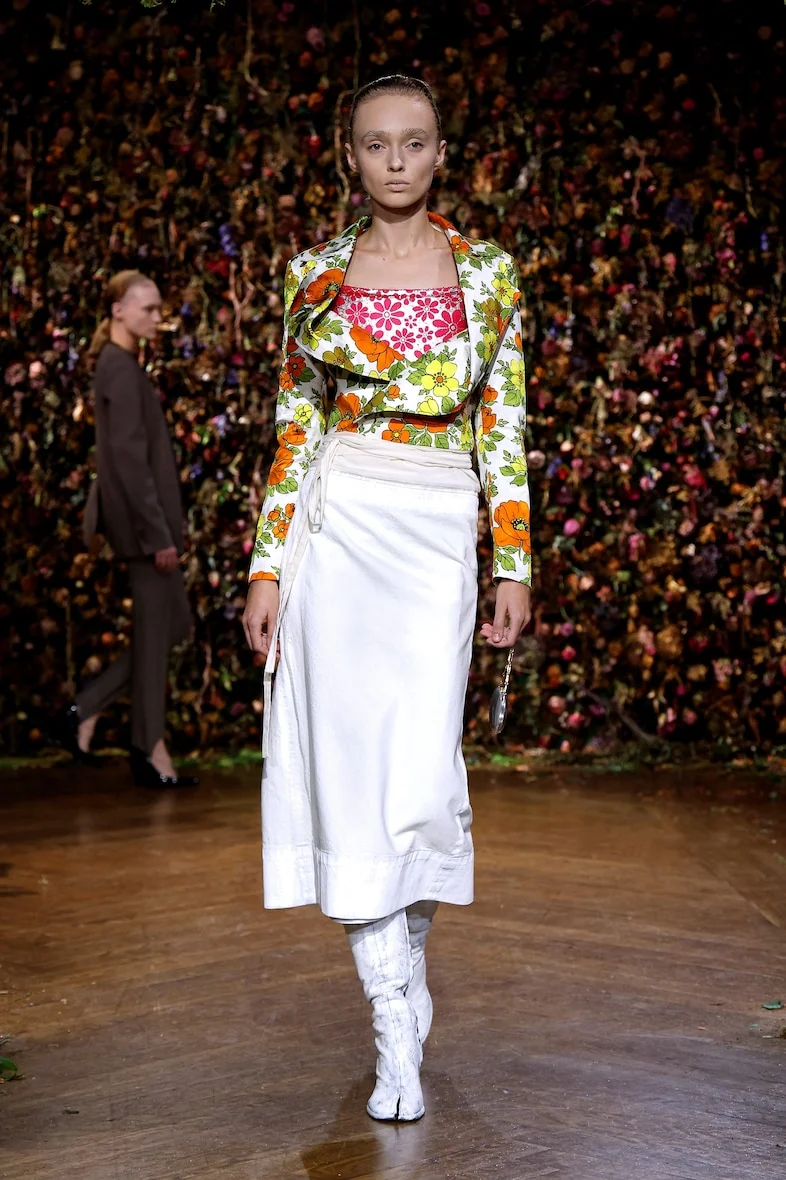
The thematic crossovers extended far beyond garment construction into the realm of set design and historical homage. Guests arriving at Margiela’s venue, L’Élysée Montmartre, entered an immersive environment defined by walls completely covered in decaying floral arrangements.
According to the official press release, the installation served as a deliberate tribute to Raf Simons’ landmark 2012 haute couture debut for Dior—a collection universally remembered for its rooms lined with millions of fresh, vibrant blooms. To execute the homage, Margiela commissioned Mark Colle, the same florist responsible for Simons’ iconic 2012 set.
However, Martens and Margiela introduced a haunting temporal twist. Unlike the lush, living walls of Simons’ debut, the flowers at L’Élysée Montmartre were thoroughly wilted, dry, and hanging lifelessly from the architecture. The installation presented the visual equivalent of a preserved memory left to decay over a decade and a half. Show notes clarified the conceptual intent: "The set concept follows our on-going founding interest in replication and our deep love of fashion."
The botanical motif permeated the collection itself, appearing immortalized as vibrant, blossoming prints that leaned toward psychedelic motifs reminiscent of the 1960s. Even the invitations distributed to attendees featured a subtle nod to the theme: a small silver lapel pin securing three dried peonies.
Cultural Context and Industry Implications
The simultaneous exploration of the "tailleur-flou" binary by two of fashion’s most influential houses signals a deeper shift in consumer demand and creative direction. As the luxury market navigates shifting demographics and economic pressures, designers are increasingly tasked with offering garments that bridge the gap between utilitarian comfort and visual statement-making.
The focus on hybridization reflects broader manufacturing trends. Modern ateliers are investing heavily in textile innovation, combining heavy-duty synthetic blends with traditional natural fibers to achieve weights and draping effects that were previously impossible. This technological capability allows designers like Anderson and Martens to push structural boundaries without sacrificing wearability.
Furthermore, the overt referencing of Raf Simons’ 2012 Dior collection highlights a growing wave of historical introspection within the fashion industry. Designers who came of age during the 1990s and 2010s are now occupying top creative roles at major luxury houses, prompting a reexamination of recent fashion history. By looking back at pivotal moments from the past two decades—such as Simons’ tenure at Dior—contemporary designers are establishing a lineage of modern minimalism and conceptual tailoring, reinterpreting past milestones through the lens of current anxieties and aesthetic preferences.
Conclusion and Analytical Outlook
The convergence of Dior and Maison Margiela on September 29 will likely be remembered as a watershed moment for Paris Fashion Week. By independently arriving at parallel conclusions regarding the intersection of hard and soft elements, both houses demonstrated a collective industry intuition.
Whether Martens’ exploration of HARD and SOFT was a meditation on the ultimate expression of softness in modern fashion history—embodied by Dior’s 2012 aesthetic—or merely a conceptual exercise in avant-garde tailoring remains open to interpretation. What is certain is that the dialogue established between these two shows has set a high benchmark for the season. As these collections transition from the runway to retail floors, their influence on silhouette engineering, textile development, and conceptual storytelling will resonate across the global fashion landscape for seasons to come.