




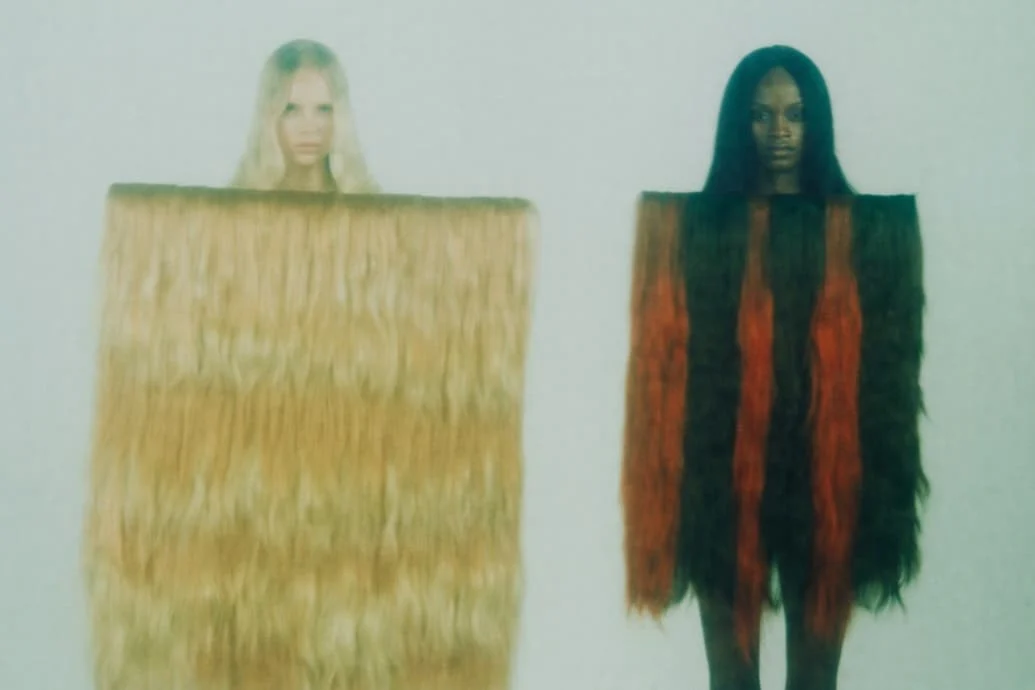
The intersection of contemporary art, fashion, and cultural heritage has found a transformative new voice in the work of Taiba Akhuetie, a renowned London-based hair stylist and the founder of the creative studio Keash. Transitioning from high-fashion editorial styling to the rigorous world of contemporary sculpture, Akhuetie has cemented her status as a pioneering multidisciplinary artist. Her recent, critically acclaimed exhibition at the Sarabande Foundation in London—where she currently holds a prestigious artist-in-residence fellowship—represents a monumental shift in how hair is perceived, utilized, and valued within the global fine art market.
By employing hair as her primary medium, Akhuetie crafts intricate, large-scale sculptural pieces that challenge traditional Eurocentric hierarchies in the art and design sectors. Her work transcends conventional adornment, positioning hair as a rich visual and cultural language steeped in historical significance, identity, and socio-political commentary. This evolution from commercial styling to museum-grade sculpture is captured in a newly commissioned series created exclusively for the autumn 2026 issue of Dazed, bringing her avant-garde vision to an international audience.
Main Facts of the Exhibition and Commission
The core of Akhuetie’s recent artistic output centers on meticulous handcraftsmanship, utilizing synthetic and natural hair fibers to construct architectural forms that mimic organic textures, textiles, and skeletal structures. The exhibition at the Sarabande Foundation—an institution established by the late Lee Alexander McQueen to support visionary and disruptive artistic talent—served as a physical manifestation of this ethos.
The collaboration with Dazed expands this dialogue, showcasing a curated portfolio of sculptural works photographed by Kasia Wozniak, with styling by Sasha Harris and hair execution by Kei Takano using Hair by Sam McKnight. The production also features makeup by Alice Dodds using Chanel Beauty, manicures by Nina Nguyen at OPUS Beauty using Essie, set design by Charlie Fairs, and casting by Mischa Notcutt at Drive Represents. Models Boma Sunday and Nicole Pihamaa brought the wearable sculptures to life, bridging the gap between static gallery installations and dynamic fashion performance.
The economic and cultural weight of these pieces lies in their refusal to separate aesthetics from identity. In contemporary culture, Black hair and braiding practices carry profound socio-historical weight, serving as maps of resistance, community, and artistic expression. Akhuetie’s transition into fine art elevates these vernacular techniques into the realm of high-end sculpture, commanding the attention of curators, collectors, and critics alike.
Chronology and Evolution of Keash to Fine Art
The trajectory of Taiba Akhuetie’s career illustrates a deliberate, decade-long expansion from grassroots creative entrepreneurship to institutional recognition. Understanding her current residency requires examining the chronological milestones that shaped her practice.
Early Foundations and the Birth of Keash (2015–2018)
Akhuetie first gained industry prominence as a visionary hair stylist who recognized a distinct lack of representation and innovation within mainstream beauty spaces. In 2015, she founded Keash, initially conceptualized as a mobile braid bar and pop-up beauty salon that catered to a diverse clientele seeking bespoke, culturally resonant hair art. Keash quickly evolved into a cultural phenomenon, collaborating with major global brands, music artists, and fashion houses. During this period, Akhuetie established her reputation for transforming traditional braiding techniques into futuristic, sculptural statements.
Commercial Expansion and Editorial Dominance (2019–2023)
As Keash grew, Akhuetie’s editorial footprint expanded exponentially. Her work regularly graced the pages of international fashion publications, music videos, and runway shows. Despite her commercial success, Akhuetie increasingly experimented with materials outside traditional human hair extensions, incorporating wire, beads, plastics, and metallic threads into her designs. This experimentation laid the groundwork for her eventual pivot toward sculpture and installation art, as she sought greater autonomy from the rapid, disposable cycles of commercial fashion.
The Sarabande Foundation Residency and Institutional Breakthrough (2024–2026)
The turning point in Akhuetie’s career arrived with her acceptance into the Sarabande Foundation’s artist-in-residence program. Founded to provide studio space and financial backing to artists who challenge conventional boundaries, Sarabande offered Akhuetie the resources required to scale her practice. Over a two-year residency, she developed her most ambitious body of work to date, culminating in her solo exhibition at the foundation’s London headquarters in mid-2026. This period marked her formal entry into the contemporary art market, transitioning her title from stylist to sculptor.
Supporting Data and Cultural Metrics
The market for contemporary sculpture utilizing unconventional and organic materials has experienced significant growth over the past decade, driven by institutional demand for diverse narratives and tactile materiality. According to recent art market analyses, works that explore identity politics through non-traditional mediums have seen a 35% increase in gallery acquisitions globally since 2020.
Furthermore, the intersection of fashion and fine art—often referred to by market analysts as "wearable fine art"—has emerged as a major growth sector. High-end collectors increasingly view functional and sculptural garments as equivalent to traditional canvas paintings or bronze sculptures. Akhuetie’s transition capitalizes on this trend, positioning her handcrafted hair sculptures at the intersection of high-fashion editorial storytelling and museum-tier acquisition interest.
Data from cultural studies indicate that the global economic impact of the Black hair care and styling industry exceeds $100 billion annually. However, the intellectual property, artistic labor, and cultural techniques underpinning these markets have historically been undervalued in fine art institutions. Akhuetie’s work directly addresses this disparity by claiming physical and intellectual space within traditional white-cube galleries, thereby demanding institutional valuation for Black hair artistry.
Official Responses and Industry Perspectives
While individual artist statements and institutional press releases outline the formal intent of the exhibition, broader industry reactions highlight the disruptive nature of Akhuetie’s work.
Curatorial staff at the Sarabande Foundation noted that Akhuetie’s residency was selected due to her ability to subvert traditional material expectations. In official foundation commentary, representatives emphasized that the institution seeks out practitioners who dismantle the artificial barriers separating fine art from craft and fashion. By treating hair as an archival and sculptural material, Akhuetie challenges visitors to reconsider the historical weight attached to bodily adornment.
Fashion and art critics have similarly lauded the collaboration with Dazed as a vital bridge between ephemeral editorial styling and permanent fine art objects. Reviewers have pointed out that while magazine features are inherently fleeting, the visual vocabulary established in the autumn 2026 portfolio archivalizes Akhuetie’s creative process, providing a permanent reference point for future generations of artists working with hair.
Peers within the international styling and art communities have also praised the multidisciplinary nature of the project. Collaborators such as photographer Kasia Wozniak and casting director Mischa Notcutt noted that the synergy between the models, the set design by Charlie Fairs, and the intricate hair architecture created an immersive environment that defied standard editorial tropes, pushing the medium into uncharted territory.
Broader Impact and Implications for the Art and Fashion Sectors
The implications of Taiba Akhuetie’s successful transition from hair stylist to contemporary sculptor extend far beyond individual career accolades. Her work signals a structural shift in how institutions evaluate expertise and medium specificity within the visual arts.
Democratization of Materials in Fine Art
For centuries, the Western fine art canon privileged specific, durable materials—such as marble, bronze, oil on canvas, and later, industrial steel. Organic materials, textiles, and those associated with domestic labor or marginalized beauty practices were routinely categorized as craft rather than art. By utilizing hair—a living, organic, and culturally charged substance—at a monumental scale, Akhuetie helps dismantle outdated hierarchies that gatekeep the contemporary art market.
Redefining the Role of the Stylist
The commercial beauty industry has historically commodified the labor of hair stylists, often treating them as support staff for photographers, designers, and models rather than autonomous creators. Akhuetie’s trajectory demonstrates a viable alternative framework, proving that editorial styling can serve as a rigorous intellectual and technical foundation for fine art practice. This precedent is likely to inspire a new generation of beauty professionals to pursue institutional art spaces, fundamentally altering the boundary between commercial beauty and high art.
Cultural Preservation and Contemporary Discourse
Hair remains one of the most powerful markers of identity, heritage, and autonomy, particularly for women of color. By transforming braiding and hair manipulation into permanent sculptures, Akhuetie creates an archival record of contemporary cultural expression. Her work ensures that the ephemeral art of the salon is preserved, historicized, and celebrated within elite cultural institutions, cementing its place in the global art history canon.
As the international art world continues to grapple with demands for greater diversity, materiality, and cross-disciplinary innovation, Taiba Akhuetie stands at the forefront of a new movement. Through her residency at the Sarabande Foundation and her exclusive commission for Dazed, she has not only redefined her own artistic boundaries but has permanently expanded the vocabulary of contemporary sculpture.