









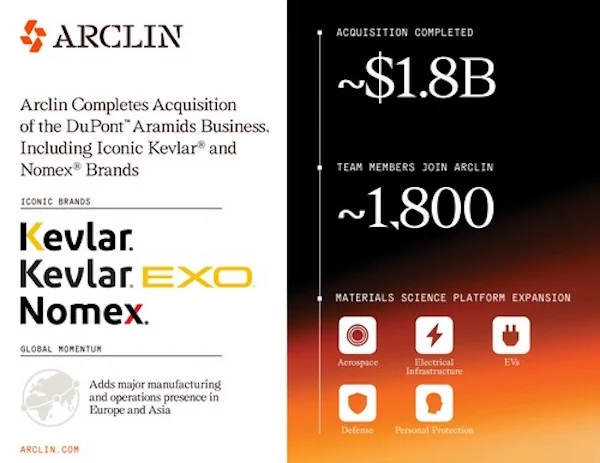
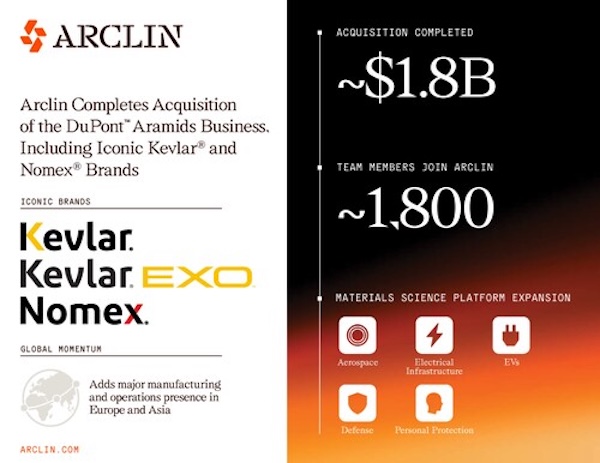
The global materials science landscape underwent a significant shift this week as Arclin, a leading chemistry and surfacing solutions provider, announced the successful completion of its acquisition of DuPont’s Aramids business. The $1.8 billion transaction, which includes the iconic Kevlar® and Nomex® brands, represents a pivotal expansion for Arclin, a portfolio company of an affiliate of TJC, L.P. (formerly The Jordan Company). By absorbing one of the most prestigious portfolios in the history of industrial materials, Arclin has effectively transitioned from a specialist in resins and overlays into a global powerhouse in life-critical and high-performance fibers. The deal, finalized on April 1, 2026, encompasses all associated manufacturing facilities, intellectual property, and a global workforce of approximately 1,800 employees, signaling a new era for the development of advanced protective materials.
Strategic Foundation and Deal Specifics
The acquisition is the culmination of a strategic review process that began when DuPont sought to further streamline its portfolio to focus on electronics, water, and next-generation solutions. For Arclin, the acquisition is not merely an expansion of assets but a fundamental transformation of its market identity. Headquartered in Alpharetta, Georgia, Arclin has long been recognized for its expertise in resin technology and decorative surfaces used in the building products and industrial sectors. With the addition of the Aramids business, Arclin now commands a dominant position in the "mission-critical" materials sector, where performance failure is not an option.
The $1.8 billion purchase price reflects the enduring value of the Kevlar® and Nomex® brands. Kevlar®, known for its high-strength, heat-resistant properties, is a staple in personal protection and aerospace, while Nomex® is the industry standard for flame-resistant apparel and electrical insulation. By integrating these brands, Arclin gains immediate access to high-margin sectors including defense, electric vehicles (EVs), and aerospace, diversifying its revenue streams away from traditional construction-heavy cycles.
A Chronology of Innovation and Transition
The journey to this acquisition is rooted in the long histories of both the brands and the companies involved. Kevlar® was famously developed by Stephanie Kwolek at DuPont in 1965 and commercially introduced in the early 1970s. Its introduction revolutionized body armor, high-performance tires, and fiber optics. Similarly, Nomex® became a cornerstone of safety for firefighters and racing drivers starting in the 1960s.
The timeline leading to the April 2026 closing involves several key milestones:
- Late 2024: DuPont announces a strategic intent to explore the divestiture of certain legacy material segments to focus on high-growth technology sectors.
- Mid-2025: Arclin, backed by the financial strength of TJC, emerges as the primary bidder, citing a vision to integrate aramid fiber technology with its proprietary resin systems.
- Early 2026: Regulatory hurdles in Europe and Asia are cleared, reflecting the global nature of the Aramids supply chain.
- April 1, 2026: The transaction officially closes, and the transition of 1,800 employees begins.
This transition marks one of the largest divestitures for DuPont in recent years and one of the most significant acquisitions in Arclin’s history, effectively doubling the company’s geographic reach through established manufacturing hubs in Europe and Asia.
Technical Synergy and Market Data
The integration of Arclin’s resin chemistry with DuPont’s aramid fibers offers unique technical synergies that the company plans to exploit. Aramid fibers are five times stronger than steel on an equal-weight basis and do not melt or ignite under normal conditions. Arclin’s legacy expertise in bonding and surfacing provides a natural bridge to developing "next-generation composites."
Market data supports the timing of this acquisition. The global aramid fiber market has been projected to grow at a compound annual growth rate (CAGR) of 5.8% through 2030, driven largely by the defense sector and the electrification of the automotive industry. In the EV sector, Nomex® is critical for battery insulation and thermal management, while Kevlar® is increasingly used in lightweighting vehicle components to extend battery range. By acquiring these brands, Arclin is positioning itself to capture a larger share of the $4.5 billion global aramid market.
Furthermore, the acquisition provides Arclin with a sophisticated R&D infrastructure. The company has signaled that it will maintain and expand the research facilities previously operated by DuPont, ensuring that the pipeline for "Aramids 2.0" remains robust. This includes exploring bio-based aramid precursors and recycling programs for used protective gear, aligning with global sustainability trends.
Leadership Perspectives and Organizational Continuity
The leadership teams of both the parent company and the newly acquired business unit have expressed a shared commitment to operational continuity. Mark Glaspey, President of Arclin, emphasized that the acquisition is a strategic geographic move as much as a product expansion. "Kevlar® and Nomex® are the gold standard in their respective industries," Glaspey stated. "With established manufacturing operations in Europe and Asia and ~1,800 new team members around the world, we are focused on operational continuity from day one while investing in manufacturing capabilities and innovation to support long-term growth."
The Aramids business will continue to be led by Matt Reinhardt, who assumes the role of Business Unit President for Aramids under the Arclin umbrella. Reinhardt highlighted the potential for accelerated development, noting that Arclin’s commitment to investment will allow the team to push the boundaries of what aramid fibers can do. "Our team’s deep expertise in aramid fiber technology, combined with Arclin’s commitment to investing in innovation and growth, positions us to better serve our customers," Reinhardt said.
Bradley Bolduc, Arclin’s Chief Executive Officer, underscored the long-term vision of the merger. He noted that the company’s mission is now to build on the "superior strength" of these brands. "We’re focused on accelerating what these materials can do, putting meaningful investment behind technological innovation and deploying Kevlar® and Nomex® strategically across the world’s most performance-critical applications," Bolduc remarked.
Broader Industrial Impact and Implications
The implications of this deal reach far beyond the corporate boardrooms of Georgia. For the defense industry, the stability of the Kevlar® supply chain is a matter of national security. Arclin’s acquisition ensures that the manufacturing of body armor and vehicle reinforcement remains backed by a company dedicated to materials science innovation. In the aerospace sector, the move is expected to lead to new hybrid materials that combine Arclin’s resins with aramid fibers to create lighter, more fire-resistant cabin interiors and structural components.
In the realm of public safety, the Nomex® brand continues to be the primary defense for first responders. Industry analysts suggest that Arclin may look to integrate its moisture-resistant and anti-microbial coatings with Nomex® fabrics to create a more durable and comfortable generation of turnout gear for firefighters.
From a financial perspective, the involvement of TJC, L.P. indicates a high level of confidence in the industrial manufacturing sector. TJC has a history of investing in companies with strong technical moats and essential product lines. By supporting Arclin’s $1.8 billion move, TJC is betting on the "indispensability" of protective materials in an increasingly volatile global environment.
Professional Advisory and Legal Framework
A transaction of this magnitude required a complex network of financial and legal advisors. Arclin and TJC were represented by Piper Sandler & Company as financial advisor, with legal counsel provided by Kirkland & Ellis LLP. On the sell-side, DuPont engaged Centerview Partners and Goldman Sachs & Co. LLC as financial advisors, while Skadden, Arps, Slate, Meagher & Flom LLP served as legal counsel.
The successful closure of the deal suggests that the regulatory review process was thorough, particularly regarding the transfer of sensitive technologies used in defense and aerospace. The transition services agreements (TSAs) are expected to remain in place for several months to ensure that customer orders and manufacturing specifications remain uninterrupted during the hand-off.
Future Outlook: Arclin as a Materials Science Titan
Looking ahead, Arclin’s immediate priority will be the seamless integration of the 1,800 new employees and the alignment of global sales strategies. However, the long-term goal is clearly the evolution of the Aramids brand. As the world moves toward more sustainable and high-performance infrastructure, the demand for materials that offer both longevity and protection will only increase.
Arclin’s expanded portfolio now spans:
- Personal Protection: Body armor, cut-resistant gloves, and helmets.
- Aerospace & Defense: Structural composites and flame-resistant interiors.
- Electrical Infrastructure: Insulation for transformers and motors.
- Electric Vehicles: Thermal barriers and tire reinforcement.
- Building & Construction: Weather-resistant barriers and fire-rated surfaces.
By bridging the gap between traditional industrial surfacing and high-tech fiber science, Arclin has not only acquired two of the most famous brands in the world but has also secured its position as an essential architect of modern safety and infrastructure. The $1.8 billion investment is a clear signal that Arclin is no longer just a supplier; it is a global steward of technologies that protect life and essential assets worldwide.