





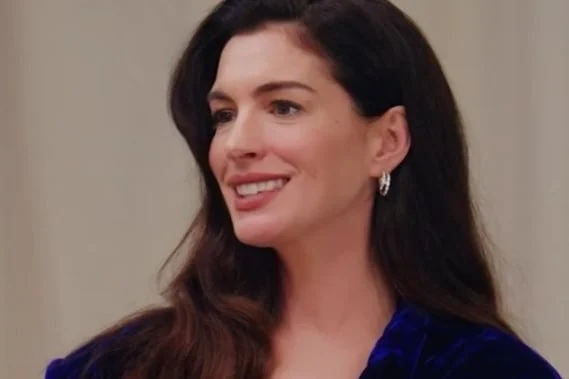
Last month, during the extensive press campaign for The Devil Wears Prada 2, a short clip from Anne Hathaway’s interview with People magazine unexpectedly went viral across social media platforms. In the snippet, Hathaway, known for her poised public persona, invoked the Arabic phrase "inshallah" after expressing her desire to live a long and healthy life. This seemingly innocuous utterance quickly became a focal point for discussion, highlighting a nuanced cultural shift in Western liberal and leftist circles regarding the adoption and perception of Arab and Muslim cultural expressions.
For individuals raised within Muslim traditions or in majority Arabic-speaking countries, "inshallah," which directly translates to "if God wills it," is a ubiquitous colloquialism, an intrinsic part of daily conversation that signifies hope, contingency, and reliance on divine will. Historically, however, such phrases have not been casually integrated into the lexicon of white, non-Muslim celebrities. While a noticeable increase in the use of terms like "inshallah" and "mashallah" (meaning "God has willed it" or "what God has willed") has been observed in liberal and leftist discourse over recent years, hearing Hathaway – affectionately dubbed "Sister Anne" in numerous TikTok comments – employ the word with both casual ease and contextual accuracy struck many as genuinely surprising and significant.
The Viral Catalyst: Anne Hathaway and the "Inshallah" Moment
The immediate aftermath of Hathaway’s clip going viral was a surge of online debate, primarily centered on the appropriateness of non-Muslims using the term. While the consensus among many cultural commentators and religious scholars quickly affirmed that there are no strict religious proscriptions against non-Muslims using the phrase, the conversation quickly broadened beyond mere linguistic permissibility. It illuminated a deeper, ongoing evolution in how Arab and Muslim culture is being perceived and integrated into the liberal Western mainstream.
This incident did not occur in a vacuum but rather as part of a larger trend. The ecstatic public response to Zohran Mamdani’s mayoral victory, which saw a proliferation of memes humorously referencing Sharia Law and the notion of a "caliphate of New Yorkistan," further underscored this cultural moment. Concurrently, the popularity of Riz Ahmed’s television show Bait, which delves into the complexities of British Muslim identity, and a Sesame Street segment featuring Ramy Youssef teaching Elmo the word "habibi" (an Arabic term of endearment), collectively pointed to an undeniable mainstreaming of Arab and Muslim cultural elements. These events suggest a growing curiosity and, at times, genuine appreciation for aspects of these cultures within broader Western society.
Historical Context: From Demonization to Growing Acceptance
To fully grasp the significance of this shift, it is essential to consider the historical backdrop. The period following the September 11, 2001, attacks ushered in an era often referred to as the "War on Terror," which had profound and lasting consequences for Muslim and Arab communities globally, particularly in Western nations. For years, media portrayals of Muslims were predominantly negative, often perpetuating stereotypes that linked Islam with extremism, violence, and intolerance. This sustained demonization fostered an environment of Islamophobia, leading to widespread discrimination, prejudice, and a general lack of understanding or misrepresentation of Muslim identities and cultures.
During this period, openly expressing Muslim or Arab identity in Western public spaces often invited suspicion or scrutiny. Mainstream media largely ignored the diverse realities of these communities or, when it did feature them, frequently did so through a lens of otherness or threat. Consequently, individuals from these backgrounds often felt marginalized, their language, traditions, and spiritual practices relegated to the periphery, if not actively vilified.
The Internet’s Role: A New Arena for Cultural Exchange
The advent and proliferation of digital platforms, particularly social media, have played a pivotal role in accelerating this cultural shift. The internet, with its capacity for rapid information dissemination and community building across geographical boundaries, has created a "collective culture that transcends locality," as Mohammed, a 25-year-old quoted in the original discourse, astutely observes. Platforms like TikTok, YouTube, and Instagram allow for direct cultural exchange, enabling nuanced perspectives to emerge and challenge established narratives.
In this digital landscape, content creators from Arab and Muslim backgrounds have found powerful avenues to share their experiences, traditions, and languages, bypassing traditional media gatekeepers. Viral clips, educational explainers, and humorous skits have introduced millions to Arabic phrases, Islamic concepts, and cultural practices in an accessible and engaging manner. This organic, peer-to-peer cultural transmission differs significantly from top-down media representations and contributes to a more authentic and less filtered understanding.
Voices from the Community: Nuance, Normalization, and Dual Identity
The impact of this mainstreaming on individuals within Arab and Muslim communities is multifaceted. Noor, a 26-year-old graduate student in New York, articulated a sentiment shared by many when she described Hathaway’s casual use of "inshallah" as "heartwarming." After years of being demonized or rendered invisible by Western media, such an act makes their language and traditions feel "normal within spaces that aren’t super tolerable or really aware of Islam." This normalization is particularly refreshing for many Gen-Z Muslims who grew up in the shadow of post-9/11 Islamophobia, navigating a social and cultural landscape often hostile to their identity. The author of the original piece noted a personal shift, finding it "much easier to talk to friends about being raised Muslim without the discussion being laced with awkward silences or antiquated questions on how conservative the religion is."
Sana, 23, echoed this sense of growing acceptance, appreciating the wider use of terms like "inshallah" and "subhanallah" (meaning "Glory be to God"). She highlighted how this linguistic mainstreaming empowers her to embrace her dual identity more confidently, particularly as a queer Muslim navigating leftist spaces. "I’d hope that we’re not scared of religion and spirituality in these spaces," Sana remarked, noting that even a few years ago, practicing faith in some leftist circles could be "isolating and othering." The increasing recognition of religious nuances, rather than monolithic stereotypes, allows for greater inclusion and self-expression.
Mohammed, 25, reflected on the broader geopolitical implications, stating that witnessing a celebrity like Anne Hathaway, who "represents the ideals of Western culture," acknowledge a "Quranic worldview" helps "destabilize the dynamic of global cultures in a good way." He views it as a "meme-able occurrence" because it’s "funny to see worlds collide." This collision, for many, represents a positive step towards cultural understanding and mutual respect, challenging the long-held Western cultural hegemony.
Driving Factors: Solidarity, Awareness, and Geopolitical Realities
While there is no single definitive explanation for the growing embrace of Muslim and Arab culture in leftist and liberal circles, several interconnected factors appear to be at play. Noor suggests that people are "finally clocking that Western media is feeding us Islamophobia and xenophobia," indicating a growing critical awareness of media biases. This awareness often translates into acts of solidarity from non-Muslim and non-Arab allies.
Crucially, there appears to be a direct correlation between this cultural awakening and increased public awareness of geopolitical conflicts. The ongoing violence inflicted upon populations in Palestine, Lebanon, and Iran, often perceived as being driven by Western imperialist policies and framed through religious and ethnic biases, has spurred many in the West to re-evaluate their perceptions of Muslims and Arabs. Mohammed explicitly links the digital lexicon’s adoption of Islamic-Arabic terminology, such as "inshallah," to the conflict in Gaza. The widespread exposure to videos of Muslims speaking in Arabic, often in harrowing contexts, has fostered a more direct, unfiltered connection with these cultures and their resilience.
The Perils of Commodification: Tokenism and Orientalism
Despite the positive aspects of increased visibility and acceptance, this cultural shift is not without its complexities and potential pitfalls. A significant concern among some within the community is the risk of this appreciation veering into orientalist or tokenistic territory. Yousef, a 24-year-old student, articulated this concern powerfully, describing how his life in the West fundamentally altered in the weeks following October 2023, coinciding with the beginning of the Israeli genocide in Gaza. "In social spaces, I felt that my presence and appearance had become politicized," he recounted. "In certain circles, it was obvious that my identity carried more weight than my personality."
Yousef observed a superficial engagement from peers, who would "suddenly be swapping out South American anthropology essays with Palestinian ones" or eagerly share "the latest trendy Palestinian music or whatever Arabic words they learnt that day." While these actions might have been well-meaning, Yousef found many encounters to be superficial, serving more to assuage the other party’s guilt rather than fostering genuine, respectful cultural engagement. He felt "consumed, as though my identity had become something temporarily relevant," likening it to being "gobbled up by the culture machine, just waiting to be spat out at any minute for the next identity that is ‘cool’."
This feeling of being reduced to a "trendy" cultural identity, ripe for temporary consumption, resonates with experiences shared by Black friends during the Black Lives Matter movement in 2020. Such tokenism is particularly disconcerting when juxtaposed against government policies and prevailing political sentiments that often contradict these fleeting cultural trends.
Political Backlash and Lingering Islamophobia
The cultural mainstreaming of Arab and Muslim elements has also provoked significant backlash, underscoring the deep divisions and persistent Islamophobia in certain segments of Western society. The Sesame Street segment where Elmo learned "habibi" in honor of National Arab American Heritage Month, for instance, sparked outrage among some conservative commentators. Fox News commentator Raymond Arroyo publicly criticized the segment, stating, "I wish ‘Sesame Street’ would stick to teaching kids about letters and numbers and leave the Arabic immersion to someone else." This reaction highlights a resistance to multiculturalism and an entrenched xenophobia that views non-Western cultural integration as a threat.
In the United Kingdom, Islamophobia continues to be a driving force behind anti-immigrant political rhetoric, particularly from parties like Reform. In the United States, religious justifications are sometimes invoked to support controversial foreign policies, including those related to Israel and America’s military actions. Even the mayoral victory of openly Muslim Zohran Mamdani, while a symbol of progress, was met with Islamophobic backlash during and after his election campaign, demonstrating that political gains do not automatically erase ingrained prejudices.
Cultural Capital vs. Material Change: The Path Forward
The central question arising from this complex cultural landscape is whether the burgeoning "cultural capital" associated with being Muslim and Arab in liberal spaces will translate into substantial, material change for these communities. As Mohammad dryly quipped, "Let’s be real, Anne Hathaway saying inshallah isn’t saving anyone." This sentiment reflects a cautious optimism, tempered by the understanding that superficial cultural adoption often falls short of addressing systemic issues like discrimination, political disenfranchisement, or the impacts of foreign policy.
However, many remain hopeful, seeing this cultural shift as a net positive, even if it begins with "liberal posturing." Noor draws a parallel with Christian terminology, idioms, and iconography, which are "omnipresent" and "very casual" in Western media. "Why can’t we have the same thing?" she asks, advocating for a similar normalization of Arab and Muslim cultural expressions. She concludes that while it might be performative, it "feels like a net positive — because ultimately, racism is scarier than performativity."
The mainstreaming of terms like "inshallah" by public figures and the broader acceptance of Arab and Muslim cultural elements represent a significant, albeit evolving, moment. It signifies a potential weakening of the historical demonization and othering of these communities in the West. Yet, the challenge remains to move beyond mere cultural consumption to foster genuine understanding, dismantle systemic Islamophobia, and effect real political and social change. The dialogue initiated by Anne Hathaway’s "inshallah" moment, therefore, is not merely about a phrase; it is about the ongoing negotiation of identity, representation, and power in a rapidly globalizing world.