





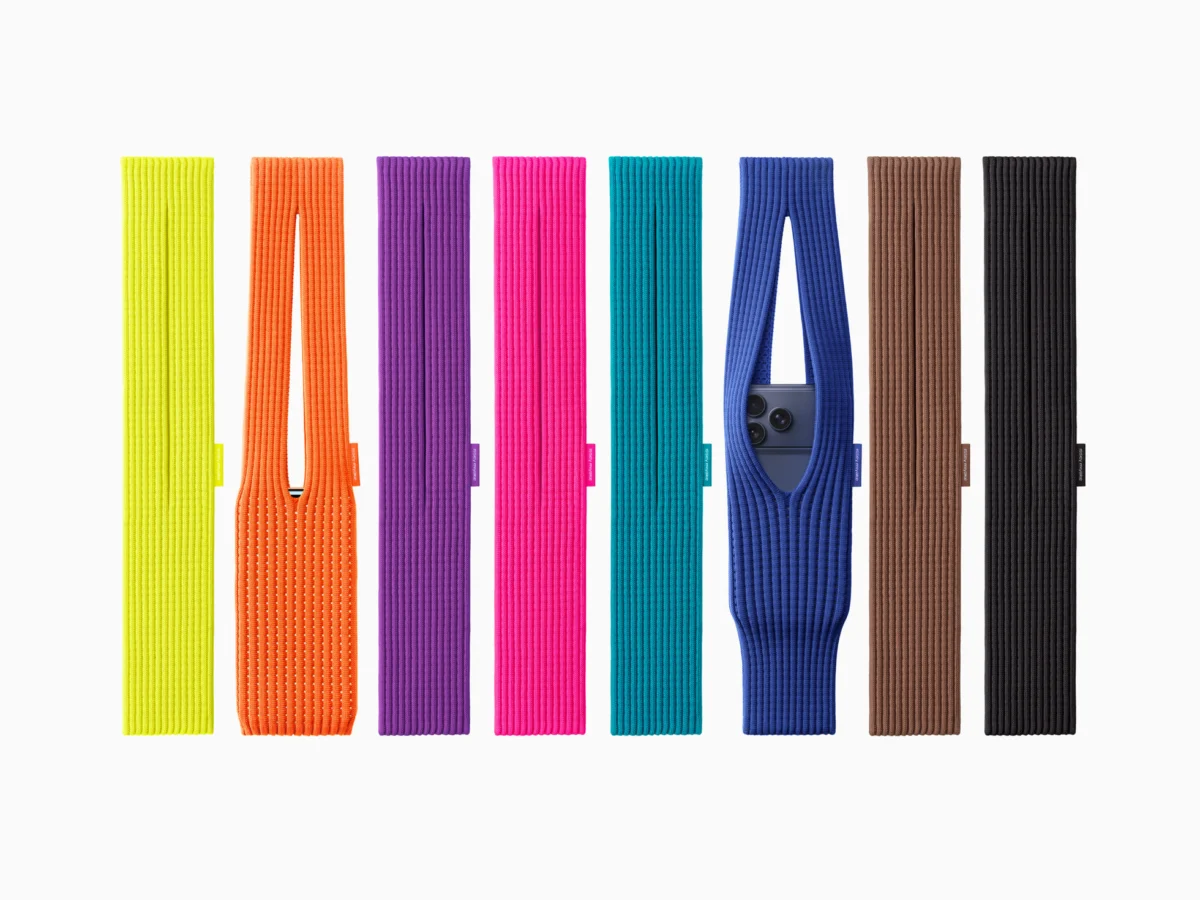
Apple has officially expanded its portfolio of high-end lifestyle accessories with the introduction of the iPhone Pocket, a limited-edition textile sling designed in collaboration with the renowned Japanese fashion house Issey Miyake. The product, which debuted on the Apple Store this week, represents a significant intersection of technical garment engineering and consumer electronics protection. Available in two distinct configurations, the iPhone Pocket retails for $149.95 for the "short" handbag-attachment size and $229.95 for the "long" crossbody variant. This launch follows a series of controversial yet commercially successful accessory releases from the Cupertino-based tech giant, further signaling Apple’s intent to solidify its presence in the luxury fashion market.
Design Philosophy and the APOC Concept
The iPhone Pocket is rooted in the "A Piece of Cloth" (APOC) design philosophy, a revolutionary concept pioneered by the late Issey Miyake and his associate Dai Fujiwara in 1997. The APOC method utilizes a unique manufacturing process where clothing is created from a single thread in a continuous tube of fabric, minimizing waste and allowing for intricate, three-dimensional structures without traditional seams.
According to Apple’s product specifications, the iPhone Pocket features a specialized ribbed mesh structure that mirrors the signature pleats for which the Miyake brand is globally recognized. The textile is engineered to be highly elastic; when the phone is inserted, the weave expands, becoming semi-transparent. This functional transparency allows users to view incoming notifications or check the time on the iPhone’s Always-On display without removing the device from the sleeve. The "short" version is designed to be looped onto the handles of larger bags, acting as a "charm" or auxiliary pocket, while the "long" version features a crossbody strap intended for standalone wear.
The Historical Context of the Jobs-Miyake Relationship
While the iPhone Pocket is the first formal consumer product collaboration to bear the Miyake name on the Apple Store, the relationship between the two entities dates back several decades. The collaboration is deeply symbolic, as Issey Miyake was the designer responsible for creating the iconic black mock-neck sweaters that became the "uniform" of Apple co-founder Steve Jobs.
In the early 1980s, Jobs visited Sony’s factories in Japan and was impressed by the company-mandated uniforms designed by Miyake. Jobs initially attempted to implement a similar uniform policy at Apple, commissioning Miyake to design a vest for employees. However, the idea was rejected by Apple’s workforce. Despite this, Jobs and Miyake developed a close personal friendship, leading Jobs to request a personal uniform that would simplify his daily routine. Miyake reportedly provided Jobs with hundreds of identical black turtlenecks, establishing a visual identity that came to represent the minimalist aesthetic of the modern tech era.

Although Issey Miyake passed away in 2022, his studio continues to operate under his design principles. The release of the iPhone Pocket is viewed by industry analysts as a posthumous tribute to the synergy between Miyake’s "tech-forward" fashion and Jobs’ "design-first" technology.
Chronology of Apple’s Luxury Accessory Strategy
The introduction of the iPhone Pocket is part of a broader, multi-year strategy by Apple to move beyond purely functional hardware into the realm of prestige collectibles. To understand the positioning of this $230 textile sleeve, one must look at the timeline of Apple’s previous high-margin accessory launches:
- October 2021: Apple released the $19 Polishing Cloth. Despite widespread social media mockery regarding its price, the item immediately went on backorder for several months, proving a robust demand for branded entry-level luxury items.
- September 2022: The Apple Watch Ultra debuted with specialized high-performance bands (Alpine Loop, Trail Loop), priced at $99, emphasizing material science and durability.
- Late 2024: Apple introduced its own $59 Crossbody Strap, a utilitarian nylon cord designed for the iPhone 16 series. While functional, it lacked the artisanal branding of the Miyake collaboration.
- November 2025: The launch of the iPhone Pocket by Issey Miyake. By pricing the item at nearly 25% of the cost of a base-model iPhone, Apple is targeting the "luxury tech" demographic previously served by its partnership with Hermès.
Supporting Data and Market Trends
The iPhone Pocket enters a market currently obsessed with "accessories for accessories." Industry data suggests that the "bag charm" and "mini-bag" markets have seen a 40% year-over-year growth among Gen Z and Millennial consumers. This trend is exemplified by the rise of "Labubu" vinyl figures—designer art toys that often retail for $30 in "blind boxes" but can fetch upwards of $10,000 for rare editions on the secondary market. These figures are frequently seen dangling from the straps of luxury handbags like the Telfar Shopping Bag or the Lululemon Everywhere Belt Bag.
Furthermore, the shift toward "digital-only" wallets has changed the way consumers interact with physical storage. With the ubiquity of Apple Pay and digital key integration (via Apple Wallet), the necessity for a traditional large-scale handbag has diminished for many urban commuters. Market research indicates that "phone-only" outings are becoming the norm, creating a lucrative niche for high-fashion phone slings.
Technical Specifications and Availability
The iPhone Pocket is compatible with all current iPhone models, including the Pro and Pro Max variants, due to the inherent stretch of the Miyake knit. The "short" model is available in a wider spectrum of vibrant colors, including "Lemon," "Azalea," and "Electric Blue," aimed at the accessory-attachment market. The "long" crossbody version is offered in more subdued, professional tones: "Carbon Black," "Slate Grey," and "Signature Cream."
Apple has confirmed that the iPhone Pocket is a limited-edition release. Unlike the standard silicone or FineWoven cases, the Miyake collaboration will not be restocked once initial inventories are depleted. This scarcity model is a classic hallmark of the "drop" culture prevalent in high-end streetwear and luxury fashion.

Broader Impact and Industry Implications
The launch of a $230 "sock" for a smartphone has predictably generated a polarized reaction. Critics argue that the product is an example of "rage-bait" marketing—items priced so exorbitantly that they generate viral social media discourse, providing free advertising for the brand. However, fashion historians and luxury analysts suggest the product has legitimate merit.
"Apple is no longer just a computer company; it is a design house," says Marcus Thorne, a senior retail analyst at GlobalData. "By aligning themselves with the Miyake estate, they are reinforcing the idea that an iPhone is a piece of wearable art. The price point isn’t about the cost of the polyester; it’s about the intellectual property of the pleat and the heritage of the APOC process."
From a sustainability perspective, the APOC manufacturing process used in the iPhone Pocket is notably more efficient than traditional cut-and-sew methods. By producing the item as a single piece of textile, Apple and Miyake’s studio are reducing fabric scraps, which typically account for 15% to 20% of waste in garment production. This aligns with Apple’s "Environmental Progress Report" goals, though the company has not explicitly marketed the Pocket as a "green" product.
Future Outlook for Tech-Fashion Collaborations
The success of the iPhone Pocket will likely determine the frequency of future high-fashion collaborations for Apple. As the smartphone market reaches saturation and hardware upgrade cycles lengthen, high-margin accessories provide a vital secondary revenue stream.
Industry insiders suggest that if the Miyake collaboration sells out as quickly as the 2021 Polishing Cloth, Apple may look toward other "architectural" fashion houses—such as Comme des Garçons or Yohji Yamamoto—to create limited-edition peripherals. For now, the iPhone Pocket stands as a testament to the enduring influence of Issey Miyake’s vision and Apple’s ability to turn a simple "piece of cloth" into a high-status technology statement.
The iPhone Pocket is currently available for purchase on Apple’s website and in select flagship Apple Store locations in New York, London, Tokyo, and Paris. As the holiday shopping season approaches, it is positioned to be one of the most discussed—and perhaps most divisive—gift items of the year. Whether it becomes a lasting fashion staple or a footnote in the history of "eccentric" tech accessories remains to be seen, but its debut has undeniably successfully bridged the gap between the runway and the Genius Bar.