





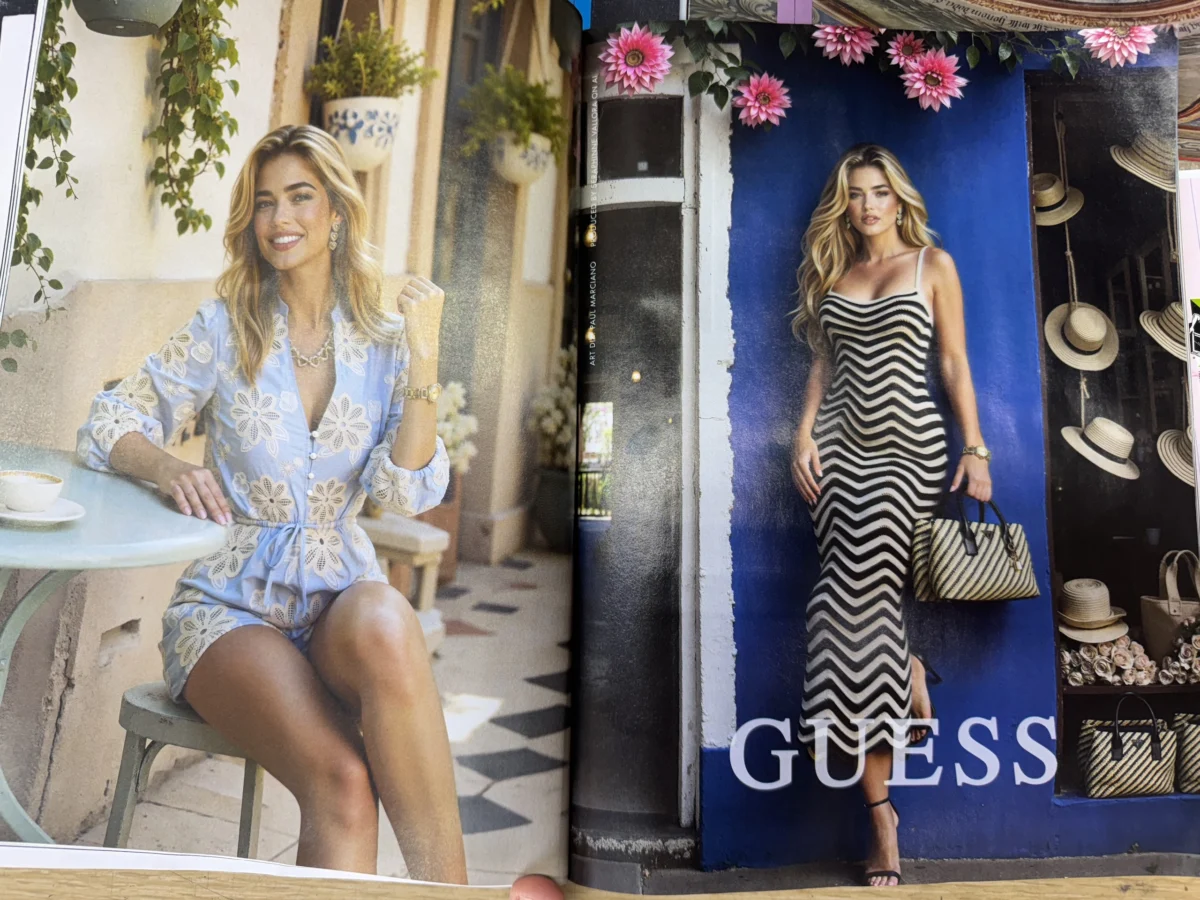
The global fashion industry, a sector historically defined by human charisma and the tangible artistry of photography, is currently undergoing a structural transformation driven by generative artificial intelligence. While the integration of technology in fashion is not new, the recent emergence of photorealistic AI models has sparked a profound debate regarding labor rights, beauty standards, and the definition of authenticity. The conversation reached a fever pitch following the July print edition of Vogue, which featured an advertisement for the brand Guess. The imagery depicted a model conforming to traditional North American beauty standards—glossy blonde hair, rose-colored lips, and a specific "voluptuous yet thin" physique—who was entirely computer-generated. This moment, occurring within the pages of the industry’s most influential publication, signaled to many that the "silicon runway" is no longer a futuristic concept but a present-day reality.
The Economic Imperative: Scaling Content in the Digital Age
The shift toward AI models is primarily driven by a radical change in how fashion brands must communicate with consumers. Historically, a major fashion house might produce four primary marketing campaigns per year to align with seasonal collections. However, the rise of social media and global e-commerce has fundamentally altered this cadence. Today, brands often require hundreds, if not thousands, of unique assets every month to populate TikTok feeds, Instagram stories, and digital storefronts.

PJ Pereira, co-founder of the AI-focused advertising firm Silverside AI, notes that the current marketing infrastructure was never designed for this level of volume. To scale from four major assets to 400,000 without a massive increase in budget, brands are turning to automation. The financial incentives are undeniable. A traditional photoshoot involves significant overhead, including daily rates for models—which can range from $1,500 for e-commerce work to over $20,000 for high-fashion talent—as well as fees for photographers, stylists, hair and makeup artists, studio rentals, and travel. In contrast, AI platforms can generate high-fidelity images for a fraction of the cost, allowing brands to place their garments on virtual models in any setting imaginable without leaving a computer terminal.
The Vulnerability of E-commerce Talent
While high-fashion "supermodels" who walk the runways of Paris and Milan may currently retain their status due to their personal brand power, the "bread and butter" of the industry—e-commerce modeling—is under immediate threat. E-commerce models are the professionals who populate the product pages of major retailers. This work provides the financial foundation for the majority of working models.
Sinead Bovell, a model and founder of the WAYE organization, emphasizes that this sector is the most susceptible to automation. Brands like H&M, Mango, and Calvin Klein have already begun experimenting with AI-generated models to display their collections. Art technologist Paul Mouginot explains that AI now allows brands to take a "flat-lay" photo of a garment and digitally drape it onto a photorealistic virtual model. This process eliminates the need for a human model to physically try on dozens of outfits in a single day, a task that is both physically exhausting and logistically expensive.

A Chronology of AI Integration in Fashion
The path to the current controversy has been marked by several key milestones that illustrate the industry’s gradual adoption of synthetic imagery:
- 2013: French retailer Veepee begins using virtual mannequins to display clothing, marking an early foray into digital garment presentation.
- 2018: The rise of digital-only influencers, such as Miquela Sousa (Lil Miquela), proves that synthetic personas can garner millions of followers and secure luxury brand partnerships.
- 2023: Levi’s announces a partnership with Lalaland.ai to create "diverse" AI models. The move is intended to increase inclusivity but results in widespread criticism for using "artificial diversity" rather than hiring diverse human talent.
- 2024: Major brands like Mango launch entire campaigns generated by AI for their teen lines, citing the need for rapid content creation.
- 2025: The July issue of Vogue features a Guess ad with an AI model, leading to a public outcry and forcing a discussion on the ethical boundaries of advertising in "fashion bibles."
The Backlash Against "Artificial Diversity"
One of the most contentious aspects of AI modeling is the concept of "robot cultural appropriation." This term, coined by Bovell, refers to the practice of brands generating AI models of color to meet diversity quotas or project an inclusive image without actually providing employment to people from those communities.
The 2023 Levi’s controversy serves as a primary case study. By opting to generate diverse models digitally, the company was accused of bypassing the very people it claimed to be representing. Commercial model Sarah Murray expressed the exhaustion felt by many in the industry, noting that "modeling as a profession is already challenging enough without having to compete with new digital standards of perfection." The critique is twofold: AI models not only take jobs away from marginalized groups but also set "uncanny" standards of beauty—flawless skin, perfectly symmetrical features, and impossible proportions—that even the most successful human models cannot achieve.

Legislative Responses and the "Digital Twin" Economy
As the technology advances, the legal framework surrounding likeness and labor is struggling to keep pace. Many models have reported new clauses in their contracts that may inadvertently grant brands the right to use their likeness to train future AI systems. This has led to a push for protective legislation.
Sara Ziff, founder of the Model Alliance, has been a vocal advocate for the Fashion Workers Act in New York. This proposed legislation would require management agencies and brands to obtain clear, written consent before creating or using a model’s digital replica. It also mandates fair compensation for the use of such "digital twins."
Some technologists see a middle ground in the "digital twin" economy. Paul Mouginot suggests that high-demand models could license their digital likeness, allowing them to "appear" in multiple shoots globally on the same day. While this could create a new revenue stream for top-tier talent, it does little to protect the thousands of entry-level and commercial models whose roles are being entirely phased out by generic, brand-owned AI avatars.

The Search for Imperfection: AI Artisans and Ethical Frontiers
Despite the move toward automation, some segments of the industry are focusing on the "human touch" that AI often lacks. Sandrine Decorde, CEO of Artcare, describes her team as "AI artisans." They use advanced tools like Flux to fine-tune AI models, intentionally adding imperfections—asymmetrical features, realistic skin textures, and unique gazes—to avoid the homogenous, "plastic" look often associated with early generative AI.
Decorde also highlights an ethical argument for AI in specific niches, such as children’s fashion. The use of minors in modeling has long been a gray area fraught with concerns over exploitation and long working hours. By using AI-generated children, brands can fulfill the market demand for "baby and kids" imagery without subjectng real children to the rigors of a professional set.
The Vogue Factor: Validation and the Future
The inclusion of an AI-generated model in Vogue represents a pivotal moment for the industry. As fashion writer Amy Odell points out, Vogue acts as the ultimate gatekeeper. When the magazine eventually features AI models in its editorial spreads—not just in advertisements—it will signal a total cultural acceptance of the technology. Odell draws a parallel to the industry’s initial resistance to reality stars like Kim Kardashian; once they appeared on the cover of Vogue, the debate was effectively over.

However, the "silent majority" of consumers may already be voting with their wallets. PJ Pereira notes that while AI ads often receive negative comments from a vocal minority, the data frequently shows higher engagement and click-through rates compared to traditional content. This suggests a disconnect between the aesthetic concerns of industry insiders and the purchasing habits of the general public.
Conclusion: An Uncertain Synthesis
The fashion industry is entering an era of "uncertain synthesis," where the lines between the biological and the digital are increasingly blurred. While AI offers unprecedented efficiency and cost savings, it poses fundamental questions about the value of human experience. As Claudia Wagner of Ubooker suggests, the real value of AI will eventually be determined by whether it is used with "purpose" or merely for "visibility."
For models like Sarah Murray and Sinead Bovell, the challenge is to differentiate themselves through their "unique human stories"—narratives that a computer model, no matter how photorealistic, cannot possess. Yet, as brands continue to prioritize scale and speed, the "human story" may become a luxury product, reserved for high-fashion editorials, while the everyday world of commercial fashion is increasingly populated by the perfect, tireless, and silent faces of the machine.