










While the landscape of integrated bracelet watches is undeniably competitive, Jaeger-LeCoultre has made a compelling entrance with its new Master Control Chronometre Perpetual Calendar. This release marks a significant moment for the heritage brand, known more for its dressier timepieces, as it ventures into a segment popularized by iconic models of the 1970s, a segment in which Jaeger-LeCoultre itself played a foundational role. The brand’s re-engagement with this sporty yet sophisticated aesthetic, particularly with a high-complication model like the perpetual calendar, merits a closer examination to assess its standing against established leaders in this coveted category.

A Legacy Reimagined: Jaeger-LeCoultre’s Historical Connection to the Integrated Bracelet
The assertion that Jaeger-LeCoultre is merely "jumping on the bandwagon" with its new integrated bracelet offerings overlooks the brand’s profound historical contributions to the genre. It is widely recognized within horological circles that the legendary Jaeger-LeCoultre Caliber 920 ébauche served as the beating heart for some of the most influential integrated bracelet watches of the 1970s. This movement powered the Audemars Piguet Royal Oak in 1972, the Patek Philippe Nautilus shortly after, and the Vacheron Constantin 222 in the latter half of the decade. While Jaeger-LeCoultre itself did not produce watches utilizing this specific caliber in its own collections at the time, its technical prowess and movement manufacturing capabilities were instrumental in the very genesis of the integrated bracelet craze. Without the "Watchmaker’s Watchmaker’s" innovation, the ultra-svelte, casually elegant integrated bracelet watch might never have achieved such widespread appeal.
Furthermore, this is not entirely uncharted territory for the Maison. In 1973, Jaeger-LeCoultre unveiled the Master Mariner Chronomètre. This model represented a forward-thinking design that skillfully bridged the gap between dress and sports watches, featuring a sleek steel case seamlessly integrated with a metal bracelet. According to company heritage records, this pioneering design served as a direct conceptual precursor to the modern Master Control Chronometre line, underscoring a long-standing affinity for this distinct watchmaking philosophy.

Design and Ergonomics: A Masterclass in Complicated Comfort
The Jaeger-LeCoultre Master Control Chronometre Perpetual Calendar is presented in two distinct iterations: a stainless steel version with a captivating blue sunray-brushed dial, and a luxurious pink gold variant complemented by a warm toffee-brown sunray-brushed dial. The reviewer’s preference leans towards the blue steel model, citing its dynamic visual appeal.
On the wrist, the Master Control Chronometre Perpetual Calendar offers a surprisingly comfortable wearing experience, especially considering the inherent complexity of a perpetual calendar complication. Its dimensions are particularly noteworthy: a diameter of 39mm and a remarkably slim profile of just 9.2mm. This slimness is a significant factor in its wearability, mitigating the top-heavy sensation often associated with more intricate timepieces. The case design further enhances this comfort. Rather than adopting sharper, more architectural lines, Jaeger-LeCoultre has opted for subtly curved transitions along the lugs and case flanks. This thoughtful design choice allows the watch to conform more naturally to the contours of the wrist, creating a balanced and integrated feel.

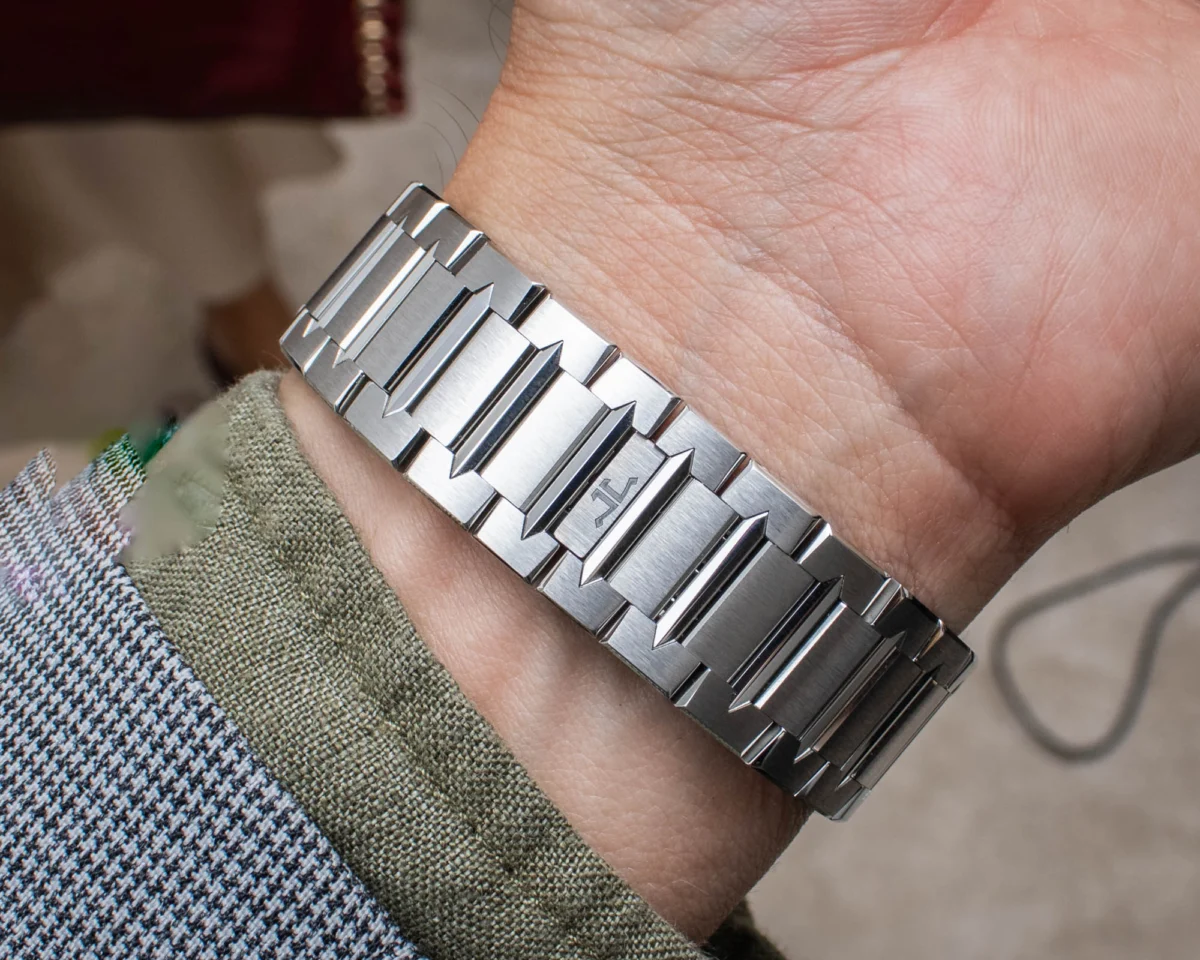
The integrated bracelet itself is a testament to Jaeger-LeCoultre’s meticulous attention to detail. The individual links are designed to echo the faceted shapes of the brand’s signature dauphine hands, imbuing the bracelet with a familiar yet distinct aesthetic identity. The construction is equally well-executed. While the visible connection screws on the interior of the links might initially raise questions, the overall finishing across all components ensures a smooth and comfortable feel during wear. There are no sharp edges or abrupt transitions, resulting in a clean, fluid integration from the case to the bracelet, contributing significantly to the watch’s cohesive appeal.
The Perpetual Calendar Display: Functionality Meets Refined Aesthetics
The perpetual calendar complication is presented in a classic four-register layout. The month and year are displayed at the 12 o’clock position, the day of the week at 3 o’clock, the date at 9 o’clock, and a poetic moon phase indicator resides at 6 o’clock. This arrangement prioritizes legibility and balance, achieving a level of symmetry that makes the complex information surprisingly intuitive to read.

A notable detail, recognized by aficionados of Jaeger-LeCoultre’s perpetual calendar watches, is the inclusion of a safety indicator positioned just above the hands. This indicator serves a crucial function: it alerts the wearer when it is not safe to adjust the calendar. While this feature is theoretically valuable, its placement can be perceived as somewhat awkward. It highlights a characteristic of older perpetual calendar movements that require such precautions, prompting a wish for a more modernized movement that would render such warnings unnecessary. However, its presence is a direct reflection of the mechanical integrity and historical lineage of the caliber.
Caliber 868: A Testament to Micro-Mechanical Engineering
The Master Control Chronometre Perpetual Calendar is powered by Jaeger-LeCoultre’s Caliber 868, an automatic perpetual calendar movement that, while having a history, remains a highly capable and significant piece of micro-mechanical engineering. Its impressive thinness, measuring just 4.72mm, is a primary contributor to the watch’s overall svelte 9.2mm case thickness. This allows for a more refined and elegant presence on the wrist, a crucial attribute for a perpetual calendar watch.

Visible through the sapphire crystal caseback, the Caliber 868 offers a substantial power reserve of 70 hours and operates at a frequency of 4 Hz. This ensures reliable timekeeping and a respectable duration between manual windings. The caseback also proudly displays the new Jaeger-LeCoultre seal, signifying the High Precision Guarantee (HPG). This in-house certification represents a significant step forward in Jaeger-LeCoultre’s quality control. It subjects the fully assembled watch to rigorous testing under four real-world conditions: resistance to shocks, altitude, temperature fluctuations, and positional changes. This comprehensive approach goes beyond traditional movement-only testing, providing a robust assurance of the watch’s performance and durability in various environments.
User Interaction and Accessibility
Jaeger-LeCoultre has strived for user-friendliness in the operation of the perpetual calendar. Beyond the standard winding crown, the watch features a single, recessed corrector located on the left side of the case. This consolidated approach is a welcome departure from older perpetual calendar designs that often incorporated multiple pushers around the case. By employing a single input for adjustments, Jaeger-LeCoultre has made the process of setting and maintaining the perpetual calendar significantly more approachable and less daunting for the wearer. This design choice underscores a commitment to enhancing the practical usability of even the most complex horological complications.

Market Positioning and Value Proposition
The Jaeger-LeCoultre Master Control Chronometre Perpetual Calendar represents a significant and convincing addition to the integrated bracelet watch market. It embodies a synthesis of sleek design, sophisticated color palettes, and a sense of inherent belonging within the established Master Control lineup. This new offering can be seen as a more contemporary and arguably "cooler" counterpart to the brand’s classic Master Ultra Thin Perpetual Calendar models, appealing to a modern collector who appreciates both heritage and cutting-edge design.
While Jaeger-LeCoultre may be perceived as entering the integrated bracelet conversation at a later stage than some competitors, the result is a timepiece that feels as though it should have been part of the collection all along. Its debut demonstrates a thoughtful integration of classic complications with contemporary design trends.

The pricing reflects the exclusivity and technical sophistication of these timepieces. The stainless steel version, reference Q4178180, is priced at $45,700 USD. The pink gold variant, reference Q417216J, is listed as "Price upon request," with observed retail prices at authorized dealers in the vicinity of $83,500 USD. These figures position the Master Control Chronometre Perpetual Calendar as a luxury offering, commensurate with the brand’s standing and the intricate horological artistry involved.
Broader Implications for the Luxury Watch Market
Jaeger-LeCoultre’s strategic move into the integrated bracelet segment, particularly with a high-complication piece, carries several implications for the broader luxury watch market. Firstly, it signals a continued demand for versatile timepieces that can transition seamlessly from formal occasions to more casual settings. The success of such models relies on a delicate balance of sporty aesthetics and refined finishing, a balance that Jaeger-LeCoultre appears to have achieved effectively.

Secondly, the brand’s historical role in powering iconic integrated bracelet watches lends significant credibility to its current offerings. This narrative allows Jaeger-LeCoultre to tap into the nostalgia and appreciation for horological history that drives much of the collector market, while simultaneously presenting a modern interpretation.
Thirdly, the introduction of the High Precision Guarantee (HPG) certification underscores a growing trend among luxury watch manufacturers to implement more stringent, real-world testing protocols. This focus on overall watch performance, rather than just movement accuracy in isolation, is likely to become a more significant differentiator in the luxury segment, offering consumers greater confidence in the durability and reliability of their timepieces.

Finally, Jaeger-LeCoultre’s ability to present a perpetual calendar within a slim, comfortable integrated bracelet case demonstrates continued innovation in movement design and case construction. This pushes the boundaries of what is considered achievable in complex watchmaking, potentially inspiring further advancements in the field and setting new benchmarks for competitors. The Master Control Chronometre Perpetual Calendar is not just a new watch; it is a statement of intent from a brand with a rich past, confidently charting its course in the evolving landscape of luxury horology.