











Vacheron Constantin’s enduring partnership with the Musée du Louvre, established in 2019, has blossomed into a profound collaboration that celebrates the preservation of historical artifacts and the artistic mastery of horology. This unique alliance, dedicated to supporting the museum’s critical conservation efforts and safeguarding its priceless antiquities, has now entered its second phase with the unveiling of a new collection: the Métiers d’Art Tribute to Great Civilizations series. This latest iteration builds upon the foundational success of the 2022 collection, which drew inspiration from the rich tapestry of ancient Egypt, Greece, Rome, and Persia. The new series, however, thoughtfully expands its scope, dedicating its exquisite craftsmanship to the artistic legacies of Egypt, Greece, Rome, and the formidable Assyrian Empire, offering a captivating journey through millennia of human history and artistic achievement.
A Legacy of Artistry and Preservation
The partnership between Vacheron Constantin and the Louvre transcends mere sponsorship; it represents a shared commitment to cultural heritage. Since its inception, Vacheron Constantin has actively contributed to the museum’s vital mission of conserving, preserving, and protecting its vast collection of historical treasures. This collaboration allows the esteemed watchmaker to translate the beauty and historical significance of these artifacts into exquisite timepieces, thereby bringing these ancient narratives to a contemporary audience. The Métiers d’Art Tribute to Great Civilizations series stands as a testament to this synergistic relationship, where the meticulous artistry of watchmaking meets the grandeur of world history.

The inaugural collection in 2022 set a high precedent, showcasing four distinct timepieces that meticulously recreated iconic artworks from four ancient civilizations. The success of this initial offering paved the way for this new collection, which, while revisiting three of the original civilizations, introduces the powerful narrative of the Assyrian Empire. This strategic expansion not only broadens the historical and geographical scope but also delves into the distinct artistic expressions and cultural achievements that have shaped human civilization. The Louvre, with its unparalleled collection spanning vast epochs, provides an inexhaustible wellspring of inspiration, offering countless masterpieces ripe for horological interpretation.
The Pinnacle of Micro-Artistry on the Wrist
The craftsmanship evident in the Métiers d’Art Tribute to Great Civilizations series is nothing short of astounding. Each watch dial is a miniature masterpiece, brought to life through a remarkable array of artisanal techniques that echo the methods employed by artisans of ancient times. These techniques include intricate stone carving, the creation of micro-mosaics composed of minuscule tesserae, cloisonné marquetry, and the delicate application of gilded gold leaf, all complemented by three distinct enameling processes. Vacheron Constantin’s artisans have demonstrated an exceptional command of these traditional decorative crafts, mirroring the enduring artistic prowess of the civilizations they honor.
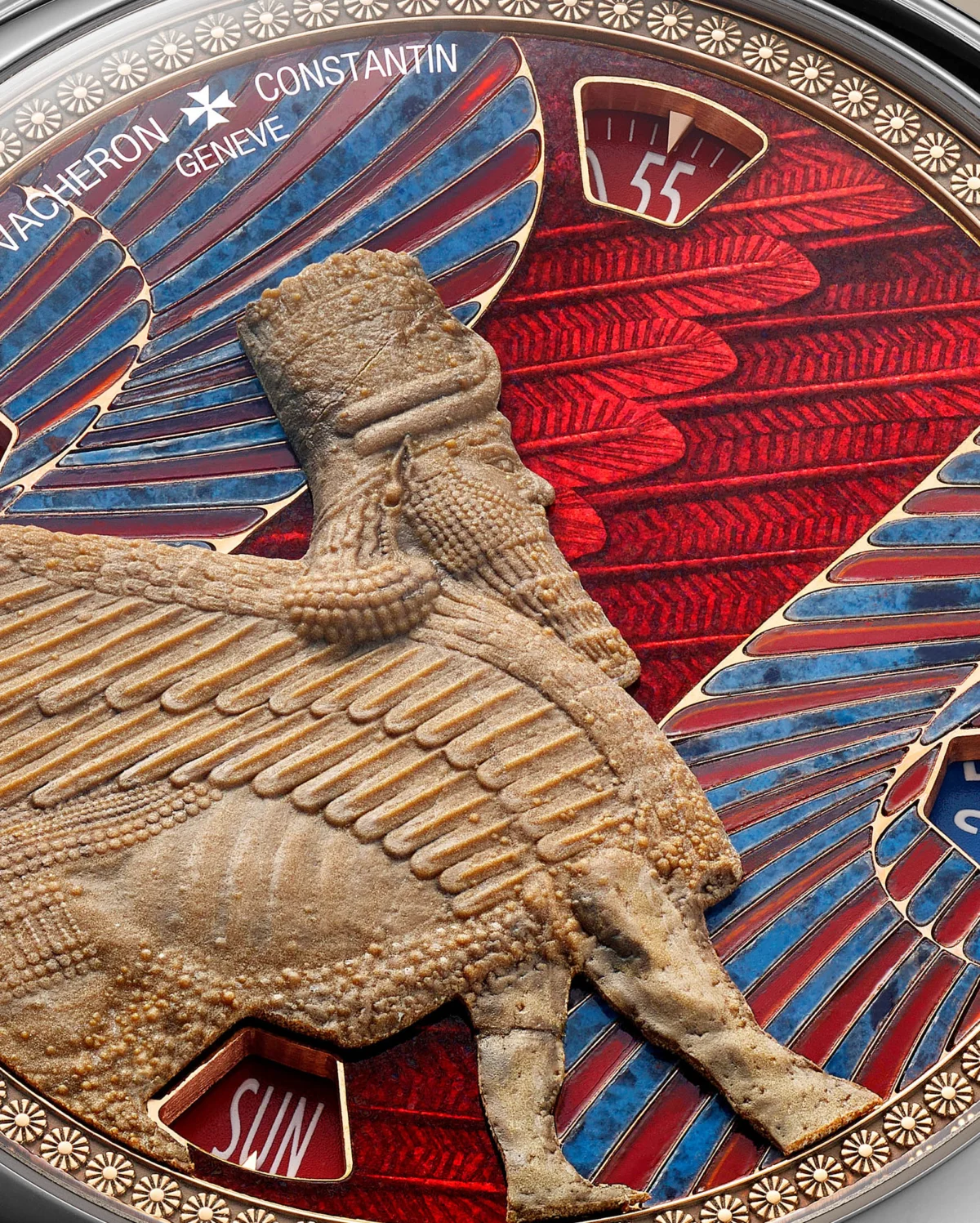
The friezes that elegantly encircle each watch dial are a prime example of this dedication to historical accuracy and artistic excellence. These intricate elements are assembled with the precision of a puzzle, featuring individually painted sections meticulously set within an engraved gold frame. The addition of precisely cut gemstones and cameos further enhances their complexity and visual appeal. These elaborate friezes are not merely decorative; they ingeniously conceal four apertures positioned at the corners of each dial, discreetly displaying the hours, minutes, day, and date. This ingenious integration of functional elements within a purely artistic composition underscores Vacheron Constantin’s commitment to both horological innovation and aesthetic sophistication.

The Calibre 2460 G4: A Canvas for Artistic Expression
At the heart of these horological marvels lies the in-house automatic movement, Calibre 2460 G4. This exceptional movement, reserved for Vacheron Constantin’s most artistically driven creations, is specifically designed to facilitate the unique time display mechanism. Instead of traditional hands, the Calibre 2460 G4 utilizes four rotating discs to indicate the time. This innovative approach is crucial as it leaves the central area of the dial entirely unobstructed, providing an expansive canvas for the intricate artwork to captivate the viewer’s attention without any visual interference. The movement boasts a power reserve of 40 hours and operates at a beat rate of 28,800 vibrations per hour, ensuring both reliable performance and a smooth aesthetic.
The cases of these remarkable timepieces measure 42mm in diameter and are available in either 18-karat white gold or 18-karat pink gold, providing a luxurious foundation for the artistic dials. A significant detail that elevates these watches is the full-size rotor, crafted from 916/1000 gold. This rotor is not merely a functional component; it features a highly detailed engraving of the Louvre’s iconic eastern façade. This deliberate inclusion ensures that even the movement, typically hidden from view, becomes a subtle yet significant element of the overall artistic narrative, reinforcing the profound connection between the watch and its muse.
Translating Sculpture into Time: A Masterclass in Material and Technique
The challenge of translating three-dimensional sculptures into the two-dimensional realm of an 18-karat gold watch dial is a testament to the exceptional skill of Vacheron Constantin’s artisans. To truly honor both the source material and the Louvre itself, the brand undertook the meticulous process of sourcing materials and stones from origins as close as possible to those of the original artworks. This dedication to authenticity extends to the very essence of the timepieces.

The process begins with the creation of detailed 3D models of the selected artworks. These models are then carefully analyzed to determine the optimal angle and proportions that would best capture the play of light and shadow, thereby imbuing the miniature representation with a sense of depth and vitality. The complexity of each dial varies significantly, with the intricate execution demanding between 120 and 220 hours of dedicated craftsmanship. This labor-intensive approach highlights the artisanal nature of these watches, positioning them as unique pieces of wearable art rather than mere instruments for timekeeping.
Echoes of Antiquity: A Closer Look at the Collection
Each watch in the Métiers d’Art Tribute to Great Civilizations series tells a distinct story, drawing inspiration from specific masterpieces housed within the Louvre.
The Pharaoh’s Visage: Tribute to Ancient Egypt
The "Bust of Akhenaten" from the Temple of Karnak serves as the muse for the timepiece dedicated to Pharaonic Egypt. This iconic depiction of Pharaoh Amenhotep IV, who later adopted the name Akhenaten in reverence of the sun cult of Aten, originally stood as a commanding presence atop a pillar in the temple. Vacheron Constantin’s interpretation captures Akhenaten’s visage in profile, elegantly facing towards his name, rendered in hieroglyphics. Both the bust and the accompanying cartouche are meticulously carved from the same sandstone as the original artifact, which was unearthed in the 19th century. The surrounding frieze, inspired by the "Collar of Nakhti," is a delicate mosaic of precisely cut pieces of red mother-of-pearl, chrysoprase, opaline, and sodalite, creating a rich and textured border that complements the central motif.

Guardians of Empire: The Assyrian Lamassu
The Neo-Assyrian Empire, at its zenith, was a vast dominion stretching from modern-day Egypt to Turkey and Iran. Its power and grandeur were symbolized by the colossal winged bulls with human faces, known as Lamassu, which stood sentinel at the grand palace of Khorsabad. These protective deities, now a celebrated part of the Louvre’s collection within the Palace of Sargon II, are powerfully represented on this Vacheron Constantin timepiece. The Lamassu is rendered in Italian limestone, set against a vibrant backdrop of red agate and light dumortierite stones. The intricate feather pattern that divides the dial is engraved directly onto the 18-karat gold baseplate and subsequently layered with translucent red enamel, creating a striking visual depth and texture.
Wisdom of the Goddess: Homage to Ancient Greece
The "Velletri Pallas," one of the most celebrated marble statues from ancient Greece, graces the dial of the watch dedicated to Hellenistic artistry. This depiction of the goddess Athena, with her right arm outstretched and her left hand extended as if imparting wisdom, is a Roman copy of a lost Greek bronze from circa 430 BC. Vacheron Constantin’s choice to feature this particular statue signifies the Golden Age of Athens, a period that laid the foundation for Western thought and philosophy, and was the era of luminaries such as Socrates, Pericles, and Euripides. Athena is sculpted from hand-patinated marble sourced from the Greek island of Paros. She stands before a background of horses, artfully rendered using onyx and mookaite, adding a dynamic and spirited element to the composition.
The Founding of Rome: The River Tiber’s Legacy
The enduring significance of the Tiber River, the lifeblood of Imperial Rome, is captured in the timepiece inspired by the "Statue of the Tiber." This sculpture portrays the Tiber as a bearded river god, holding an oar in his left hand and a cornucopia in his right. Below him, the legendary twins Romulus and Remus are depicted suckling at the teats of the she-wolf, a poignant symbol of Rome’s mythical origin. In Vacheron Constantin’s horological interpretation, the river god gazes upward towards a mosaic representation of his cornucopia, meticulously crafted from fragments of jasper, chrysocolla, and opaline. The river god himself is sculpted with remarkable detail in Italian marble, and a subtle yet elegant ring of mother-of-pearl half-moons encircles the dial, adding a refined finishing touch.

A Limited Edition Masterpiece
Echoing the exclusivity of the 2022 collection, this new series of the Métiers d’Art Tribute to Great Civilizations will be produced in an extremely limited edition. Only fifteen examples of each of the four watches will be manufactured. This represents a significant expansion from the initial five pieces per model in the first series, allowing a slightly broader, yet still highly exclusive, group of collectors to acquire these extraordinary timepieces.
While pricing for this exceptional collection has not yet been publicly disclosed, the intricate craftsmanship, the use of precious materials, the in-house mechanical complexity, and the historical significance inherent in each piece suggest a valuation commensurate with Vacheron Constantin’s high-end Métiers d’Art offerings. These watches are not merely timekeeping devices; they are wearable legacies, tangible links to the grand narratives of human civilization, meticulously brought to life by the hands of master artisans.
The Vacheron Constantin Métiers d’Art Tribute to Great Civilizations series stands as a powerful testament to the enduring allure of history and the unparalleled artistry of haute horlogerie. This collaboration with the Louvre continues to push the boundaries of what is possible in watchmaking, transforming museum artifacts into miniature marvels that tell stories spanning thousands of years, all while ticking away the present moment on one’s wrist.

For further information on this remarkable collection and Vacheron Constantin’s commitment to artistic preservation, interested parties are encouraged to visit the official Vacheron Constantin website.