










In the ever-evolving landscape of horological appreciation, the allure of vintage timepieces continues to captivate collectors worldwide. While many iconic models have been thoroughly documented and celebrated, the pursuit of undiscovered gems remains a potent driving force. It is within these less-trodden paths of watch history that true horological adventures lie, offering a profound connection to the craftsmanship and design philosophies of bygone eras. One such captivating discovery is the circa 1981 Jaeger-LeCoultre 114.100.54, a watch that, despite its relative obscurity, possesses a unique mystique and a compelling narrative that warrants deeper exploration. Affectionately nicknamed the "Baby Midas" for its subtle yet distinctive aesthetic resonance with a more prominent contemporary, this timepiece represents a fascinating, albeit brief, chapter in Jaeger-LeCoultre’s expansive history.

The Genesis of an Unsung Design: The "Jaeger Paris" Legacy
To fully appreciate the Jaeger-LeCoultre 114.100.54, one must first understand the historical context of the "Jaeger Paris" designation. The origins of the Jaeger brand trace back to Edmond Jaeger, a visionary French pioneer in instrumentation. From the early 20th century, Jaeger was renowned for its precision gauges and dials, adorning everything from aircraft and automobiles to the critical deck chronometers for the French navy. Their expertise also extended to watch movements, notably for Cartier between 1907 and 1922. The pivotal merger with Jacques-David LeCoultre in 1937, forming the esteemed Jaeger-LeCoultre name, marked a new era for Swiss watchmaking. However, the Jaeger company maintained its instrumentation operations and a significant presence in Paris, which served as a secondary hub for the burgeoning Jaeger-LeCoultre brand outside of Switzerland.
For decades, the Jaeger Paris offices were a crucible of horological innovation in France, contributing to many of the brand’s memorable designs from its base in the 17th arrondissement. By the early 1980s, however, the landscape had shifted. The independent Jaeger brand’s prominence in automotive and aviation instrumentation had waned, and the Paris branch, once a mighty satellite of the larger JLC entity, had become more of a localized footnote, primarily serving the French domestic market. It was against this backdrop that the Jaeger Paris office, in collaboration with Cyma, conceived and produced the 114.100.54.

A Radical Departure: The Integrated Bracelet Sports Watch Emerges
The early 1980s were a period of significant transition in the watch industry, marked by the lingering effects of the Quartz Crisis and a burgeoning interest in more avant-garde designs. While Jaeger-LeCoultre would later fully embrace the integrated bracelet sports watch genre in the 2020s, the 114.100.54 represents a surprisingly early, albeit limited, foray into this territory over four decades prior. This ultra-slim, integrated dress watch, released in extremely small quantities between approximately 1981 and 1983, was characterized by its radical design and was sold under various nameplates, including Cyma and Bucherer, in different markets.
Estimates suggest that fewer than 200 units of this model were ever produced, making each surviving example a rare find. The scarcity of information surrounding this watch, coupled with the dizzying array of dial variations that appear among the few known examples, only amplifies its enigmatic appeal. This inherent mystery, rather than deterring collectors, deepens the fascination, transforming the acquisition of such a piece into a horological treasure hunt.

Design Analysis: The "Baby Midas" Aesthetic
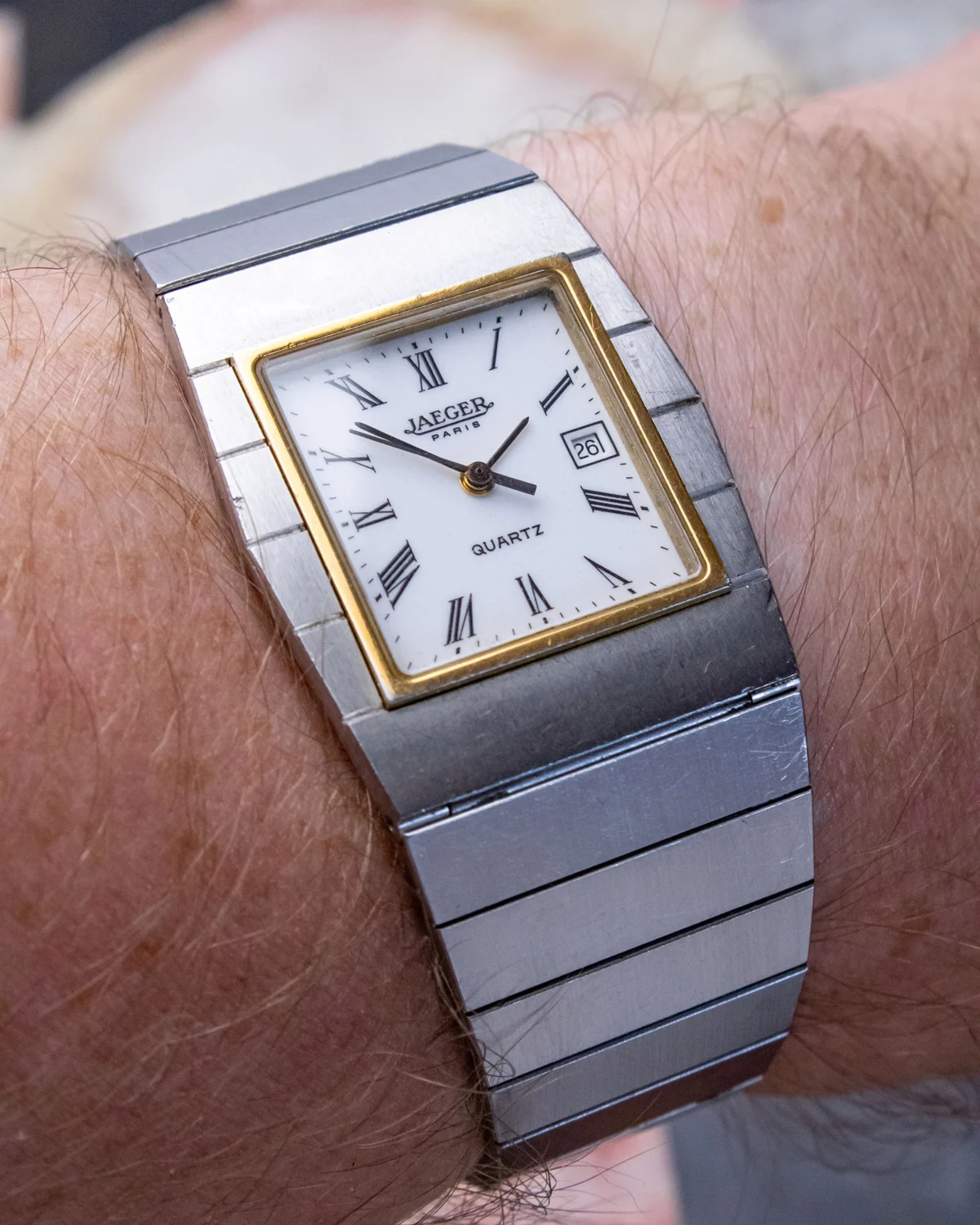
The Jaeger-LeCoultre 114.100.54, specifically an early 1981-serial example, embodies a harmonious blend of 1980s modernist minimalism and classic horological refinement. The stainless steel case measures a discreet 27.5mm in width and 35mm from lug to lug, with an astonishingly slim profile of just 5.5mm. This remarkable thinness is achieved through an innovative case construction where the majority of the crown and caseback are cleverly concealed beneath the case side, creating an illusion of even greater slenderness.
The watch’s silhouette is decidedly hexagonal, with pronounced points at the 3 and 9 o’clock positions that taper gracefully towards the integrated lugs. This geometric form subtly evokes the iconic Rolex King Midas, hence the "Baby Midas" moniker, but infuses it with a distinctly ’80s contemporary flair. The case exhibits a gentle arching profile, designed to conform more naturally to the wrist and facilitate a seamless transition into the integrated bracelet.

A key design element that visually connects the case to the bracelet is the extension of the bracelet’s textured pattern across the case. The nearly flat, linearly brushed main case is adorned with five sets of grooves, creating a cohesive aesthetic. However, a distinct visual separation between the case and the dial is maintained by a slim, gold-plated rectangular bezel. This subtle touch of gold serves to elegantly frame the dial, preventing the watch from appearing overly monolithic and adding a sophisticated glint to the wrist.
Dial and Movement: A Fusion of Tradition and Technology
While the case of the Jaeger-LeCoultre 114.100.54 leans towards ’80s modernism, its dial presents a more traditional aesthetic. The layout, featuring slim, black-printed Roman numerals on a gloss white dial, would not feel out of place in Jaeger-LeCoultre’s more conventional collections or even within the esteemed offerings of Cartier. The simple stick hands, an outer minute track, and a date window positioned at 3 o’clock contribute to a conventionally handsome and legible display.

A clear indicator of the watch’s era is the prominent "Quartz" text at the 6 o’clock position. This inscription reflects a period just a few years after the Quartz Crisis, when quartz movements were still considered a desirable technological advancement rather than a point of contention for enthusiasts. The "Jaeger Paris" signature at 12 o’clock unequivocally signifies its intended market – the French domestic sphere. However, the "Swiss Made" inscription beneath the minute track reassures that the watch’s Parisian branding did not compromise the renowned build quality associated with Swiss watchmaking.
To achieve its remarkable thinness, the Jaeger-LeCoultre 114.100.54 is equipped with a reliable ETA quartz movement. While it may not possess the historical prestige of Jaeger-LeCoultre’s in-house mechanical calibers, this choice was instrumental in realizing the watch’s signature ultra-slim profile. The functionality and dependability of vintage quartz movements are undeniable, and in the context of this particular design, their role in achieving such spectacular thinness is a testament to pragmatic engineering.

The Integrated Bracelet: Seamless Integration and Comfort
The stainless steel bracelet of the Jaeger-LeCoultre 114.100.54 is a crucial component of its integrated design, contributing significantly to its sleek charm. The textured finish of the case seamlessly extends onto the bracelet, creating an almost unbroken transition from case surface to the single-link construction. The all-over brushed finish ensures a subdued play of light on the wrist, enhancing its understated elegance.
True to the conventions of vintage watch bracelets, this one is both slim and exceptionally flexible. It drapes around the wrist naturally, offering a streamlined and comfortable wearing experience. The hidden jewelry-style flip-lock clasp maintains the seamless aesthetic, while an ingenious spring bar link system facilitates easy sizing, a practical consideration for any watch. This thoughtful integration of the bracelet with the case is a hallmark of high-end integrated bracelet designs, and the 114.100.54 executes this with notable success.

Implications and the Enduring Appeal of the Obscure
The Jaeger-LeCoultre 114.100.54 stands as a compelling testament to the enduring allure of the vintage watch hobby, particularly the thrill of uncovering and understanding pieces that lie outside the mainstream narrative. Its story highlights several significant points:
- The "Jaeger Paris" Niche: The existence of this watch underscores the distinct market presence and design output of the Jaeger Paris branch during a transitional period for the broader Jaeger-LeCoultre brand. It signifies a period where the company explored localized design initiatives that may not have received global attention.
- Early Adoption of Integrated Bracelet Design: While integrated bracelet sports watches gained widespread popularity in later decades, the 114.100.54 demonstrates that Jaeger-LeCoultre, through its Parisian outpost, was experimenting with this form factor as early as the turn of the 1980s. This predates many contemporary interpretations and positions the watch as a forward-thinking, albeit niche, design from its time.
- The Value of Rarity and Mystery: The extreme rarity and the intriguing variations of the 114.100.54 contribute significantly to its desirability among dedicated collectors. The challenge of piecing together its history and understanding its context adds a layer of intellectual engagement that transcends mere aesthetic appreciation.
- Horological Exploration: The pursuit of such watches serves as a reminder that the vast universe of horology is far from fully explored. There are always "unexplored corners of the map," offering opportunities for discovery and a deeper understanding of watchmaking history. The "Baby Midas" is a prime example of a "diamond in the rough" that rewards diligent research and a passion for the unconventional.
In conclusion, the Jaeger-LeCoultre 114.100.54 "Baby Midas" is more than just a rare watch; it is a historical artifact that speaks volumes about the design sensibilities and market strategies of Jaeger-LeCoultre during a dynamic period. Its ultra-slim profile, integrated bracelet, and enigmatic "Jaeger Paris" signature combine to create a timepiece that, while not the most valuable or complicated in Jaeger-LeCoultre’s storied lineage, offers a profound and rewarding experience for those who venture beyond the well-trodden paths of horological history. It is a testament to the fact that true treasures often lie in the uncharted territories, waiting to be discovered by the curious and the passionate.