









Barmag, a prominent subsidiary of the Rieter Group, has officially announced its participation in the upcoming FILTECH 2026 exhibition, where it will showcase its latest technological advancements in the production of nonwovens for filter media under the specialized Neumag brand. Scheduled to take place from June 30 to July 2, 2026, in Cologne, Germany, the event serves as the world’s leading platform for filtration and separation technology. Barmag will be positioned in Hall 8, Booth E68, offering a comprehensive look at its engineering solutions designed to address the increasing global demand for high-efficiency filtration materials. The presentation will focus on the dual pillars of meltblown and spunbond technologies, emphasizing cost-competitiveness without compromising on the rigorous quality standards required by modern industrial and medical applications.
Strategic Focus on High-Performance Filter Media
The global filtration market has undergone a significant transformation over the last several years, driven by heightened environmental regulations, a post-pandemic emphasis on respiratory safety, and the increasing complexity of industrial emission controls. In response to these market dynamics, Neumag has refined its portfolio to focus on solutions that allow manufacturers to produce high-performance filter media efficiently. The primary objective of the showcase at FILTECH 2026 is to demonstrate how integrated technology can lower the total cost of ownership while maximizing the physical and mechanical properties of the nonwoven fabrics.
Nonwovens used in filtration are required to balance several competing factors: high particle capture efficiency, low air resistance (pressure drop), and long-term structural durability. Neumag’s approach involves the use of precision extrusion and sophisticated fiber-forming techniques that ensure uniformity across the entire web width. By optimizing the distribution of fibers and the pore size of the media, Neumag’s systems enable the production of filters that meet stringent international standards, such as the ISO 16890 for air filters and various EN standards for respiratory protection.
Meltblown Technology: Versatility Across Polymer Spectrums
A centerpiece of the Neumag presentation will be its industry-leading meltblown technology. Meltblown nonwovens are the gold standard for fine-particle filtration due to their extremely fine fiber diameters, often in the sub-micron range. Neumag’s machinery is engineered to facilitate the straightforward production of these high-performance materials while maintaining high throughput speeds.
One of the defining features of the Neumag meltblown process is its exceptional polymer versatility. While traditional meltblown lines are often limited to standard polyolefins like polypropylene (PP) and polyethylene (PE), Neumag’s systems are designed to process a wide array of technical plastics. This includes:
- Polyesters and Polyamides: PET, PBT, and PA are frequently utilized for industrial filters requiring high thermal stability or chemical resistance.
- Sustainable Polymers: Polylactic acid (PLA) is increasingly sought after for biodegradable or bio-based filtration solutions.
- Specialty Engineering Plastics: Polyphenylene sulfide (PPS) and Thermoplastic polyurethane (TPU) allow for the creation of filters used in extreme environments, such as high-temperature flue gas filtration or elasticated medical components.
The ability to process these diverse raw materials safely and reliably is a direct result of Neumag’s proprietary die-head designs and precise thermal management systems. By controlling the rheological behavior of different polymers during the extrusion process, the technology ensures that the resulting nonwoven web possesses the exact density and fiber orientation required for specific filtration tasks.
The hycuTEC Advantage: Redefining Electret Filtration Efficiency
In the realm of air filtration, the ability to capture microscopic particles without significantly obstructing airflow is a critical engineering challenge. Neumag’s hycuTEC hydrocharging technology addresses this by creating high-performance electret filter media. Electret filters use a permanent electrostatic charge to attract and trap particles, allowing the physical structure of the filter to remain more "open," which drastically reduces the pressure drop.
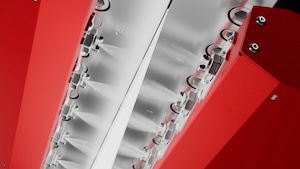
The hycuTEC system, which previously received the prestigious Edana Filtrex Innovation Award, will be a major highlight at the Cologne trade fair. This technology uses a hydrocharging process—utilizing high-pressure water jets—to impart a deep and stable electrostatic charge to the fibers. According to technical data released by the company, the hycuTEC unit can reduce the pressure drop of a typical FFP2 filter medium to less than 25% of its original level.
Andreas Frisch, Regional Sales Director Nonwoven at Barmag, highlighted the operational benefits of this innovation. "Filtration efficiencies of over 99.99% are easily achievable with standard media weighing around 35 g/m² and a maximum pressure drop of 35 Pa," Frisch explained. "Furthermore, the additional drying step is eliminated in most applications—another advantage of this innovative technology." The elimination of the drying phase is particularly significant for manufacturers, as it reduces energy consumption and shortens the overall production line, leading to a smaller factory footprint and lower operational costs.
Advanced Spunbond Solutions and Bicomponent Engineering
While meltblown fibers provide the fine filtration "engine," spunbond nonwovens are increasingly vital as both carrier materials and standalone filter media. Spunbond fabrics offer superior mechanical strength and pleatability, making them ideal for automotive cabin filters, HVAC systems, and industrial vacuum applications. Neumag’s spunbond solutions allow for the precise tailoring of nonwoven structures to meet specific customer requirements, often combining multiple functions—such as support and pre-filtration—within a single layer.
A key differentiator for Barmag is its long-standing expertise in bicomponent (Bico) spinning processes. The Neumag Bico spunbond process enables the simultaneous extrusion of two different polymers into a single filament. This opens up a vast design space for innovative nonwoven structures:
- Core-Sheath Filaments: Allowing for a high-strength core with a low-melting-point sheath for thermal bonding.
- Side-by-Side Filaments: Creating fibers that naturally crimp for increased loft and dust-holding capacity.
- Split Fibers: Generating ultra-fine microfibers through mechanical or chemical splitting after the web is formed.
- Mixed Fibers: Producing different fiber types on a single production line to create a gradient density structure.
By utilizing these complex fiber cross-sections, manufacturers can create filters that have higher permeability and a longer service life compared to traditional monocomponent materials.
Chronology of Innovation and the FILTECH Context
Barmag’s presence at FILTECH 2026 is the latest milestone in a long history of textile and nonwoven engineering. As a subsidiary of the Swiss-based Rieter Group, Barmag benefits from a global infrastructure and a deep well of research and development resources. The development of the Neumag brand has been characterized by a steady progression toward higher precision and sustainability.
- 2021-2023: Introduction and market saturation of the hycuTEC technology following the surge in demand for high-quality mask materials during the global health crisis.
- 2024: Expansion of the meltblown polymer range to include more recycled PET (rPET) and bio-based alternatives, responding to the European Green Deal.
- 2025: Optimization of the Bico spunbond process to integrate digital twin monitoring and AI-driven quality control.
- 2026 (June): The showcase at FILTECH 2026 serves as the official launchpad for the next generation of these technologies, focused on "Industry 4.0" integration and energy-efficient manufacturing.
FILTECH itself has grown from a niche technical conference into a massive international trade fair, reflecting the critical nature of filtration in the 21st century. The 2026 edition is expected to host over 500 exhibitors and thousands of visitors from the chemical, pharmaceutical, automotive, and environmental sectors.
Market Analysis: The Rising Demand for Precision Filtration
The strategic importance of Barmag’s technologies is underscored by current market data. The global air filtration market is projected to grow at a compound annual growth rate (CAGR) of approximately 6.2% through 2030. This growth is fueled by increasing urbanization and the resulting need for clean indoor air, as well as the transition toward electric vehicles, which require specialized filtration for battery cooling and cabin air quality.
Furthermore, the industrial sector is facing stricter "zero-leakage" mandates. Technologies like Neumag’s Bico spunbond and hycuTEC-enhanced meltblown are essential for producing HEPA (High-Efficiency Particulate Air) and ULPA (Ultra-Low Penetration Air) filters used in semiconductor cleanrooms and pharmaceutical laboratories. The ability to achieve 99.99% efficiency with low pressure drop is not just a technical achievement; it is a commercial necessity for industries where energy costs associated with air handling are a major overhead.
Official Responses and Industry Implications
Industry analysts view Barmag’s focus on versatility and energy efficiency as a direct response to the "Total Cost of Ownership" (TCO) model that now dominates procurement in the nonwovens industry. By providing lines that can switch between different polymers (e.g., from PP to PET) with minimal downtime, Neumag is catering to a market that demands agility.
Regional Sales Director Andreas Frisch’s statements suggest a shift in the company’s focus toward holistic sustainability. By removing the drying step in the hydrocharging process, Barmag is addressing the carbon footprint of the manufacturing process itself, not just the performance of the end product. This aligns with the Rieter Group’s broader commitment to ESG (Environmental, Social, and Governance) goals.
As the industry moves toward 2030, the integration of specialized nonwoven technologies will likely see a convergence of medical-grade efficiency and industrial-grade durability. Barmag’s presentation at FILTECH 2026 in Cologne will provide a roadmap for this transition, demonstrating that the future of filtration lies in the microscopic engineering of fibers and the intelligent application of electrostatic forces. Visitors to Hall 8, Booth E68 will witness firsthand how these German-engineered solutions are setting new benchmarks for the global nonwovens sector.