








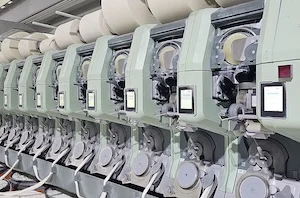
The global textile machinery landscape is set for a transformative display of innovation as Winterthur-based Rieter Group and Barmag, a subsidiary of the Oerlikon Group, prepare to exhibit their latest advancements at the International Textile Machinery Exhibition (ITM) 2026. Scheduled to take place in Istanbul, Türkiye, from June 9 to 13, the event serves as a critical juncture for spinning mills seeking to navigate the dual pressures of rising operational costs and the demand for sustainable production. For the first time in their storied histories, Rieter and Barmag will showcase their portfolios side-by-side, signaling a strategic alignment aimed at providing comprehensive solutions for both natural and man-made fiber processing. This collaborative presence underscores a shared commitment to the "Vision 2027" roadmap, which aims to transition the industry toward fully automated, digitally integrated spinning operations.
A Strategic Convergence of Natural and Synthetic Fiber Expertise
The decision for Rieter and Barmag to exhibit in adjacent booths—Hall 7, Booths 702 and 704—represents a significant milestone for the textile industry. Rieter, with over 230 years of experience in short-staple spinning, and Barmag, a global leader in man-made fiber systems, are positioning themselves as a unified front for mill owners who increasingly operate "hybrid" facilities. Modern spinning mills no longer rely solely on cotton; the blending of natural fibers with synthetic filaments like polyester and recycled materials has become the industry standard.
By aligning their technological showcases, the two companies offer a seamless transition from polymer processing to yarn production. Industry analysts suggest that this partnership reflects a broader market trend where hardware manufacturers must provide holistic "system" solutions rather than isolated machines. The synergy allows customers to leverage Rieter’s leadership in yarn quality and Barmag’s prowess in chemical fiber equipment, creating a one-stop-shop for future-proof textile manufacturing.
Advancing Toward Vision 2027: The Fully Automated Mill
At the heart of Rieter’s presentation is the progression toward "Vision 2027," the company’s ambitious goal of delivering a spinning mill that requires minimal human intervention. As labor shortages continue to impact textile hubs in Turkey, India, and Southeast Asia, the move toward "lights-out" manufacturing has transitioned from a luxury to a necessity.
Rieter’s automation suite at ITM 2026 focuses on the logistics of the spinning process, which traditionally accounts for a significant portion of labor costs. The exhibition will highlight:
- Efficient Bale Transport: Automated systems that move raw material from the warehouse to the blowroom without manual handling.
- Automated Can Transport: Robotic solutions that bridge the gap between carding, drawing, and spinning frames, ensuring a continuous flow of material.
- Fully Automatic Packaging: Integrated solutions for steaming, palletizing, and labeling finished yarn packages, readying them for shipment with surgical precision.
Supporting these hardware advancements is the ESSENTIAL digital suite. This modular platform provides real-time data analytics to everyone from machine operators to executive management. By utilizing Artificial Intelligence (AI) to monitor performance, the ESSENTIAL modules can predict maintenance needs and optimize energy consumption, providing a factual basis for decision-making that was previously reliant on anecdotal observation.
Technical Milestones in Rotor and Compact Spinning
Rieter’s hardware innovations at ITM 2026 are designed to push the boundaries of productivity and resource efficiency. One of the primary highlights is the R 70 rotor spinning machine. In an era where energy prices remain volatile, the R 70 offers a compelling value proposition with a 10% reduction in energy consumption compared to previous generations, achieved through innovative low-vacuum technology.
The R 70 is specifically engineered to handle the challenges of the modern raw material market. It can process high proportions of recycled or non-virgin material at full production speeds. A unique pneumatic rotor-cleaning system ensures that even when processing dusty or contaminated recycled fibers, the yarn quality remains consistent. Reports from early adopters indicate productivity boosts ranging from 7% to 15%, depending on the material blend, making it a cornerstone for mills looking to enhance their competitive edge.
Complementing the R 70 is the COMPACT4, an innovative compacting solution. Compact spinning has long been the gold standard for high-quality, low-hairiness yarn, but it has often been associated with high maintenance requirements. The COMPACT4 addresses this by offering a fine-tuned spinning geometry that maximizes yarn strength while minimizing downtime. Its design focuses on "daily mill use," meaning components are easier to clean and replace, thereby reducing the total cost of ownership.
Revolutionizing Fiber Preparation with AI and High-Speed Combing
The foundation of high-quality yarn is laid in the preparation stages, and Rieter is introducing two major upgrades in this department: the OMEGAlap E 40 and the C 81 card.
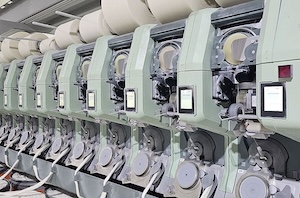
The OMEGAlap E 40 combing preparation machine sets a new industry benchmark with a production capacity of 800 kg/h. This represents a 33% increase over its predecessor, a feat achieved through a redesigned rapid lap-changing mechanism. Despite this increase in output, the machine consumes 30% less energy and 63% less compressed air. For mill managers, this translates to a significantly smaller carbon footprint and lower utility bills without sacrificing volume.
In the carding section, the C 81 card utilizes AI to revolutionize fiber cleaning. Two specific features stand out:
- Carding Gap Control (CGC): This AI-driven system automatically maintains the ideal distance between the cylinder and the flats, which is crucial for reducing neps (small knots of tangled fibers) and ensuring yarn uniformity.
- Trash Level Monitor (TLM): This sensor-based system monitors the level of impurities in the fiber stream in real-time. By adjusting the carding intensity based on the actual trash content of the raw cotton, the C 81 maximizes fiber yield—ensuring that good fiber isn’t accidentally discarded with the waste.
Barmag’s Innovations in Man-Made Fiber Processes
Barmag’s contribution to the joint exhibition focuses on the evolving needs of the synthetic fiber market. A centerpiece of their display will be the WINGS POY 2.0, a semi-automated winding machine. The introduction of an automatic string-up function addresses a long-standing pain point in filament production, reducing the risk of operator error and improving the efficiency of the winding process.
For texturing—the process that gives synthetic yarns a natural, "bulky" feel—Barmag will showcase the eFK EvoSmart. This manual texturing machine is designed for energy-efficient production of high-quality yarns. Furthermore, the EVOSteam process from Neumag (another Oerlikon brand) will be highlighted, showcasing developments in staple fiber production that prioritize steam efficiency and fiber tenacity.
The Turkish Context: Why ITM 2026 Matters
Türkiye remains a pivotal market for Rieter and Barmag. As the world’s fifth-largest textile exporter and the second-largest supplier to the European Union, the Turkish textile industry is currently undergoing a massive modernization phase. Turkish mill owners are facing increased competition from lower-wage regions and are under pressure to comply with the EU’s upcoming "Green Deal" and circular economy regulations.
The innovations presented by Rieter and Barmag are tailor-made for this environment. The ability to spin recycled fibers, reduce energy consumption, and automate labor-intensive processes aligns perfectly with the strategic goals of the Turkish textile sector. Industry experts believe that ITM 2026 will serve as a catalyst for a new wave of investment in the region, as mills look to replace aging machinery with the high-tech solutions offered by the Swiss and German giants.
Addressing the Circular Economy
A recurring theme for Rieter at ITM 2026 is the "circular textile value chain." The industry is moving away from the "take-make-dispose" model toward a system where textile waste is mechanically or chemically recycled back into new yarn. Rieter has been working closely with fiber manufacturers to refine the technology required to spin these often-fragile recycled fibers.
The latest technological breakthroughs to be shown in Istanbul significantly increase the efficiency of processing textile waste. By optimizing the air-guiding components in machines like the R 70 and improving the cleaning capabilities of the C 81 card, Rieter is enabling mills to produce high-value yarns from what was previously considered waste material. This not only supports environmental goals but also provides a buffer against the fluctuating prices of virgin cotton.
Conclusion: Empowering the Modern Spinning Mill
The joint presence of Rieter and Barmag at ITM 2026, alongside Rieter’s specialized subsidiaries—Accotex, Bräcker, Graf, Novibra, Suessen, SSM, and Temco—represents a formidable concentration of textile engineering expertise. By combining state-of-the-art hardware with AI-driven software and a clear path toward total automation, these companies are providing the tools necessary for the industry to thrive in a challenging global market.
As June 2026 approaches, the anticipation within the spinning community is high. The transition to a fully automated spinning mill is no longer a distant vision but a tangible reality being built step-by-step. For the visitors at the Tüyap Fair and Congress Center in Istanbul, the Rieter and Barmag booths will offer a glimpse into a more efficient, flexible, and sustainable future for textile manufacturing. Through precision engineering and digital integration, Rieter continues to ensure that its customers remain at the forefront of the global textile value chain.