




As a connoisseur of both fine timepieces and the roaring engines of classic automobiles, the Danish independent brand REC has consistently captured my attention. Their foundational philosophy, centered on integrating reclaimed materials from iconic vehicles into their watches, has a proven track record of producing compelling timepieces. However, the brand has also underscored the inherent complexities of automotive-inspired watch design, sometimes veering into overly literal interpretations, as seen in the Ford Mustang-themed REC P-51. With its latest endeavor, the REC 98T/4, REC has transcended these challenges, reaching new heights by unveiling its inaugural in-house developed movement, a sophisticated and mature design aesthetic, and a direct link to a legendary piece of motorsport history: a fragment of Ayrton Senna’s 1986 Lotus 98T Formula One car. This limited-edition release marks a significant evolutionary leap for the young Danish marque, presenting a design that commands admiration independently of its celebrated inspiration and showcasing a marked improvement in overall quality.
The Genesis of a Motorsport Icon: Ayrton Senna and the Lotus 98T
To fully appreciate the significance of the REC 98T/4, a deeper dive into the provenance of its key component is essential. The Lotus 98T, piloted by the legendary Ayrton Senna during the 1986 Formula One season, stands as a pivotal machine in motorsport history. This era was characterized by the fierce competition of turbocharged engines, pushing the boundaries of engineering and performance. The 98T, in particular, was a marvel of its time, a culmination of Lotus’s innovative spirit and Renault’s potent engine technology.
The 1986 season was a watershed moment for both Senna and the Lotus team. Senna, in his second year with Lotus, was establishing himself as a force to be reckoned with, showcasing exceptional talent and a relentless pursuit of victory. The Lotus 98T, chassis number 4, specifically, was one of the final iterations of this iconic car. It was distinguished by its striking black and gold livery, a tribute to the iconic John Player Special branding that had graced Lotus cars in previous eras. This livery itself is a significant part of the car’s legacy, evoking a sense of classic racing grandeur.

Under the hood, the 98T was powered by the formidable Renault EF15B turbo engine. In qualifying trim, this engine was reported to produce over 1,300 horsepower, a staggering figure that underscored the extreme engineering of the period. This immense power, coupled with the aerodynamic sophistication of the 98T, allowed Senna to secure an impressive five pole positions during the 1986 season. However, the season was not without its challenges. Reliability issues, a common concern with such highly tuned turbocharged engines, hampered the car’s overall performance in races, ultimately preventing Lotus from achieving higher standings in both the constructors’ and drivers’ championships. Despite these setbacks, the 98T remains an indelible symbol of Senna’s early brilliance and the zenith of turbo-era Formula One. The specific piece of the intake plenum tube used in the REC 98T/4 originates from this very chassis number 4, adding a tangible connection to a specific, historic racing machine.
Design Evolution: A Mature Aesthetic Meets Automotive Heritage
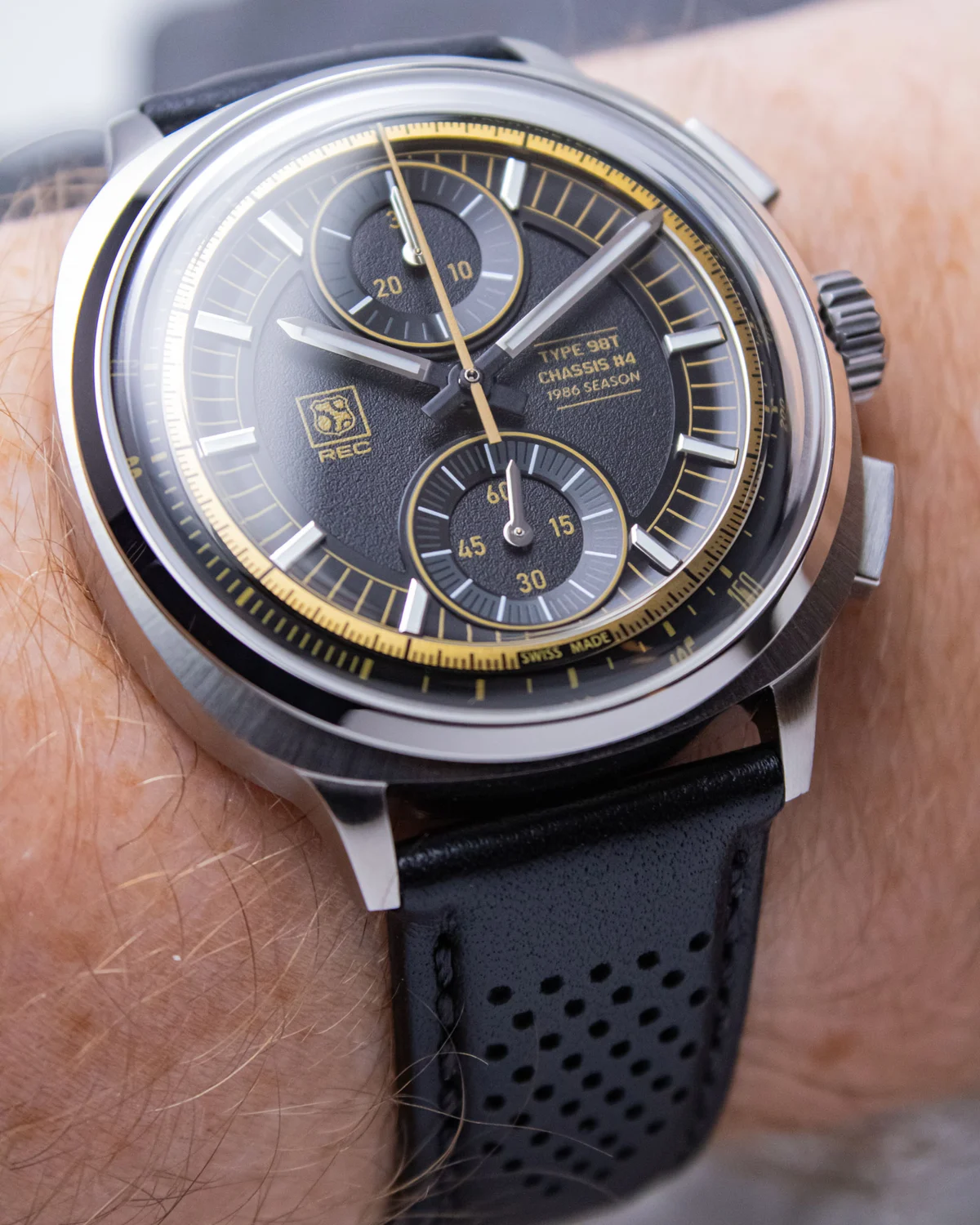
The REC 98T/4 presents a significant departure from some of REC’s earlier, more literal interpretations of automotive design. The 39.7mm wide, 13mm thick stainless steel case, while possessing a visual echo of the Heuer Camaro in its initial impression, evolves into a more expansive, softer cushion form imbued with thoughtful detailing. The case’s side profile is a testament to this refined approach. Its flowing, double-tapered silhouette is meticulously sculpted to subtly evoke the outline of the 1986 Lotus 98T’s cockpit and nosecone. Crucially, this inspiration is integrated in a manner that allows the case to stand independently as a smooth, organic form.
This sophisticated integration represents a mature restraint from REC, especially given the rarity and historical gravitas of the car. Instead of overt automotive cues, the design language is more suggestive, allowing the wearer’s imagination to connect the dots. The finishing across the 98T/4’s case is notably precise. The upper surfaces boast attractively grained radial brushing, offering a subtle play of light. The case sides are treated to smoother linear brushing, emphasizing their elegant taper. The diminutive lugs are carefully sculpted, and the narrow, sloping bezel is mirror-polished, creating a striking contrast. Even the trapezoidal pushers are not overlooked, featuring slim polished chamfers that contribute to an enhanced sense of depth and sophistication.
While the squarish case design might suggest a larger wrist presence, the 98T/4 wears closer to a 41mm or 42mm round case. However, its relatively trim thickness and short lugs ensure a manageable and comfortable fit, even on smaller wrists. The caseback marks another notable advancement, featuring a broad, domed sapphire crystal. This unobstructed window offers a clear and unimpeded view of the bespoke movement within, a deliberate design choice that highlights the horological engineering. Furthermore, the inclusion of a solid 100-meter water resistance rating ensures that the 98T/4 is as capable in practical, sporty scenarios as its design suggests.

The Dial: A Symphony of Black, Gold, and Reclaimed History
The intrinsic appeal of REC as a brand lies in its commitment to incorporating reclaimed materials. In the 98T/4, these materials are integrated into the dial with a surprising degree of subtlety, playing a supporting rather than a dominant role. The outer tachymeter ring, positioned outboard of the gold-tone chronograph seconds scale, is meticulously crafted from an aluminum intake plenum tube sourced from Ayrton Senna’s Lotus 98T chassis number 4. This specific component was utilized during the crucial closing races of the 1986 Formula One World Championship.
Rather than making this reclaimed aluminum the visual focal point, REC has masterfully allowed it to complement the John Player Special-inspired black and gold color scheme of the dial. The overall presentation is bold and impactful, yet harmoniously balanced. The strategic use of gold elements creates a striking visual presence on the wrist without overwhelming the intricate layout of the dial. The dial features a relatively uncommon 12 o’clock and 6 o’clock subdial configuration, contributing to a sense of poise and visual weight. The subtle, low-contrast transitions between black-on-gray and gray-on-black markings on the subdial scales not only imply depth at a glance but also reward closer inspection with nuanced detailing.
REC’s mastery of texture is also evident here. The dial exhibits a range of finishes, from the grainy matte black of the main dial surface to the satin texture of the hours ring and subdial rings. The pointed baton hands are finished in a vivid white-metal polish, providing excellent legibility. The raised central chronograph seconds scale features high-shine radial brushing, adding another layer of visual interest. While the timeless appeal of the black and gold colorway undoubtedly elevates the watch’s presentation, the core design of this unique, slightly retro chronograph possesses a versatility that could translate exceptionally well into a variety of color combinations, underscoring its inherent design strength.
The Heart of the Machine: An In-House Movement with Bespoke Charm
At the core of the REC 98T/4 lies the RC-98T/4 automatic chronograph movement, a significant milestone as REC’s first entirely in-house developed caliber. While the brand is based in Denmark, the "Swiss Made" designation indicates a likely partnership with a third-party manufacturing specialist for the movement’s production. Regardless of its manufacturing origin, the RC-98T/4 stands out as an impressively capable modern chronograph, particularly at its price point.

Key specifications include a robust 62-hour power reserve, a beat rate of 28,800 vibrations per hour, and a prominently displayed column wheel chronograph actuation system. The operation of the chronograph on the wrist is characterized by a light and precise feel, with a distinct, firmer feedback during the reset function. However, the finishing of the RC-98T/4 movement is arguably its most impressive attribute. The upper bridges are finished with a brushed and black-coated aesthetic, directly inspired by the valve covers of the Lotus 98T. The lower bridges and balance cock showcase tight, small-scale perlage, a traditional haute horlogerie decoration.
Further enhancing the visual spectacle are a polished, prominently framed column wheel and a custom brushed black-and-gold cutout rotor. This rotor is adorned with Ayrton Senna’s iconic number 12, a subtle yet powerful nod to the legendary driver. This level of intricate finishing and thoughtful detailing within the movement is rarely encountered at this price segment, offering a wealth of visual appeal that complements the watch’s overall narrative.
To complete the ensemble, REC pairs the 98T/4 with a black leather deployant strap. This strap is padded and features faux perforations, adding a subtle textural element that enhances the overall aesthetic without detracting from the watch itself. The two-button deployant clasp is solidly constructed, providing a satisfying heft that contributes to a well-balanced feel for extended wear.
Implications and Legacy: A New Standard for Automotive Horology
The REC 98T/4 is more than just a watch; it is a testament to the power of storytelling through design and the enduring legacy of motorsport icons. For REC, this release signifies a maturation of their brand identity. Moving beyond simply incorporating reclaimed materials, they have demonstrated an elevated level of design sophistication, engineering prowess, and a nuanced understanding of how to translate automotive passion into a refined horological product.

The limited production run of only 989 examples ensures the exclusivity of this timepiece, appealing to collectors and enthusiasts who appreciate both unique heritage and meticulous craftsmanship. The watch is readily available through REC’s e-commerce platform, making this piece of motorsport history accessible to a global audience.
The MSRP of $4,195 USD positions the REC 98T/4 as a competitive offering in the luxury chronograph market, especially considering the in-house developed movement, the unique provenance of its materials, and the overall quality of its execution. This pricing strategy underscores REC’s commitment to delivering exceptional value and pushing the boundaries of what is achievable within this segment.
The REC 98T/4 sets a new benchmark for automotive-inspired watches. It proves that by blending genuine heritage, sophisticated design, and advanced horological engineering, brands can create timepieces that resonate deeply with enthusiasts across both automotive and watchmaking worlds. The watch’s success lies not just in its ability to tell time, but in its capacity to evoke emotion, preserve history, and inspire a new generation of collectors to appreciate the intertwined legacies of speed, engineering, and human achievement. REC’s journey with the 98T/4 solidifies their position as a brand that not only uses reclaimed materials but also breathes new life and narrative into them, creating objects of enduring fascination.