











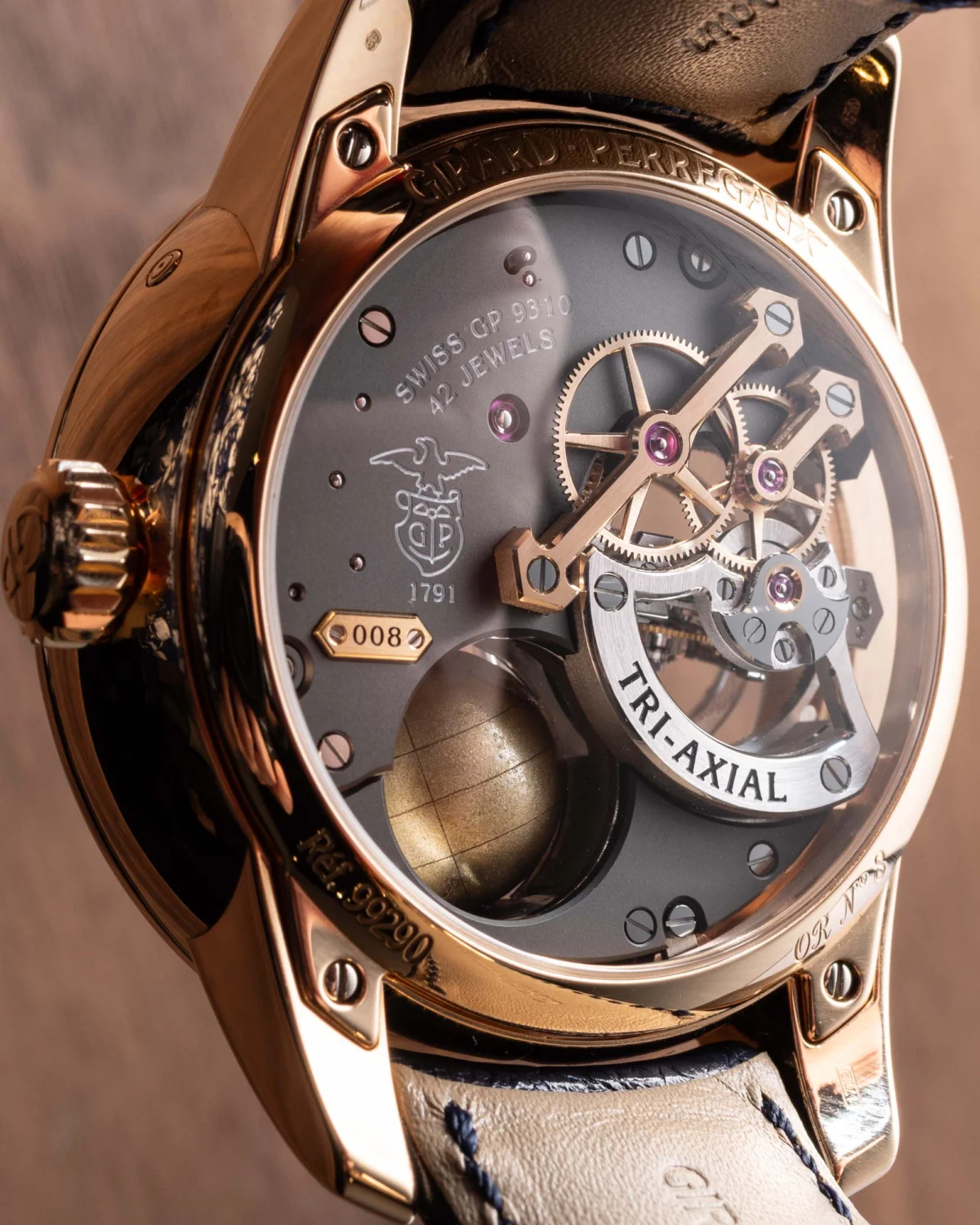
The Girard-Perregaux Planetarium Tri-Axial, reference 99290-52-451-BA4A, is a remarkable testament to the pinnacle of haute horlogerie, a complex and luxurious timepiece that pushes the boundaries of mechanical watchmaking. Encased in 18-karat pink gold, this ultra-luxury creation presents a fascinating and compelling, albeit unusual, horological statement. The emergence of triple-axis tourbillons, such as the one featured in this Girard-Perregaux model, signals a potential resurgence for these intricate complications. This trend is partly driven by a strategic focus within the luxury watch industry on the highest echelons of the market, where demand is perceived to be more resilient to economic fluctuations.

The Evolving Landscape of the Tourbillon
The tourbillon, originally conceived by Abraham-Louis Breguet in the late 18th century to counteract the effects of gravity on pocket watch movements, has undergone a significant evolution. Historically, the presence of a tourbillon on a wristwatch was an unambiguous indicator of immense wealth, with such timepieces often commanding prices well into six figures. However, advancements in manufacturing and design have led to a democratization of the single-axis tourbillon, making them more accessible and diminishing their exclusive status symbol. This shift has prompted watchmakers to explore more complex and exotic iterations of the tourbillon to reclaim its position as a marker of unparalleled horological achievement and exclusivity.
Triple-axis tourbillons represent a significant leap in complexity from their single-axis counterparts. By incorporating multiple axes of rotation, these mechanisms create a mesmerizing three-dimensional display of intricate mechanical motion. While the exact origins of the first true triple-axis tourbillon are debated, Jaeger-LeCoultre, with its Gyrotourbillon family developed by Eric Coudray, is widely credited with popularizing this advanced complication approximately two decades ago. Independent watchmakers like Thomas Prescher have also been instrumental in advancing the art of the multi-axis tourbillon, focusing on both technical prowess and aesthetic elegance. The Girard-Perregaux Planetarium Tri-Axial, with its in-house caliber GP09310-0002, showcases a distinct approach to this complex mechanism, highlighting the diverse engineering philosophies within this niche segment of watchmaking.

Girard-Perregaux’s Approach to Multi-Axis Complications
Girard-Perregaux’s execution of the triple-axis tourbillon in the Planetarium Tri-Axial emphasizes visual dynamism, robust construction, and a commanding presence, rather than prioritizing thinness or delicate engineering. This approach is evident in the overall architecture of the movement, which is designed for both mechanical resilience and visual impact. The caliber GP09310-0002 comprises 388 individual components and operates at a frequency of 3Hz, offering a power reserve of 64 hours. Time is displayed on a sub-dial, complemented by a day/night indicator that features a three-dimensional representation of the Earth, a nod to the "Planetarium" nomenclature.
The name "Planetarium" itself, however, might be considered somewhat misleading. While the watch incorporates celestial indicators such as a moon phase and the aforementioned day/night function, it does not present a dynamic model of the solar system’s moving bodies, which is the typical understanding of a planetarium. The dial’s globe, crafted from hand-painted titanium, is an artistic and visually striking element, embodying a masculine aesthetic. The design language of the time display, featuring dauphine hands and hour markers, draws inspiration from Girard-Perregaux’s classic 1945 collection, suggesting a blend of historical appreciation and avant-garde mechanical innovation.

Design and Dimensions: A Bold Statement
The Girard-Perregaux Planetarium Tri-Axial is undeniably a substantial timepiece. Its 18-karat pink gold case measures a commanding 48mm in width and an imposing 18.82mm in thickness. These dimensions, while potentially challenging for those with more conservative aesthetic preferences, are partly necessitated by the complex tourbillon mechanism and the desire to showcase its intricate movements. The case is water-resistant to 30 meters and features sophisticated sapphire crystal work on both the front and back, allowing for unobstructed views of the horological artistry within.
This particular iteration is presented in 18-karat pink gold, but Girard-Perregaux also offers a white gold variant (reference 99290-53-653-BA6A). Notably, the white gold model carries a price premium of €36,000 over its pink gold counterpart, a difference that underscores the intricate cost factors associated with precious metals and high-complication watchmaking.

Despite its considerable size, the Planetarium Tri-Axial is designed for comfortable wear. The broad, flat profile of the case allows it to sit securely on the wrist, and the included blue alligator strap provides a snug and comfortable fit. The bulbous nature of the case, while contributing to its visual drama, also serves a practical purpose: it accommodates the complex movement without excessively increasing the perceived thickness and provides an optimal vantage point for observing the animated mechanics.
The Mechanics of Three-Dimensional Rotation
The triple-axis tourbillon within the Planetarium Tri-Axial is a marvel of micro-engineering. Girard-Perregaux’s design features a large outer cage rotating on a horizontal axis. Nestled within this is a secondary cage that rotates on a vertical axis, creating the fundamental three-dimensional effect. The complexity is further enhanced by a third, innermost rotating element that spins on its own axis. While the original purpose of the tourbillon was to improve chronometric accuracy by negating gravitational effects, the significance of the innermost axis for timekeeping precision in this configuration is debatable. However, from a purely mechanical spectacle perspective, this third rotating element undoubtedly contributes significantly to the watch’s allure and, consequently, its value.

The underlying architecture of the movement adheres to Girard-Perregaux’s signature stylistic elements, characterized by broad bridging structures. This design choice not only contributes to the aesthetic coherence of the movement but also enhances its mechanical integrity, potentially reducing fragility during operation and maintenance.
A Niche Masterpiece: Artistic Expression and Technical Prowess
The Girard-Perregaux Planetarium Tri-Axial is not intended for the mainstream fashion market; rather, it stands as a profound expression of mechanical artistry and sophisticated Swiss craftsmanship. Girard-Perregaux, a manufacture with a rich heritage, demonstrates its remarkable versatility and technical acumen through creations like this. While these watches are not frequently marketed or seen in circulation, their production signifies the brand’s commitment to pushing the boundaries of horology and catering to the most discerning collectors.

The watch’s aesthetic, particularly the blue aventurine dial and the refined finishing of its surfaces, positions it as a serious contender in the realm of classic-inspired haute horlogerie. One can envision how this same intricate mechanical movement could be reinterpreted by Girard-Perregaux or another forward-thinking brand to create a timepiece with a distinctly futuristic design language.
The enduring appeal of Girard-Perregaux lies in its capacity to produce a wide spectrum of watches and movements, often leaning towards classicism but not shying away from playful experimentation. The Planetarium Tri-Axial exemplifies this duality, offering a unique proposition that invites individual interpretation.

The retail price for the Girard-Perregaux Planetarium Tri-Axial in 18-karat pink gold is €381,000. Further information can be obtained from the official Girard-Perregaux website.