










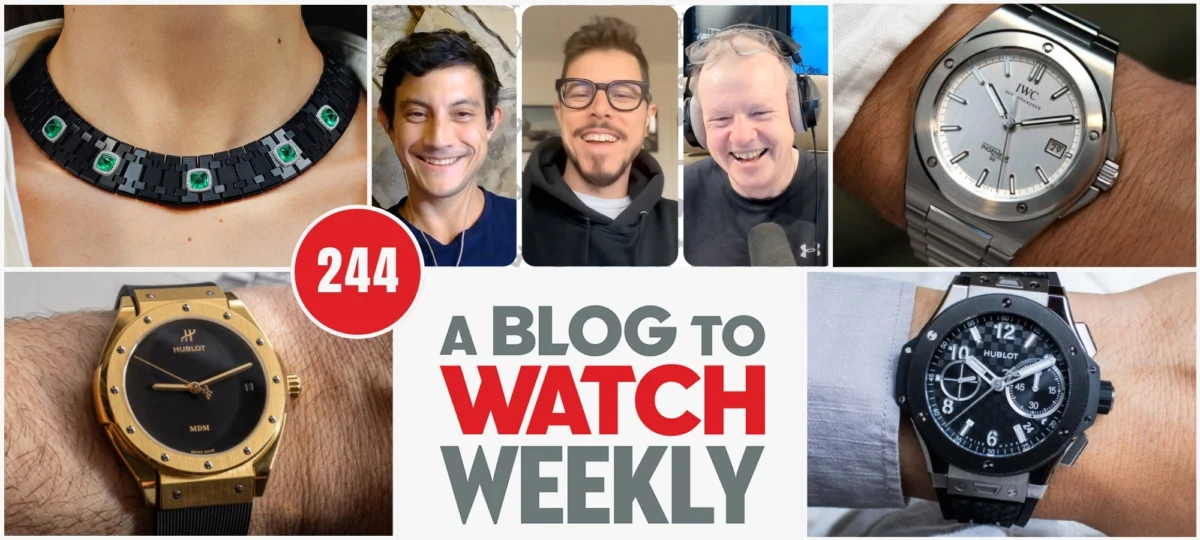
The horological landscape is currently undergoing a period of significant strategic realignment, underscored by the latest industry developments discussed in the most recent installment of aBlogtoWatch Weekly. In episode 244, hosts Rick, David, and Ripley navigate the complexities of luxury watchmaking, focusing on the leadership transition at Hublot under François-Henry Bennahmias, the high-jewelry integration at Audemars Piguet, and the historical milestone of the IWC Ingenieur. These developments arrive at a time when legacy manufacturers are increasingly tasked with balancing their traditional design codes against the demands of a modern, luxury-conscious consumer base that values both heritage and material innovation.
The Bennahmias Era: A New Chapter for Hublot
The appointment of François-Henry Bennahmias to a key role within the Hublot ecosystem represents a pivotal shift for the Nyon-based manufacturer. Bennahmias, who previously helmed Audemars Piguet for over a decade, is widely credited with transforming the Royal Oak into a cultural phenomenon. His influence on Hublot is already becoming apparent through the "Original" series, which seeks to reconnect the brand with its foundational DNA.
Hublot’s historical significance is rooted in the "Art of Fusion," a philosophy introduced by brand founder Carlo Crocco in 1980. Crocco famously challenged the status quo by pairing a precious metal—gold—with a utilitarian material—natural rubber—on a luxury timepiece. This design choice, initially met with skepticism by traditionalists, became the cornerstone of the brand’s identity. The current push to revitalize the Classic Fusion Original and Big Bang Original models serves as a strategic recalibration, ensuring that as the brand experiments with complex movements and avant-garde materials like sapphire and neon-colored ceramics, it does not lose sight of the minimalist elegance that defined its inception.
Audemars Piguet and the Expansion of Joaillerie
Audemars Piguet continues to refine its position in the ultra-luxury segment, recently drawing attention with the expansion of its Royal Oak Joaillerie collection. The integration of high-jewelry techniques into the brand’s most iconic sports watch platform raises critical questions regarding the intersection of horology and ornamentation. By applying complex diamond setting, baguette-cut gemstones, and intricate pave work to the Royal Oak architecture, the brand is effectively moving the product from the category of a functional tool watch into that of a high-jewelry artifact.
This trend reflects a broader market shift where the primary utility of a luxury timepiece—timekeeping—is secondary to its value as a wearable asset and a symbol of craftsmanship. For collectors, the challenge lies in determining the threshold where excessive decoration obscures the fundamental design language established by Gérald Genta in 1972. However, from a financial perspective, the Joaillerie segment provides significant margin growth and reinforces the brand’s exclusivity, catering to a demographic that views horology as an extension of haute couture.
The IWC Ingenieur: Celebrating a Half-Century of Engineering
The 50th anniversary of the IWC Ingenieur provides an opportunity to reflect on the evolution of the integrated-bracelet sports watch. Originally designed by Genta as a robust, anti-magnetic tool for professionals, the Ingenieur has seen several iterations over the last five decades. The current anniversary models aim to bridge the gap between the vintage aesthetic of the 1970s and modern manufacturing standards.
The Ingenieur’s history is inextricably linked to the post-Quartz Crisis era, where IWC had to distinguish itself through technical prowess rather than mere aesthetic novelty. Its focus on magnetic resistance remains a defining feature, though the modern market often focuses more on the case geometry. The podcast panel’s discussion also touched upon the Aquatimer, a collection that arguably remains the "hidden gem" of the IWC catalog. Despite being a highly competent diver’s watch with innovative features like the internal rotating bezel, it has frequently been overshadowed by the brand’s Pilot and Portugieser lines. This highlights a persistent issue in the watch industry: the struggle of functional, mid-tier collections to gain the same level of collector obsession as "hype" models.

Industry Implications and Market Dynamics
The topics explored in this episode underscore several key trends currently influencing the Swiss watch industry. First is the "heritage revival" cycle. Brands are increasingly looking to their archives to stabilize their portfolios amidst economic fluctuations. By leaning into the 1970s and 1980s, companies like Hublot and IWC are leveraging established design nostalgia to capture younger buyers who are entering the market with a keen interest in historical provenance.
Second is the stratification of the market. The move by Audemars Piguet to double down on high jewelry signals that the "middle ground" of luxury is becoming increasingly crowded. Manufacturers are either pushing into ultra-high-end jewelry-infused timepieces to justify higher price points or focusing on extreme technical innovation to maintain their status as pioneers.
Finally, the "Picker Wheel of Death" segment on the podcast—featuring a comparative look at Greubel Forsey, Gerald Charles, and Cuervo y Sobrinos—illustrates the diverse spectrum of the current market. Greubel Forsey represents the pinnacle of artisanal, low-volume watchmaking, where the focus is entirely on technical perfection and extreme finishing. In contrast, Gerald Charles continues the legacy of Genta’s later designs, offering a unique, avant-garde silhouette that appeals to a niche but dedicated following. Cuervo y Sobrinos, with its Latin heritage, provides a reminder that the global watch market is increasingly appreciative of regional history and distinctive, non-Swiss design narratives.
Data and Chronology of Key Events
- 1980: Carlo Crocco establishes Hublot, debuting the gold-on-rubber concept at the Basel Watch Fair.
- 1972: The debut of the Audemars Piguet Royal Oak, marking the birth of the luxury steel sports watch.
- 1970s: The IWC Ingenieur undergoes a significant redesign by Gérald Genta, establishing the integrated bracelet aesthetic.
- 2023–2024: François-Henry Bennahmias concludes his tenure at Audemars Piguet, transitioning into new advisory and leadership roles that influence the wider industry, including Hublot.
- 2024–2025: Significant anniversaries for the Ingenieur collection drive a renewed focus on anti-magnetic engineering within the IWC product roadmap.
Analytical Perspective
The industry is currently in a state of consolidation where the "story" behind the watch is as critical as the movement inside it. The success of the "Original" Hublot campaigns demonstrates that collectors are seeking a return to simplicity. Simultaneously, the focus on jewelry at Audemars Piguet indicates that the brand is effectively insulating itself from the volatility of the secondary market by catering to the top-tier of global wealth, where demand for unique, high-value jewelry pieces remains inelastic.
Furthermore, the discussion regarding the IWC Aquatimer highlights the "collection fatigue" that can affect even the most storied brands. When a manufacturer has one dominant line (the Pilot/Ingenieur), it becomes difficult to allocate marketing resources to secondary lines like the Aquatimer, regardless of their technical merit. This creates a vacuum in the market where smaller, independent brands or specialized lines like those from Gerald Charles can find success by focusing on design-first or niche-utility propositions.
As the industry moves forward, the ability to balance the weight of history with the necessity of constant innovation will define the market leaders. The current trajectory suggests a market that is becoming more bifurcated: on one side, a focus on "iconic" vintage-inspired designs, and on the other, an aggressive push into material science and jewelry-level finishing. For the consumer, this era offers a wider variety of choices than at any time in the past, provided they can navigate the increasing complexity of pricing and branding strategies employed by the major houses.
In summary, the insights provided by the aBlogtoWatch team reflect a sophisticated and evolving market. Whether it is the strategic maneuvering of Hublot’s new leadership, the artistic transformation of the Royal Oak, or the historical celebrations of IWC, these events collectively tell the story of an industry that is simultaneously looking back at its roots while rapidly innovating for a future that demands both exclusivity and mechanical excellence.