









The Yema Spacegraf Heure Sidérale Tourbillon Volant Limited Edition stands as a definitive milestone in the contemporary history of French watchmaking, blending centuries-old astronomical tradition with modern materials science. As the latest release in the brand’s prestigious "Millésime" collection, this timepiece serves as both a functional instrument and a horological tribute to the city of Morteau and the historic Besançon Observatory. By integrating a complex sidereal complication—which tracks the rotation of the Earth relative to the stars rather than the sun—Yema has positioned itself at the forefront of independent watchmaking, challenging the industry’s status quo with a caliber designed, developed, and assembled in the heart of the French Jura mountains.
A Historical Foundation: The Legacy of the Besançon Observatory
To understand the significance of the Spacegraf Heure Sidérale, one must look back to 1878, the year the Besançon Observatory was established. Located in a region that has served as the cradle of French watchmaking for over two centuries, the observatory was commissioned to provide a standardized, scientific reference for timekeeping. In an era before GPS and atomic clocks, watchmakers in the region calibrated their chronometers against the movement of the stars.
The term "sidereal time" refers to a timekeeping system based on the Earth’s rate of rotation measured relative to fixed stars. A sidereal day is approximately four minutes shorter than a solar day, a discrepancy that necessitates highly complex gearing to track accurately. By incorporating a celestial disc that rotates in synchronization with the night sky, Yema is not merely adding a decorative element; it is reviving a forgotten discipline of professional horology that was once the benchmark for all high-precision timekeeping in France.
Technical Architecture and The CMM.32 Calibre
The technical heart of this timepiece is the proprietary CMM.32 Calibre (Calibre Manufacture Morteau 32). This movement represents a significant investment by Yema into vertical integration, moving the brand away from outsourced components toward a fully autonomous manufacturing model.

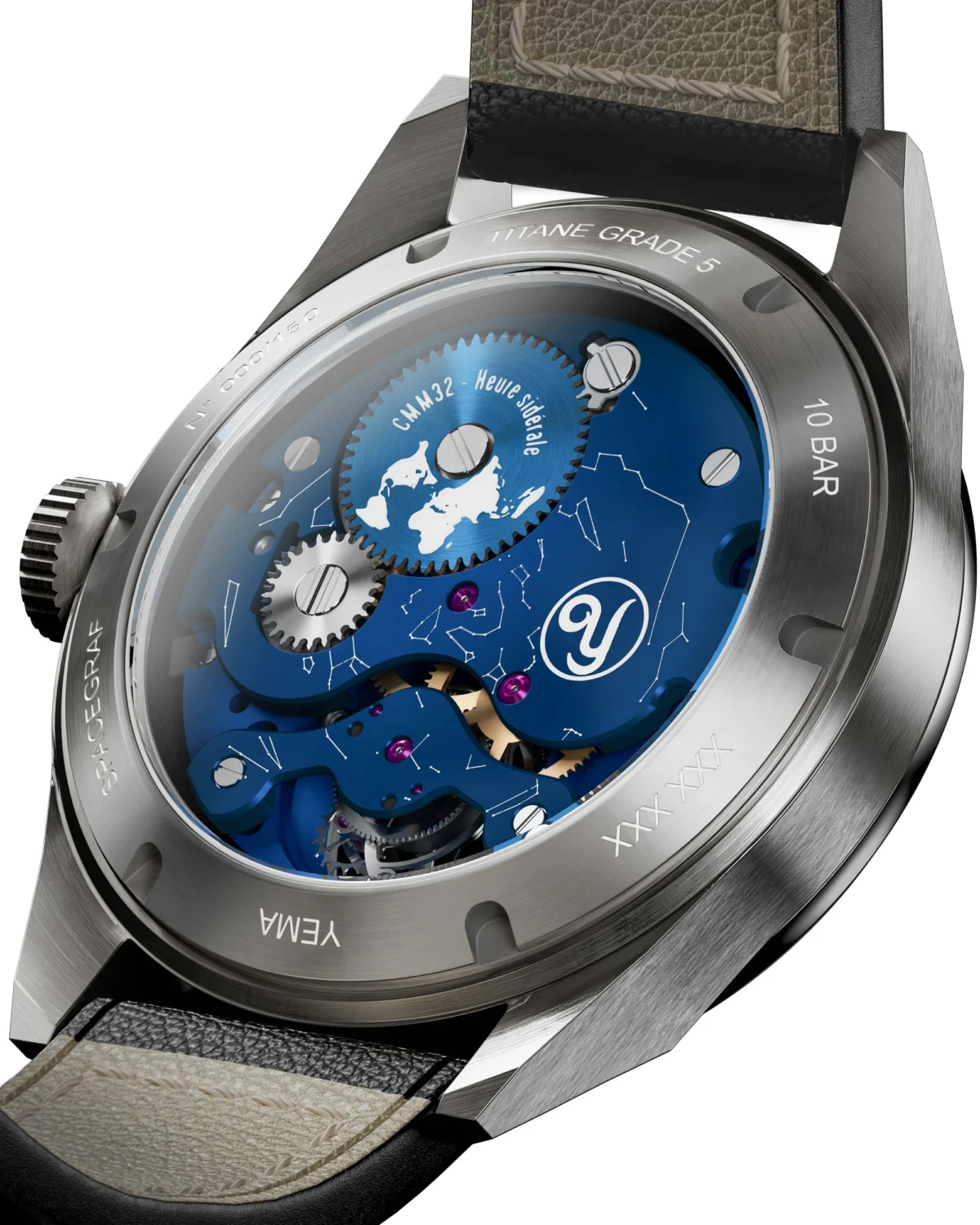
The CMM.32 is a flying tourbillon movement, meaning the carriage is supported only from one side, creating the visual illusion that the balance wheel is floating. This design requires exceptional precision in assembly to ensure stability and accuracy. Furthermore, the movement boasts a power reserve of 105 hours—nearly double that of many standard luxury chronographs—which ensures that the watch remains operational for over four days without winding.
Perhaps most impressive is the movement’s durability profile. Rated for 5,000G shock resistance in all directions, the caliber is designed to withstand the rigors of active wear, a rarity for tourbillon-equipped watches that are typically treated as fragile collector pieces. The aesthetic finish of the movement, featuring deep blue plates and bridges, serves as a visual metaphor for the night sky, bridging the gap between the mechanical function of the gears and the thematic inspiration of the dial.
Material Science and Design Philosophy
The choice of Grade 5 titanium for the 42mm case is a strategic decision that balances physical presence with ergonomic comfort. Despite the density of the complications housed within—specifically the celestial vault disc and the flying tourbillon—the case maintains a thickness of just 12.15mm.
The dial architecture is a masterclass in multi-dimensional engineering. Yema has utilized a notched, three-dimensional chapter ring that frames the tourbillon, complemented by a traditional railroad-track scale for minutes. To ensure legibility, the watchmakers have utilized Grade X1 Super-LumiNova BGW9. Unlike standard luminescent applications, this material has been applied with such depth that the entire celestial disc illuminates in low-light conditions, providing a coherent and readable map of the stars on the wearer’s wrist. The integration of this luminous material into the depth of the dial components ensures that the watch maintains its identity as a scientific instrument even in total darkness.
Chronology of Development
The trajectory of the Spacegraf project mirrors Yema’s broader corporate evolution over the last decade. Since 2017, the brand has embarked on a systematic effort to reclaim its heritage as a manufacturer of professional-grade tools.

- 2017-2019: Yema initiated the "Manufacture" program, focusing on the development of in-house movements to reduce reliance on Swiss and Japanese suppliers.
- 2022: The successful launch of the first generation of the CMM series proved that the brand could scale the production of complex movements.
- 2024-2025: The engineering team began intensive research into the celestial complications required for the Spacegraf project, working closely with local astronomical experts in the Jura region to map the sidereal disc accurately.
- October 2026: The official unveiling of the Spacegraf Heure Sidérale, marking the peak of the Millésime series.
Industry Implications and Market Impact
The release of the Spacegraf Heure Sidérale carries broader implications for the independent watch market. By offering a high-complication tourbillon with a unique astronomical feature at a price point that remains accessible compared to the major Swiss houses, Yema is effectively democratizing haute horlogerie.
Industry analysts observe that this move is a deliberate attempt to shift the perception of French watchmaking. For decades, the global market has been dominated by Swiss, Japanese, and German manufacturers. However, the success of the CMM series suggests a resurgence in French craftsmanship. The ability to produce a movement with 105 hours of power reserve and high-level shock resistance suggests that Yema has successfully mastered the supply chain and manufacturing precision required to compete with established luxury brands.
Furthermore, the limited-edition nature of the piece ensures its collectability. By limiting production, Yema maintains the exclusivity necessary for brand prestige while using the watch as a "halo product" to elevate the status of their more standard collections.
Official Stance and Future Directions
While Yema has not released specific production numbers, the company’s leadership has emphasized that the Millésime line is intended to serve as a laboratory for future innovations. In official communications, the brand noted that the development of the Spacegraf was not merely a design exercise, but a "technological manifesto." The intent was to prove that modern French horology could honor its 19th-century roots while simultaneously adopting 21st-century manufacturing techniques like CAD-aided design and advanced material stress testing.
The brand’s commitment to the Morteau region—the heart of the French watchmaking industry—remains a cornerstone of its identity. By keeping the design, development, and assembly within this geographic cluster, Yema reinforces the authenticity of its "Made in France" label.

Analysis: A Shift in Luxury Standards
The Yema Spacegraf Heure Sidérale serves as a litmus test for the current state of the watch industry. Consumers are increasingly seeking value beyond mere brand recognition, looking instead for technical merit, heritage, and the "story" behind the movement. The inclusion of a sidereal complication, which provides a genuine connection to the natural world and the history of navigation, offers a depth of engagement that standard chronograph or GMT watches cannot replicate.
The watch is not without its challenges. The complexity of the tourbillon and the celestial disc requires a high degree of maintenance and careful handling, despite the 5,000G shock resistance rating. However, for the serious collector, these are considered inherent characteristics of high-complication timepieces.
As we look toward the future of horology, the Spacegraf Heure Sidérale signals a move toward more cerebral, science-oriented watchmaking. Yema has demonstrated that it is capable of bridging the gap between historical romanticism and rigorous modern engineering. Whether this model will inspire a broader trend of celestial-themed complications in the mid-market sector remains to be seen, but it has undoubtedly established a new benchmark for what is expected from the Millésime designation. For now, the watch stands as a testament to the fact that when tradition is met with technical ambition, the result is a product that transcends the simple function of telling time.