








The Swiss-German horological landscape is currently experiencing a significant shift as Glashutte Original, a pillar of the Swatch Group’s prestige portfolio, unveils the latest iteration of its 70s collection. Long considered a boutique alternative to the industry’s more ubiquitous integrated bracelet sports watches, this new generation marks a departure from the brand’s previous design language. By embracing a sharper, more angular aesthetic and introducing a novel "Hexagrid" dial texture, Glashutte Original is positioning its flagship sports timepiece as a direct, high-specification rival to the established icons of the luxury watch market.

A Chronology of the 70s Evolution
The history of the 70s collection is rooted in the brand’s desire to bridge the gap between traditional Saxon watchmaking and the modern demand for versatile, robust luxury timepieces. While the previous generation of the 70s was characterized by rounded, organic surfacing and a prominent "Panorama Date" display positioned at 6 o’clock, the new generation represents a strategic pivot.
Historically, Glashutte Original has utilized the 70s line to showcase its distinct Teutonic identity. However, market research and evolving consumer trends have necessitated a transition toward a more contemporary, taut profile. The overhaul, finalized in late 2026, involves a complete recalibration of the case geometry and dial architecture. This transition reflects a broader industry movement toward "sports-chic" designs that prioritize ergonomic comfort and architectural precision over the more whimsical, retro-leaning silhouettes of the early 2010s.

Engineering and Technical Specifications
The cornerstone of this new model is its 39mm stainless steel case, which has been refined to offer a slimmer, more balanced wrist presence. Measuring 9.6mm in height with a 43.7mm lug-to-lug distance, the dimensions are calculated to ensure compatibility with a wide range of wrist sizes, addressing a common critique of previous, bulkier versions.
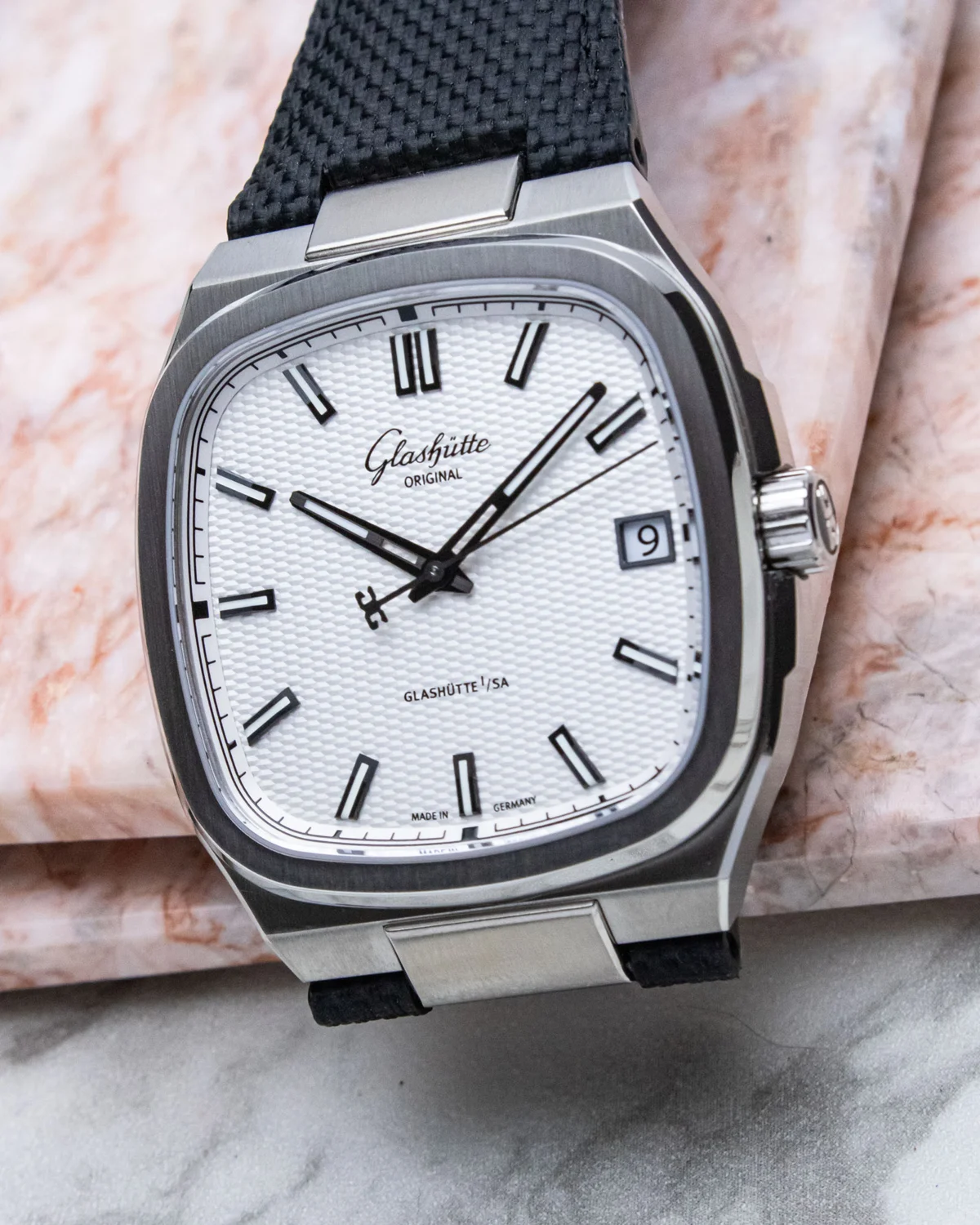
The case architecture serves as an exercise in geometric balance. Rather than relying on external markers such as exposed screws or oversized bezels, the designers have opted for a multi-faceted approach. The bezel features a flat, linearly-brushed upper surface flanked by dual-layered polished facets. This construction allows for effective light play while maintaining a subtle, professional profile. The water resistance remains firmly set at 100 meters, meeting the standard expected of the luxury sports category.

Internally, the timepiece is powered by the in-house Caliber 36 automatic movement. This movement remains one of the most significant technical assets for the Swatch Group, particularly at this price point. It offers a 100-hour power reserve at a 28,800 bph frequency. The movement is visible through a sapphire display caseback, revealing a three-quarter plate adorned with traditional Glashutte striping, polished anglage, and gold-filled engravings. The balance cock, featuring a swan-neck regulator, is finished with hand-engraved filigree, a hallmark of the Glashutte region’s heritage.
The Hexagrid Dial: A New Visual Identity
Perhaps the most notable aesthetic update is the introduction of the "Hexagrid" dial texture. Drawing inspiration from 1970s audio equipment—specifically the perforated speaker grilles of that era—the pattern provides a three-dimensional effect that changes under different lighting conditions.

For the silver-dial variant, the brand has selected black-coated white gold indices and hands, creating high-contrast legibility. The rehaut, or chapter ring, has been updated to include a quadrant-based scale, enhancing the watch’s utilitarian credentials. While the move from the signature 6 o’clock "Panorama Date" to a more conventional 3 o’clock position has sparked discussion among collectors, the company’s design department has indicated that this change was implemented to enhance dial symmetry and streamline the overall visual output, appealing to a broader demographic of international buyers.
Market Positioning and Competitive Analysis
The release of this collection occurs at a time when the luxury watch market is experiencing a cooling effect, with consumers increasingly favoring value-driven, high-specification timepieces over speculative "hype" models. Priced at $13,200 USD, the Glashutte Original 70s enters a crowded segment dominated by established legends such as the Audemars Piguet Royal Oak, the Vacheron Constantin Overseas, and the more entry-level Tissot PRX.

Unlike the Tissot PRX, which targets the accessible luxury segment, the Glashutte Original 70s occupies the high-end tier. Its primary competition lies in the mid-to-high luxury bracket, where consumers are increasingly looking for in-house movement finishing that rivals the "Holy Trinity" of Swiss watchmaking. The 70s collection’s strength lies in its finishing-to-price ratio; few other brands offer a hand-engraved balance cock and a 100-hour power reserve within a $13,000 to $15,000 price range.
Integration and Ergonomics
The decision to focus on the strap and bracelet system also signals a shift toward user-centric design. The "Groove Lock" quick-release system allows for the seamless interchangeability of the stainless steel bracelet and the woven-effect rubber strap. The latter, which features a leather lining and a traditional butterfly-style deployant clasp, underscores the brand’s commitment to comfort. By avoiding the common "cut-to-fit" trend, the company preserves the longevity of the strap, a detail that is often overlooked in modern sports watch production.

Broader Implications and Industry Impact
Industry analysts suggest that this release is a deliberate move by the Swatch Group to re-establish Glashutte Original’s footprint in the sports-luxury segment. By refining the 70s collection, the group is providing an alternative for collectors who appreciate the technical pedigree of German watchmaking but desire the versatility of a daily-wear sports watch.
The implications for the brand are significant. By aligning the 70s collection with a more modern, global design language, Glashutte Original is attempting to transcend its reputation as a niche manufacturer. The move is expected to bolster the brand’s presence in emerging markets where consumers are increasingly educated about movement finishing and historical horological provenance.

Furthermore, the emphasis on the Caliber 36 movement as a "spectacle" suggests that the brand is leaning into its strengths as a manufacture. In a market where many competitors have turned to modular or outsourced movements, Glashutte Original’s dedication to an in-house, high-performance caliber provides a clear differentiator.
Official Stance and Availability
Glashutte Original has confirmed that the new 70s collection is currently rolling out to authorized dealers globally. While the brand has not provided specific production numbers, they have stated that the release represents a long-term commitment to the 70s line. The focus, according to internal communications, is on long-term brand equity and establishing the collection as a staple in the luxury sports segment rather than a limited-run novelty.

As the industry continues to evolve, the Glashutte Original 70s stands as a testament to the importance of iterative design. By listening to the feedback of the collector community while maintaining the rigorous standards of Saxon horology, the brand has created a timepiece that balances the demands of modern wearability with the weight of historical legacy. Whether this shift toward a more conventional aesthetic will satisfy the purists or attract a new wave of enthusiasts remains to be seen, but the technical merits of the watch place it firmly among the top contenders in its class.