








The House of Mugler has long defined itself through radical futurism and boundary-pushing silhouettes. From its inception, founder Thierry Mugler envisioned a universe entirely his own, dressing models in sculptural, cyborgian aesthetics decades before such themes became mainstream fixtures of the fashion landscape. The late French designer famously remarked on his desire to construct an alternate reality scaled entirely to his artistic vision. Today, that legacy of provocation and fantasy is being aggressively carried forward by Portuguese creative director Miguel Castro Freitas. Since assuming the mantle of creative direction one year ago, Castro Freitas has consistently generated global digital engagement by reinterpreting and subverting the brand’s most provocative historical archives.
This ongoing dialogue between past and present culminated in the final chapter of his runway narrative, bringing a high-stakes, theatrical conclusion to a house renowned for defying convention. The presentation not only underscored Castro Freitas’s technical command over the atelier’s heritage but also reignited conversations regarding the limits of wearable art, performance, and the commodification of shock value in contemporary high fashion.
The Evolution of a Trilogy: From Nipple Rings to Peek-a-Boo Silhouettes
Castro Freitas’s tenure at Mugler has been structured around a grand thematic arc titled A Trilogy of Glorified Clichés. The series was designed to deconstruct, exaggerate, and ultimately celebrate the tropes of femininity and glamour that have historically defined the French luxury house.
The first installment of the trilogy debuted during the Spring/Summer 26 presentation, immediately capturing international headlines. Among the standout garments was a slinky, translucent nude dress engineered to be structurally supported solely by the model’s own body piercing jewelry—specifically, nipple rings. While the avant-garde styling stunned modern audiences, fashion historians quickly noted the lineage of the design, which traced back to a concept originally introduced by Thierry Mugler himself during the late 1990s.
For the final chapter of the trilogy, Castro Freitas turned his attention to another legendary piece from the Mugler archives: the Autumn/Winter 1995 peek-a-boo dress. This historical garment is best remembered for its engineered oval cut-out positioned directly over the lower back, exposing the model’s posterior. Immediately following the recent runway appearance, digital fashion commentators and social media users drew immediate comparisons to Alexander McQueen’s infamous low-slung bumster trousers from the late 1990s. However, fashion critics were quick to clarify that Mugler was equally pioneering in introducing unapologetically bodily, exhibitionist tailoring to the runway long before the turn of the millennium.
Futuristic Extremes and Avant-Garde Styling on the Runway
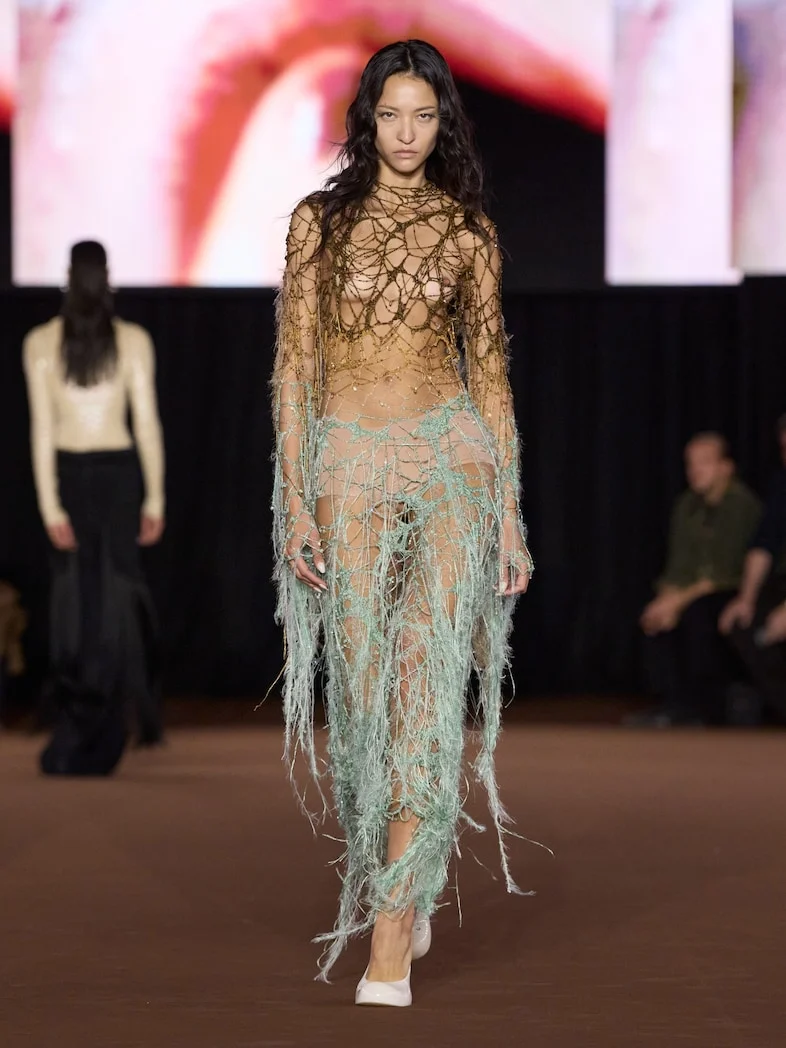
Beyond the archival nods, the latest presentation pushed avant-garde design to its outer limits through an immersive sensory environment. As massive digital screens flashed looping footage of wildlife, natural landscapes, and intimate close-ups of people kissing, models navigated the runway in an eclectic mix of structured tailoring and dystopian streetwear.
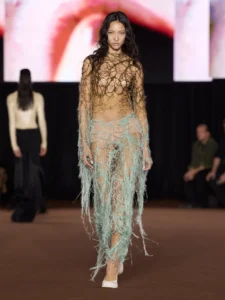
Among the more striking commercial and conceptual pieces were monochromatic structured suits cut deliberately beneath the chest to expose under-boob architecture—a radical departure from conventional corporate dress codes. Textural contrasts dominated the collection, pairing shaggy, voluminous black fur dresses with high-intensity neon accents. Simultaneously, lightweight netted gowns appeared deliberately distressed, giving the optical illusion of unravelling directly on the body as the models walked.
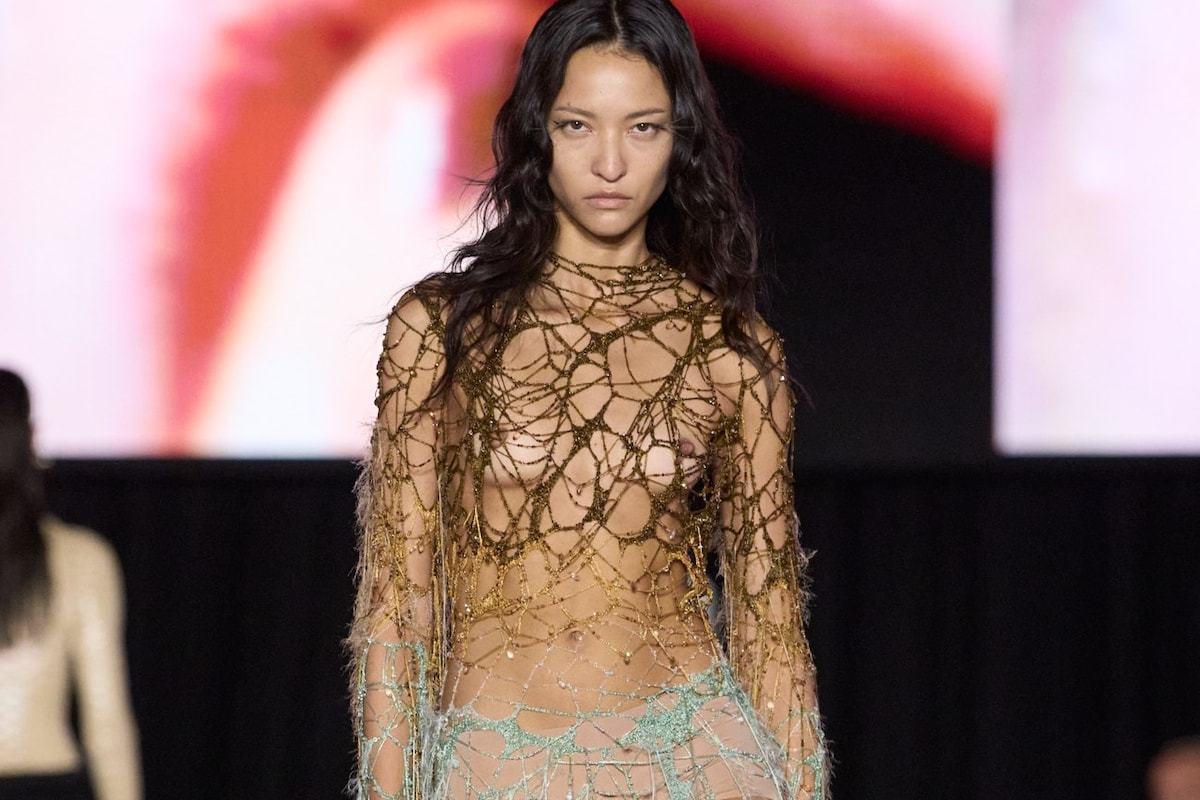
The beauty and accessories direction further amplified the otherworldly atmosphere. Models wore tall, slicked-back buns that dramatically elongated the silhouette of the head, paired with cartoonish, exaggerated footwear rendered in saturated, bright colorways. Visage-shielding headpieces obscured the eyes, reinforcing a sense of anonymity and machine-like detachment.
The Alexis Stone Controversy: A Living Archive Steps Front Row
While the garments themselves commanded industry attention, the most talked-about moment of the event occurred off the runway. Renowned makeup artist and prosthetic transformation artist Alexis Stone occupied a front-row seat transformed into an uncanny, hyper-realistic prosthetic clone of the late Thierry Mugler.
The appearance sparked immediate debate across digital platforms, dividing industry insiders and fashion purists. While supporters praised the stunt as a brilliant, postmodern homage to the house’s founding father—effectively positioning Thierry Mugler as an eternal spectator of his own legacy—detractors questioned whether the stunt crossed the line from reverent performance art into macabre spectacle. Regardless of critical polarization, the appearance achieved its immediate objective, dominating social media algorithms and driving unprecedented digital engagement metrics for the brand within hours of the show’s conclusion.
Chronology of the Modern Mugler Era
To understand the trajectory of the brand under Miguel Castro Freitas, it is necessary to examine the timeline of leadership and creative output following Thierry Mugler’s retirement and subsequent passing:
- 1973–2002: Thierry Mugler builds his eponymous house, establishing a reputation for theatrical runway presentations, insectile couture, and hyper-structured tailoring.
- 2010s: Under the creative direction of Nicola Formichetti and subsequently Casey Cadwallader, the brand undergoes revivals, heavily leaning into sheer, hyper-sexualized mesh bodysuits that become ubiquitous among contemporary pop culture icons such as Beyoncé, Kim Kardashian, and Cardi B.
- January 2022: The fashion world mourns the passing of Thierry Mugler at the age of 73, prompting widespread retrospectives on his contributions to modern futurism.
- Late 2024 / Early 2025: Miguel Castro Freitas is appointed as the new creative director of Mugler, tasked with bridging the founder’s historical archive with a contemporary consumer base.
- September 2025 (SS26): Castro Freitas debuts the first chapter of A Trilogy of Glorified Clichés, introducing the nipple-ring-supported dress and setting a provocative tone for his tenure.
- Current Presentation: The designer concludes the trilogy with the reinterpretation of the AW95 peek-a-boo dress and the viral Alexis Stone prosthetic appearance.
Industry Impact and Market Implications
The strategic direction under Castro Freitas highlights a broader shift within the luxury sector toward high-impact viral moments. In an era dominated by short-form video algorithms and shifting consumer attention spans, heritage houses are increasingly forced to balance historical reverence with shocking theatricality to maintain market relevance.
From an economic perspective, collections that generate intense online discourse rarely translate directly to ready-to-wear sales at scale; rather, they serve as top-of-funnel marketing engines. The halo effect generated by viral garments—such as structural cut-outs and avant-garde tailoring—drives traffic toward more accessible entry points, including the brand’s highly lucrative fragrance lines, leather goods, and baseline accessories.
Furthermore, the revival of 1990s and early 2000s extreme fashion aligns with a broader consumer nostalgia cycle. Gen Z and millennial luxury consumers increasingly value authenticity, historical provenance, and counter-cultural rebellion over traditional elegance. By reviving and updating the most controversial silhouettes of Thierry Mugler’s career, Castro Freitas has successfully positioned the brand not merely as a preserved museum archive, but as an active, living participant in contemporary cultural discourse.
As this three-part trilogy concludes, industry analysts and fashion critics alike are left watching to see how Mugler will sustain this high-octane momentum in upcoming seasons. Whether the house can transition from shock-driven spectacle to a sustainable long-term commercial blueprint remains to be seen, but one reality is indisputable: Mugler under Miguel Castro Freitas has firmly reclaimed its status as one of the most unpredictable and talked-about forces in modern fashion.