





Paris Fashion Week has once again established itself as the global epicenter of sartorial innovation, halfway through a relentless schedule marked by historic debuts, conceptual homages, and star-studded front rows. Amidst a whirlwind calendar that has already seen Rihanna grace Jonathan Anderson’s nature-infused Dior showcase at Les Tuileries, Glenn Martens’ poignant tribute to Raf Simons at Maison Margiela, Anthony Vaccarello’s golden crescendo at Saint Laurent, and Apple Martin’s runway debut for Chloé, attention turned to the historic Tennis Club de Paris. There, designer Pierpaolo Piccioli presented his third ready-to-wear collection for Balenciaga, cementing a new design vocabulary for the storied maison for the Spring/Summer 2027 season.
The Venue and the Artistic Collaboration
Staged inside the historic Tennis Club de Paris on Avenue Georges Lafont, the presentation space underwent a radical transformation. Striking white walls, pale wooden floorboards, and dual symmetrical rows of minimalist white benches replaced the traditional athletic infrastructure, creating an austere, gallery-like atmosphere.
At the center of this monochromatic room stood an imposing, organic sculpture by celebrated textile artist Aude Franjou. Entitled Les Coraux de la Liberté, the towering piece featured curling red and yellow tentacles constructed entirely from winding layers of linen fibre, scaling upward toward the ceiling in a coral-like formation. The collaboration underscored Piccioli’s ongoing dialogue with contemporary fine art, building upon Franjou’s historic installation inside the July Column at the Place de la Bastille during Paris Design Week the previous September—where she became the first artist ever granted permission to scale the national monument. By titling the SS27 collection after the sculpture, Piccioli established a direct thematic bridge between monumental public art and intimate garment construction.
Front Row Presence and Cultural Resonance
True to the high-profile nature of Paris Fashion Week, the venue attracted a formidable assembly of cultural figures, international artists, and fashion icons. Attendees spotted navigating the stark white benches included stylist Law Roach, acclaimed French actress Isabelle Huppert, experimental musician Nia Archives, and singer-songwriter Lauryn Hill. The diverse front row reflected Balenciaga’s continued cultural reach across film, music, and high fashion, bridging traditional luxury clientele with contemporary artistic communities.
Deconstructing the Collection: Couture Meets the Everyday
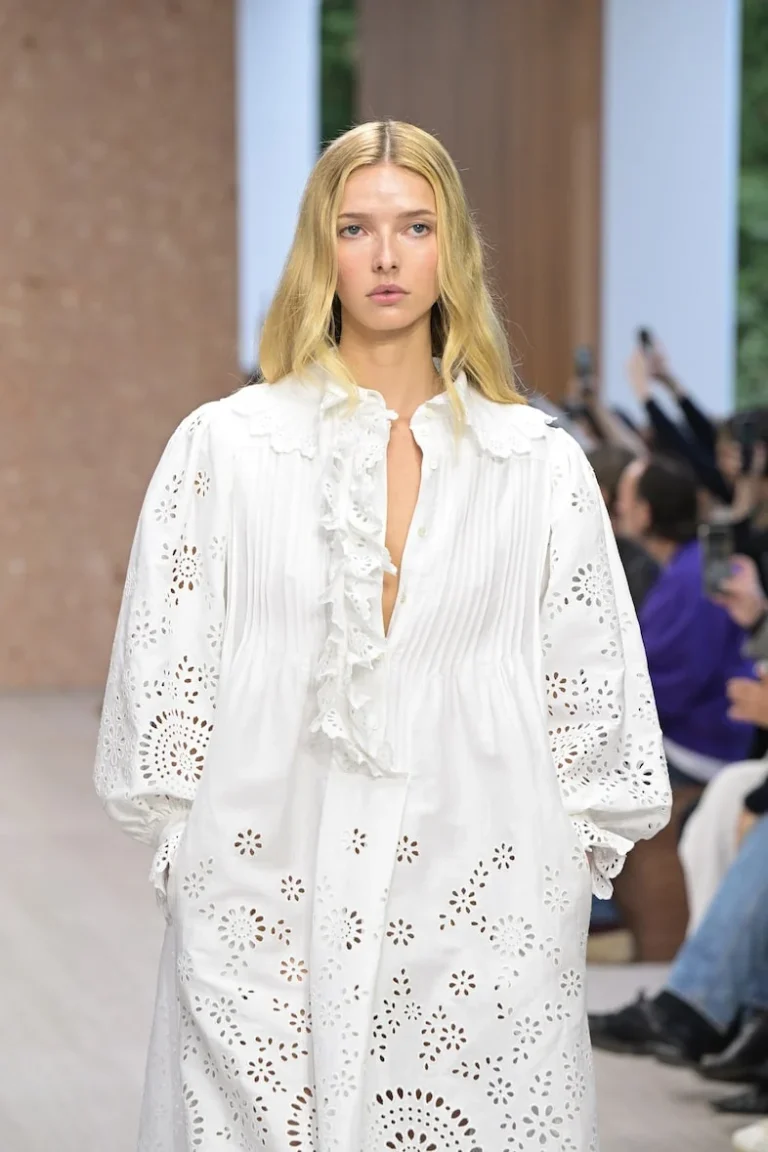
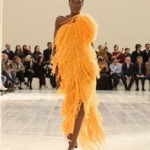
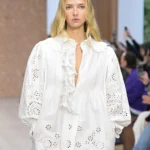
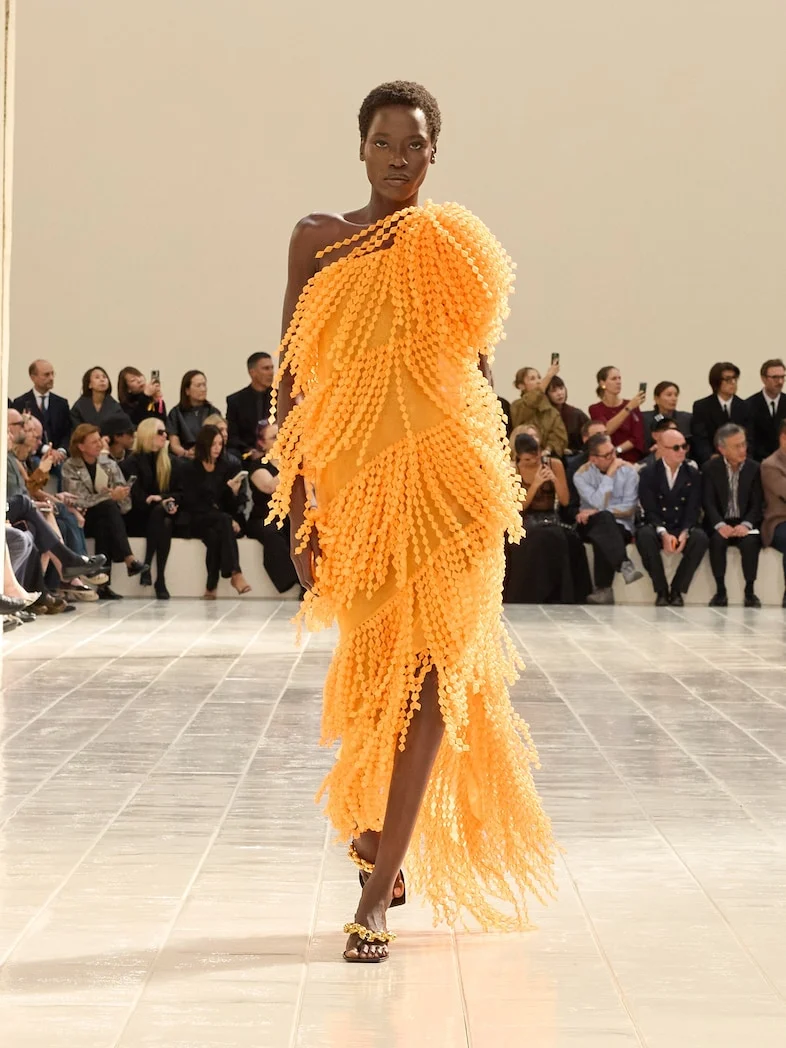
As the minimalist soundtrack reverberated through the venue, the SS27 collection unfurled with an all-white opening sequence defined by architectural capes and intricate floral detailing. The palette quickly expanded into a vivid spectrum of royal blue, shocking pink, and glowing vermillion, applied across blouson jackets, high-collared shirts, and fluid tunic tops.
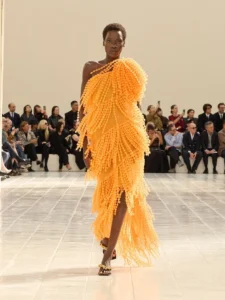
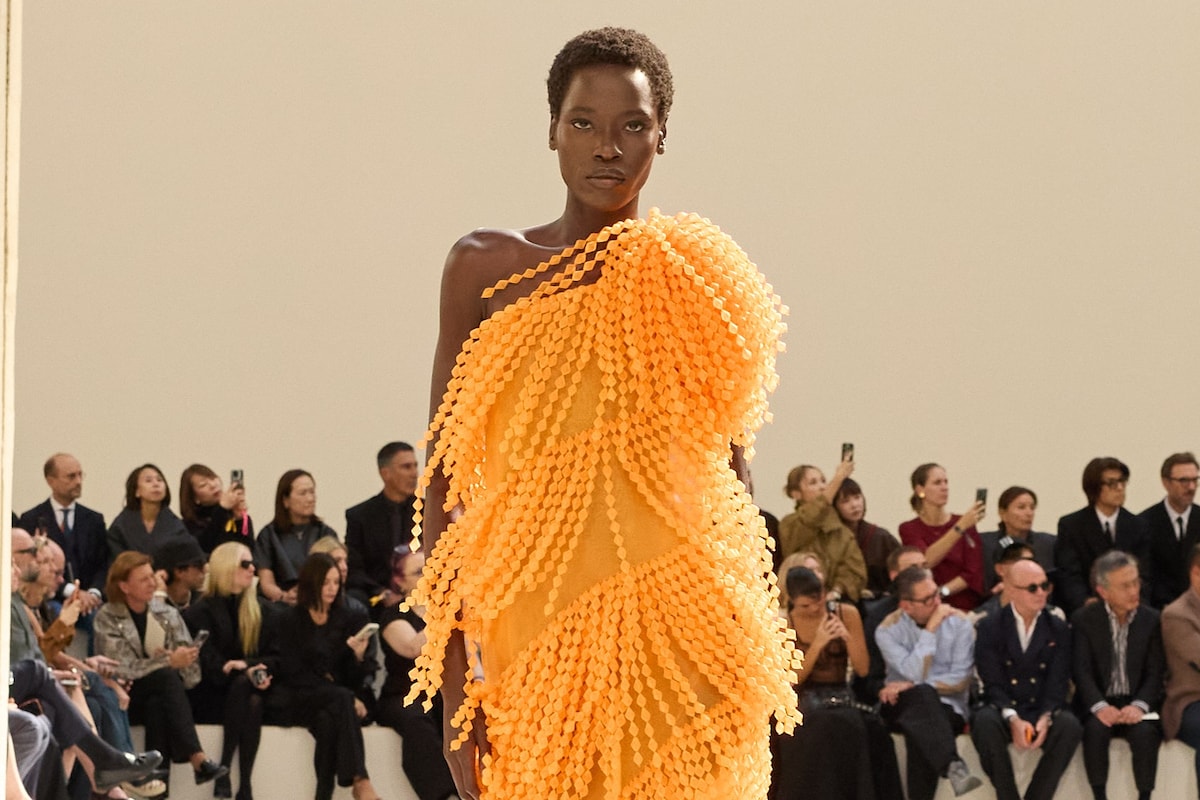
Key silhouettes featured exaggerated Tudor-style shoulders, voluminous cocoon-collar coats, and distinctive frogspawn-like collars that explicitly mirrored the organic, textured forms of Franjou’s central sculpture. According to official show notes, these high-craft elements were not mere runway flourishes, but a deliberate exercise in translating atelier mastery into commercial viability.
"Techniques originating in the 55th Balenciaga Couture Collection are applied to a spectrum of ready-to-wear clothing for both women and men," the official notes stated. "A wardrobe of prototypical ready-to-wear garments are redefined through studies of cut and construction, and their proximity to the hand."
Contextual Chronology of Paris Fashion Week SS27
The Balenciaga presentation arrived at a critical juncture in the Paris Fashion Week calendar, reflecting an industry-wide push toward narrative-driven collections and archival reverence.
The spring/summer season commenced under intense media scrutiny, driven by high-profile creative leadership changes and milestone anniversaries across major luxury houses. On Tuesday, Jonathan Anderson captured global headlines at Dior by integrating organic elements within the historic gardens of Paris, signalling a pastoral shift for the French luxury titan. Simultaneously, Glenn Martens surprised critics at Maison Margiela by replicating the physical architecture of Raf Simons’ seminal Dior Autumn/Winter 2012 haute couture show, a gesture widely interpreted by fashion historians as a masterclass in inter-generational design dialogue.
Further cementing the week’s emotional resonance, Anthony Vaccarello delivered what industry analysts speculated to be a swan-song performance for Saint Laurent, featuring a glittering crescendo of metallic garments accompanied by a live performance from Charlotte Gainsbourg. The momentum continued into the morning of the Balenciaga show, where cultural fascination peaked with the runway debut of Apple Martin at Chloé. Amidst this saturated landscape of high-drama spectacles, Piccioli’s approach at Balenciaga offered a calculated counter-narrative: an emphasis on structural rigor over theatrical shock value.
Technical Analysis and Manufacturing Implications
Piccioli’s direction for Balenciaga represents a structural evolution from the streetwear-dominated era of the late 2010s toward a sophisticated synthesis of haute couture methodology and mass-market ready-to-wear. By applying labor-intensive atelier techniques—traditionally reserved for custom, one-of-a-kind garments—to everyday staples such as shirts, trousers, and blousons, the maison is redefining the commercial boundaries of luxury fashion.
Industry analysts note that this strategy addresses a broader economic shift within the global luxury sector. As consumers increasingly demand provenance, artisanal craftsmanship, and tangible value in their apparel purchases, brands capable of democratizing haute couture techniques gain a distinct competitive advantage. The integration of sculptural textiles, advanced draping, and meticulous pattern-cutting into standard menswear and womenswear collections signals a maturation of Balenciaga’s brand identity under Piccioli’s stewardship.
Broader Industry Impact and Future Outlook
The presentation of Les Coraux de la Liberté marks a defining milestone in Pierpaolo Piccioli’s tenure at Balenciaga, proving his capacity to honor the house’s foundational heritage of avant-garde tailoring while infusing it with humanistic warmth and artistic collaboration.
As Paris Fashion Week presses forward toward its conclusion, the reverberations of Piccioli’s collection are expected to influence retail buying patterns for the upcoming spring and summer seasons. By proving that rigorous artisanal craftsmanship can successfully coexist with utilitarian wardrobes, Balenciaga has established a compelling benchmark for modern luxury—one where the discipline of the haute couture atelier directly informs the rhythm of everyday life.