








The little black dress remains one of fashion’s most enduring icons, a garment whose perceived simplicity masks a highly complex manufacturing process. While the aesthetic legacy of the "LBD" was cemented by Audrey Hepburn in the 1961 film Breakfast at Tiffany’s, the modern garment industry faces the dual challenge of replicating this timeless elegance at a global, high-speed scale. Achieving the clean lines, structural integrity, and flawless necklines that define high-end apparel requires precision machinery, a niche currently dominated by Swedish textile technology specialist Svegea, a prominent member of the Swedish Textile Machinery Association (TMAS).
The Technical Anatomy of Elegance: The Role of Bias Binding
At the heart of the LBD’s construction is bias binding—a technique involving fabric strips cut at a 45-degree angle to the grain. Unlike straight-grain fabric, which possesses limited stretch, bias-cut material offers inherent flexibility. This diagonal cut allows the fabric to drape fluidly around curved surfaces, such as armholes and necklines, without puckering, twisting, or distorting.
In industrial manufacturing, the precision of this binding is the difference between a high-quality garment and a mass-produced item that loses its shape after a single wash. The technical challenge lies in maintaining absolute uniformity across thousands of units. When handled manually, variations in cutting tension and width are inevitable, leading to inconsistencies that compromise the garment’s fit. As consumer expectations for quality increase alongside the demand for faster fashion cycles, the industry has transitioned from manual labor to automated, high-precision systems.
Chronology of Innovation: From Manual Cutting to Automation
The evolution of garment manufacturing technology has been marked by a shift toward total system integration. Historically, fabric cutting was a labor-intensive, artisanal process that relied heavily on individual skill.
- Pre-1980s: Bias binding was largely prepared by hand, resulting in significant material waste and inconsistent results.
- 1990s: The emergence of specialized cutting machines began to standardize strip widths, though the process remained fragmented.
- 2000s–2010s: The industry saw a surge in demand for "smart" factories. Manufacturers began seeking equipment that could handle entire workflows—from roll to binding—rather than isolated tasks.
- 2020–2026: Companies like Svegea shifted focus toward fully automated, high-speed integrated units. The current state-of-the-art involves synchronized processes where fabric is tubed, opened, cut, and wound in a continuous, tension-controlled loop.
This trajectory reflects a broader trend within the European machinery sector: moving away from commodity manufacturing and toward highly specialized, high-margin engineering solutions that address specific, often invisible, production pain points.
The Svegea Production Ecosystem: A Deep Dive
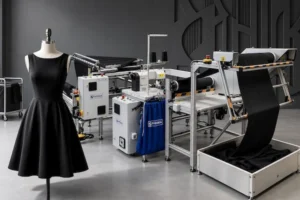
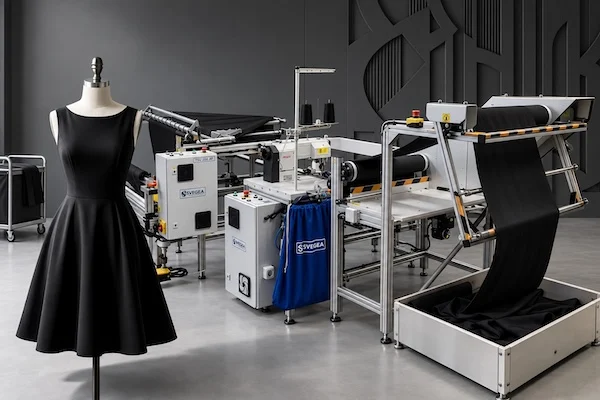
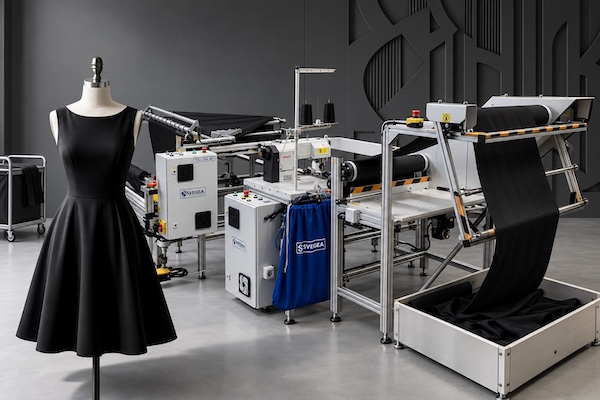
Svegea’s approach to this challenge is centered on a streamlined, automated workflow designed to minimize human error and material waste. The process is a testament to industrial efficiency:
- Tube Sewing: The process begins by joining open-width fabric into a continuous tube. This creates the structural foundation required for uniform bias cutting.
- Bias Cutting and Winding: Once the tube is formed, it is fed into a bias cutter. The machine’s precision blades cut the fabric at the exact required angle and width—down to a tolerance of 6mm—ensuring that every strip is identical.
- Winding: The resulting strips are rewound onto spools, ready for integration into the garment assembly line.
By automating these steps, manufacturers can maintain a constant production speed while ensuring that every garment—whether it is a high-fashion LBD or a high-volume activewear top—meets the same rigorous quality standards. This is particularly vital for garments with few design elements, where the quality of the finish is the only indicator of craftsmanship.
Market Data and Industrial Implications
The global textile machinery market is currently undergoing a period of rapid transformation. According to recent industry reports, the demand for automated cutting and sewing equipment is expected to grow as manufacturers prioritize sustainability and waste reduction.
Material efficiency is a key economic driver for this technology. When bias strips are cut manually, the margin for error is high, often resulting in significant fabric waste. Automated systems optimize the use of material, allowing factories to achieve higher yields from every roll of fabric. Furthermore, as labor costs in traditional manufacturing hubs rise, the ROI (Return on Investment) for automated machinery has become increasingly attractive.
For the average consumer, this translates to better-fitting garments that maintain their structural integrity over time. For the manufacturer, it represents a shift toward "lean" production, where precision is not an optional extra but a baseline requirement for competitiveness in a crowded global market.
Official Perspectives: The Value of Swedish Specialization
The Swedish Textile Machinery Association (TMAS) has long advocated for this focus on specialized, niche engineering. By fostering a collaborative environment, TMAS members have positioned themselves as critical partners in the global supply chain.
Industry analysts suggest that the success of companies like Svegea lies in their ability to solve specific technical problems rather than attempting to provide generic solutions. By addressing the "invisible" aspects of garment construction, Swedish manufacturers have secured a role as the backbone of the global textile industry.
"The focus is on the repeatability of results," noted a representative of the industrial textile sector. "When a brand sells a product, they are selling a promise of quality. If the neckline on a dress distorts after one wear, that promise is broken. Automation is the only way to ensure that the 1,000th dress off the line is identical to the first."
Broader Impact: Beyond the Dress
While the LBD serves as a perfect case study for the necessity of bias binding, the implications of this technology extend far into other sectors:
- Activewear: Modern athletic garments require significant flexibility and reinforcement. Automated bias binding ensures that seams can withstand the mechanical stress of high-intensity movement.
- Childrenswear: The requirement for durable, soft, and irritation-free finishes makes precise edge finishing mandatory.
- Home Textiles: From high-end bedding to upholstery, the demand for clean, reinforced edges is universal.
- Technical Textiles: Beyond fashion, the ability to cut and wind specialized materials with high precision is vital for industries ranging from automotive interiors to medical textiles.
Conclusion: The Future of Precision Manufacturing
The future of the fashion and textile industry is intrinsically linked to the level of automation employed in the factory. As the industry faces mounting pressure to improve sustainability, the role of precision machinery becomes even more pronounced. Reducing waste through accurate, automated cutting is no longer just a financial advantage—it is an environmental necessity.
As TMAS continues to represent the interests of Swedish engineering firms, the emphasis remains clear: high-value, high-precision, and high-efficiency. The legacy of the little black dress may be rooted in its aesthetic simplicity, but its continued relevance in the modern wardrobe is a victory for the invisible, highly technical machinery that makes such perfection possible. The evolution of companies like Svegea ensures that the standards of the past are not only met but consistently exceeded by the innovations of the future.