










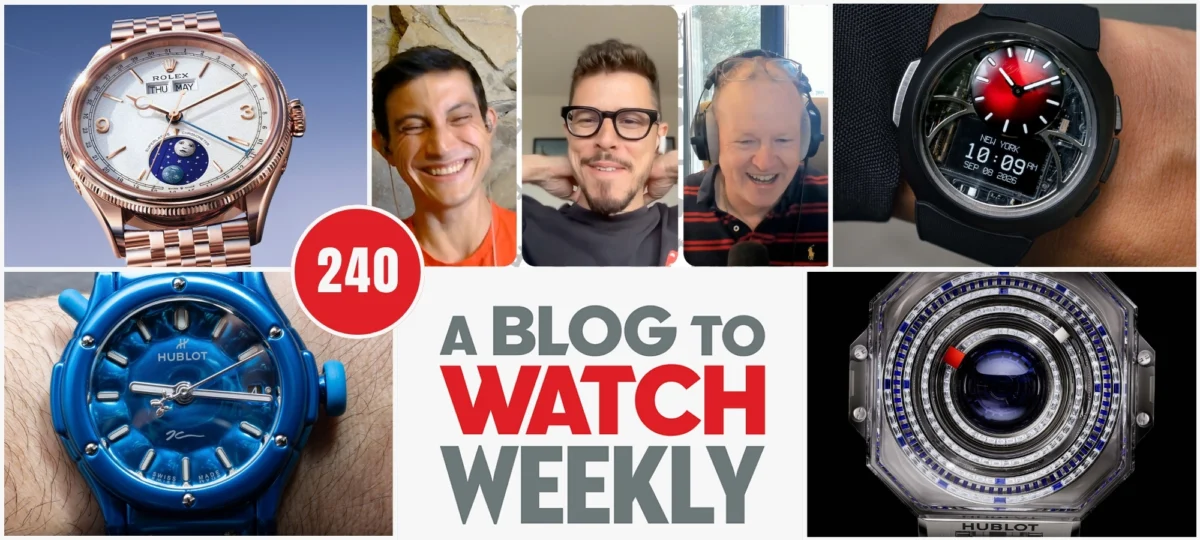
This week’s episode of aBlogtoWatch Weekly features hosts Rick, David, and Ripley as they navigate the evolving landscape of the luxury watch industry, addressing a diverse range of topics from digital integration in high horology to the aggressive market positioning of legacy brands. The discussion, anchored in the current state of watch marketing and brand strategy, provides a comprehensive overview of recent developments at H. Moser & Cie., Cartier, Rolex, and Hublot.
Digital Evolution and Marketing Strategies
The industry’s relationship with digital integration remains a point of contention. The episode highlights the recent strategic pivot by H. Moser & Cie., a brand traditionally celebrated for its minimalist aesthetic and mechanical purity, into the digital realm. This transition reflects a broader trend among heritage manufacturers attempting to capture a younger, digitally native demographic. Industry analysts note that such moves are often met with skepticism by purists, yet they are increasingly necessary for brands looking to maintain relevance in an era where digital engagement is a primary driver of luxury consumption.
The discussion extends to the current state of watch marketing, with the hosts observing a decline in the effectiveness of traditional promotional narratives. In the early 2000s, brand communication focused heavily on technical heritage and artisanal craftsmanship. Today, the focus has shifted toward lifestyle integration and community building. Many legacy brands have struggled to sustain long-term engagement, often relying on sporadic campaigns rather than continuous, value-driven discourse. Data suggests that brands that fail to adapt their storytelling to social-first platforms face a diminishing share of voice, regardless of their historical prestige.
The Strategic Ambition of Cartier
A significant portion of the broadcast is dedicated to an analysis of Cartier’s competitive position against Rolex. For decades, Rolex has maintained a near-monopoly on the "entry-to-mid-level" luxury watch market, characterized by extreme brand equity, high liquidity, and consistent value retention. Cartier, while historically a jeweler first, has successfully leveraged its iconic design language—specifically the Tank and Santos collections—to challenge this dominance.
Market data indicates that Cartier has been one of the fastest-growing brands in the secondary market over the last five years. However, the question remains whether Cartier can disrupt the "Crown’s" stronghold. Industry experts argue that while Cartier excels in design and brand cachet, it lacks the vertically integrated, industrial-scale manufacturing dominance that defines Rolex. For Cartier to truly challenge Rolex in the long term, it would need to increase its production of high-complication movements and sustain the aggressive pricing strategies that have bolstered its reputation among collectors.
Rolex and the Evolution of the Perpetual 1908
The introduction of the Rolex Perpetual 1908 Padellone marks a notable shift in the brand’s product architecture. Historically, Rolex has been synonymous with professional tool watches, such as the Submariner and the Daytona. The 1908 line, however, represents a deliberate push into the "dress watch" segment, a space where Rolex has historically been secondary to brands like Patek Philippe or Vacheron Constantin.
The "Padellone" reference, a term historically used by collectors to describe oversized vintage dress watches, reflects a new design language for the brand. Analysts point out that the pricing of the 1908 series is significantly higher than the average Oyster Perpetual model, signaling an attempt to elevate the brand’s average transaction value. This move serves two purposes: it diversifies the brand’s portfolio beyond the sports watch category and positions Rolex as a competitor in the ultra-luxury segment, where profit margins are higher and volume requirements are lower.

Hublot and the Intersection of Art and Horology
The collaboration between Hublot and artist Jeff Koons serves as a case study in the polarization of modern luxury marketing. By integrating the aesthetic motifs of Koons’ "Balloon Dog" series into high-concept timepieces, Hublot continues its tradition of "The Art of Fusion," a marketing philosophy that marries unconventional materials—such as sapphire crystal—with avant-garde design.
From a commercial standpoint, these timepieces are not intended for mass-market consumption. Rather, they serve as brand halo products, designed to generate headlines and maintain Hublot’s visibility within the art and luxury lifestyle sectors. While critics frequently point to the extreme pricing and unconventional design as detractors, the strategy has historically proven effective for Hublot in terms of brand awareness and establishing a unique identity in a crowded market.
Comparative Analysis: Watches and Automotive Branding
The episode concludes with an exploration of the thematic parallels between watch brands and automotive manufacturers. This comparison is a staple of horological journalism, as both industries rely heavily on engineering prestige, performance metrics, and status signaling.
The hosts suggest that a "watch brands versus car brands" framework could serve as a useful metric for understanding consumer behavior. For instance, the parallels between the engineering-focused culture of Porsche and the reliability-driven ethos of Rolex are frequently cited in consumer studies. By categorizing brands into tiers—from entry-level utilitarian to high-performance hyper-luxury—observers can better predict how brand loyalty transfers between these two luxury sectors.
Industry Implications and Future Outlook
The discussions within this episode highlight several key trends that will define the luxury watch market in the coming years:
- The Price Floor Rise: As brands like Rolex and Hublot push further upmarket, the price floor for "accessible" luxury is rising. This creates a vacuum in the lower-price segments, which is increasingly being filled by independent micro-brands and Japanese manufacturers.
- Design as the Primary Differentiator: With mechanical movements reaching a plateau of reliability across the industry, design, materials, and brand storytelling have become the primary levers for competitive advantage.
- The Sustainability of Marketing Cycles: Brands that cannot maintain a consistent narrative risk losing the interest of the next generation of collectors, who prioritize brand transparency and digital authenticity.
The analysis provided by the aBlogtoWatch team underscores the necessity for brands to balance their historical legacies with the demands of a rapidly changing economic and social environment. As the industry approaches the end of the current fiscal year, the strategies employed by these major players—whether through the adoption of new digital platforms or the expansion into higher-margin watch categories—will serve as a roadmap for the broader luxury goods market.
The conversation serves as a reminder that the watch industry is no longer an isolated ecosystem of mechanical engineering. It is now deeply intertwined with global finance, celebrity culture, and digital-first marketing. Whether through the lens of a $50,000 sapphire-cased Hublot or the strategic expansion of Cartier’s dress watch line, the message remains clear: to remain relevant, legacy brands must be willing to evolve, even if that evolution tests the patience of their most traditional collectors.