








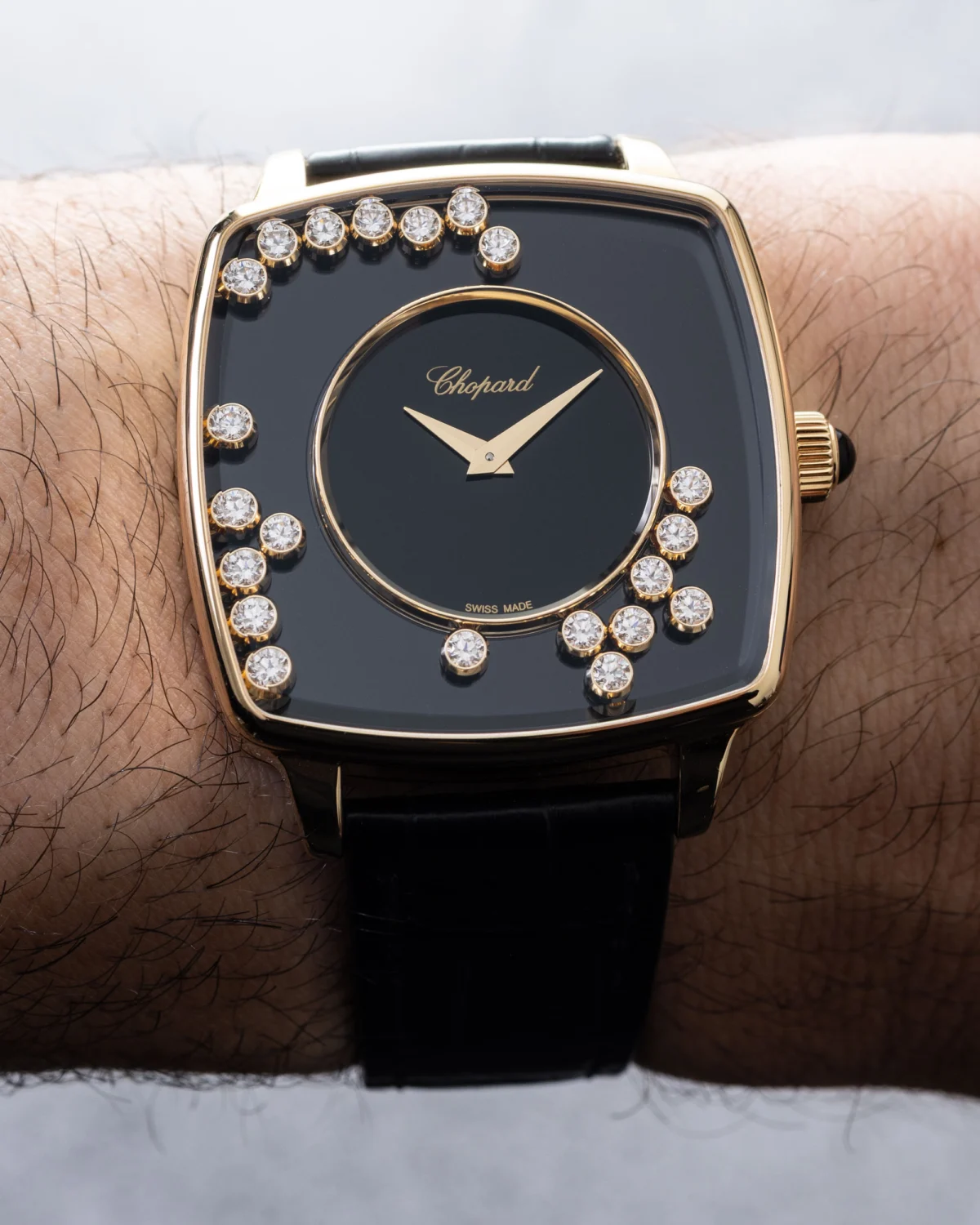
The Chopard Happy Diamonds Heritage collection marks a significant strategic pivot for the Swiss luxury maison, reintroducing a concept that initially debuted in 1976 as a masculine design. While the "Happy Diamonds" aesthetic—characterized by free-moving diamonds encased between sapphire crystals—has become synonymous with Chopard’s feminine jewelry and watch offerings over the last five decades, its origins lie in the formal attire of men’s fashion in the late 1970s. By re-launching these models in 2026, Chopard is reclaiming its historical narrative and addressing a modern shift in luxury consumption, where the boundaries between men’s and women’s horology continue to blur.

Historical Context and the 1976 Genesis
To understand the weight of this reintroduction, one must look back to the mid-1970s, a volatile and creative era for the Swiss watch industry. As the "Quartz Crisis" threatened the dominance of mechanical watchmaking, brands were forced to innovate not only in technology but in design. In 1976, Chopard introduced the original Happy Diamonds watch, which defied traditional watchmaking norms by detaching the diamonds from the dial, allowing them to glide across the periphery of the movement.
Archival advertisements from that period highlight a demographic that may seem surprising to contemporary collectors: men in tuxedos. The initial design was housed in a cushion-shaped case, a silhouette favored during the era’s penchant for geometric, bold forms. This design was not merely a decorative choice; it was an engineering feat that required a precise "sandwich" construction of sapphire crystals. For decades, however, the collection migrated almost exclusively toward the women’s market, evolving into the Happy Sport line and becoming a cornerstone of Chopard’s revenue stream. The 2026 Heritage release is a deliberate archival revival, returning to the original cushion-shaped geometry that first brought the brand fame for its mobile diamond concept.

Design Specifications and Mechanical Integrity
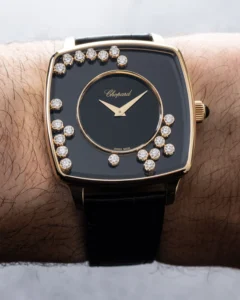
The Chopard Happy Diamonds Heritage collection is available in two distinct sizes, catering to different aesthetic preferences while maintaining a cohesive design language. The flagship model, the 34mm version (Reference 202299-0001), is crafted from 18k "ethical" yellow gold—a testament to Chopard’s long-standing commitment to sustainable sourcing in the jewelry industry.
The 34mm timepiece features an in-house manually wound mechanical movement, the Chopard Caliber 10.01-C. This movement operates at a frequency of 21,600 vibrations per hour (3Hz) and provides a power reserve of approximately 45 hours. Given the case dimensions—measuring 34mm in width and 8.5mm in thickness—the movement is compact, allowing for a slim profile that rests elegantly on the wrist. The aesthetic is anchored by a deep black onyx dial, which provides a high-contrast backdrop for the 21 individual diamonds that circulate around the dial’s perimeter.

The smaller, 24mm variant (Reference 203787-0001) utilizes a Swiss-made quartz movement, prioritizing convenience and a more compact form factor. Both models feature water resistance rated to 30 meters, suitable for daily wear, though they are fundamentally designed as pieces of high jewelry. A notable design detail is the use of an onyx cabochon set into the crown, mirroring the material of the dial and creating a balanced, monochromatic look that allows the dancing diamonds to serve as the primary visual focus.
The Engineering of "Dancing" Diamonds
The technical challenge of the Happy Diamonds concept lies in the friction and physics of the settings. The diamonds are not mounted to the dial but are secured within individual gold settings that move freely within a sealed chamber. This chamber, situated between two layers of sapphire crystal, acts as a track.

Observations of the current Heritage collection indicate that the mobility of these diamonds varies based on the housing constraints. In the 34mm Heritage model, the chamber allows for fluid, rapid movement. As the wearer moves their wrist, the diamonds shift, creating an audible, tactile experience—a soft, rhythmic clicking as the gold settings contact the sapphire or the surrounding track. This auditory feedback is an intentional component of the watch’s "personality," bridging the gap between a static timepiece and a kinetic sculpture.
Market Positioning and Industry Implications
The decision to market the Happy Diamonds Heritage to men in 2026 reflects broader trends in the global luxury goods sector. Market analysts have noted a marked increase in male consumer interest in high-end jewelry and "statement" watches that transcend traditional utilitarian tool-watch categories. By reintroducing a product that was explicitly designed for men in the 1970s, Chopard is positioning itself to capture the "jewelry-forward" male consumer who is increasingly comfortable with decorative, high-visibility accessories.

From a pricing perspective, the 34mm model is positioned at $48,400 USD, while the 24mm model is listed at $24,000 USD. These price points reflect the use of precious materials, the complexity of the "sandwich" crystal construction, and the brand’s positioning within the ultra-luxury segment. Unlike limited-edition releases, which rely on artificial scarcity to generate demand, these models have been added to the permanent catalog, suggesting that Chopard views this as a long-term strategic addition rather than a fleeting marketing campaign.
Sustainability and Ethical Gold Initiatives
A critical element of the 2026 launch is Chopard’s continued emphasis on "ethical" gold. Since 2018, the brand has claimed to use 100% ethical gold in all its jewelry and watch production. This includes gold sourced through the Swiss Better Gold Association, as well as gold that is certified by the Responsible Jewellery Council (RJC). In the context of the Happy Diamonds Heritage, this sourcing strategy is used to appeal to a generation of luxury consumers who prioritize ESG (Environmental, Social, and Governance) criteria in their purchasing decisions.

Broader Impact and Future Outlook
The reintroduction of the Happy Diamonds for men is a bold assertion of the brand’s identity. It challenges the contemporary rigid classification of watch designs by gender. By leaning into its own history, Chopard avoids the pitfalls of trying to "masculinize" a feminine product; instead, it demonstrates that the Happy Diamonds concept is inherently gender-neutral, relying on the universal appeal of light, motion, and precision.
While the market for high-jewelry men’s watches remains a niche, it is a rapidly growing one. Chopard’s move to expand its accessories line—incorporating the cushion-case motif into wider jewelry offerings—suggests that the company is building an ecosystem around this design language. Whether this reintroduction will shift the dial for the broader industry remains to be seen, but it serves as a reminder that the most enduring design concepts in horology often find their strength in their ability to adapt to the changing cultural zeitgeist, even if that means returning to the drawing board of 1976. For collectors and enthusiasts, the Heritage collection offers a rare opportunity to own a piece of brand history that feels entirely relevant in a modern, inclusive, and fashion-conscious luxury market.