










The Evolution of the Endeavour Collection
The Endeavour line has long served as the canvas for H. Moser & Cie.’s most avant-garde experiments in minimalism. Historically, the brand—re-established in its modern form in 2005 by the Meylan family—has carved out a niche by subverting luxury watchmaking norms. While competitors often push for more "data" on the dial, Moser has consistently focused on the "essential."
The development of the 1730-1200 reference follows a multi-year trajectory of movement innovation. Since the debut of the HMC 902 automatic movement, the brand has sought to refine its chronograph architecture. The transition to the manual-wound HMC 730 caliber represents a strategic pivot toward traditional tactile engagement. By removing the automatic winding rotor, watchmakers gained the internal volume necessary to house the dual-time and date modules without increasing the case thickness beyond a manageable 13.2mm.
Technical Architecture of the HMC 730 Caliber
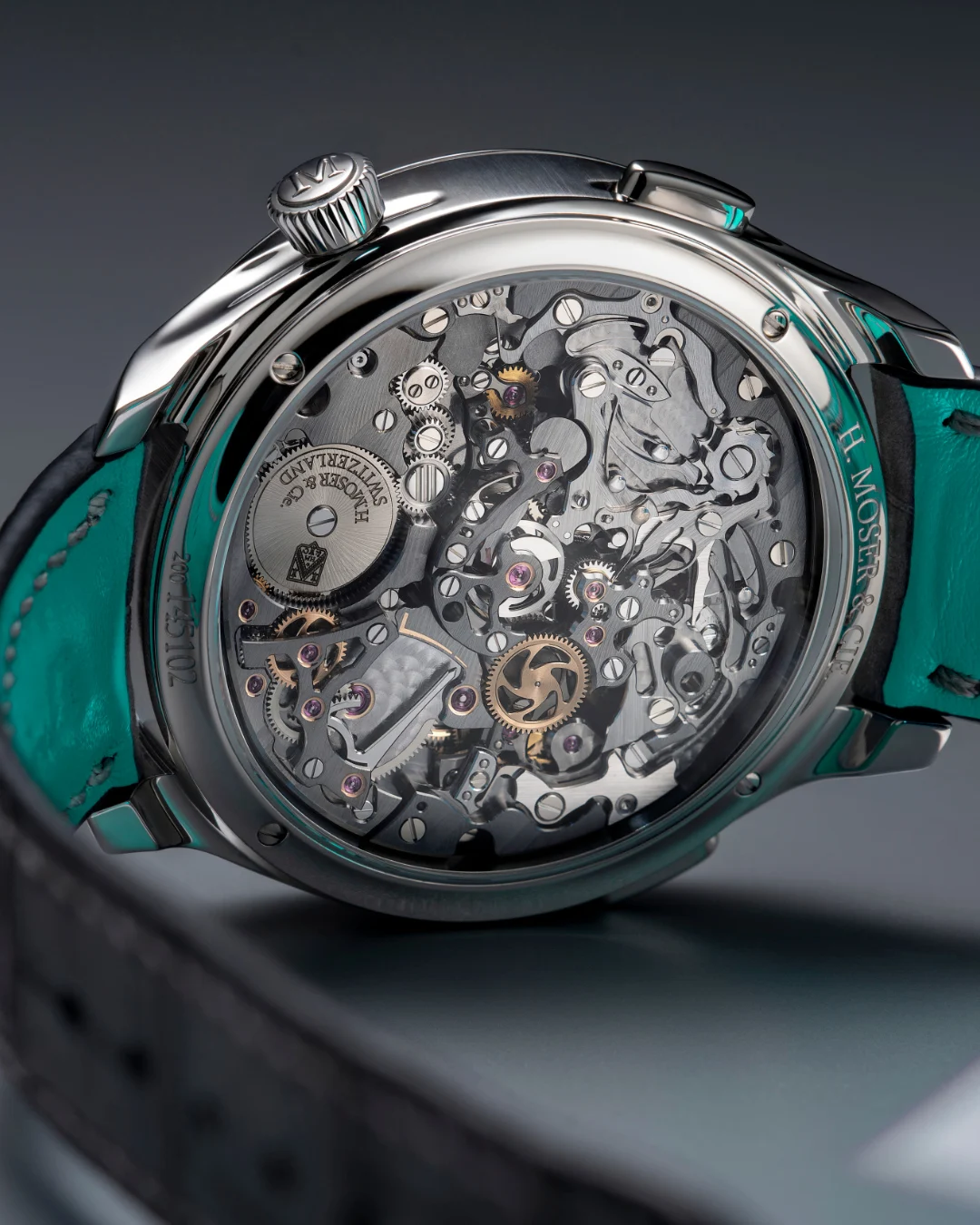
The HMC 730 caliber, developed in close collaboration with the movement specialists at Agenhor, is the technical heart of this timepiece. Agenhor, renowned for its work on complex, display-efficient movements, brought a unique set of engineering solutions to the table. The movement operates at 21,600 vibrations per hour and is comprised of 383 individual components, held together by 49 jewels.

A primary technical highlight is the horizontal clutch system, which utilizes a friction wheel equipped with micro-teeth. This design is specifically intended to eliminate the "jumping" effect often associated with the engagement of traditional chronograph gears. Furthermore, the elapsed-minute display utilizes a retrograde principle. Rather than a sweeping hand, energy is stored and released via a snail cam, allowing the minute hand to jump instantaneously to the next increment. This not only enhances readability but also provides a distinct visual signature that emphasizes precision.
The manual-wind nature of the movement is supported by twin barrels that guarantee a 72-hour power reserve. In a move that prioritizes the dial’s aesthetic purity, the power reserve indicator has been relocated to the movement side, visible only through the sapphire caseback. This design choice underscores the brand’s commitment to the wearer’s experience: the complication is functional when required, but hidden when the user is simply checking the time.
Navigating the Dual Time and Chronograph Functionality
The watch is designed for the modern traveler, but it avoids the "pilot watch" aesthetic typically associated with such functions. The second time zone is managed via a discreet central disc in Blackor fumé. A white, Super-LumiNova-tipped arrow indicates the secondary hour, which can be easily adjusted. When not in use, the arrow remains subtle, allowing the turquoise fumé sunburst dial to serve as the primary focus.
The flyback chronograph controls are similarly unconventional. The pushers are positioned at 10 and 2 o’clock, rather than the standard 2 and 4 o’clock, providing an ergonomic advantage for the thumb and index finger. The screw-down crown, located at 4 o’clock, features the brand’s signature "M" engraving. Because the chronograph functions are centrally mounted—utilizing a red hand for seconds and a rhodium-plated hand for minutes—the dial remains remarkably open. The white minute track and tachymeter flange provide the necessary scale for performance measurement without crowding the centerpiece.

Practical Utility and User-Centric Engineering
One of the most significant, yet understated, features of the HMC 730 is the bi-directional date adjustment. In many complex movements, adjusting the date during certain hours of the day can cause mechanical damage. The HMC 730 is engineered to allow the date to be set both forward and backward at any time, a feature that provides immense utility for those crossing multiple time zones.
This functionality speaks to the broader philosophy at H. Moser & Cie.: the belief that extreme mechanical complexity should never come at the expense of day-to-day usability. The inclusion of the grey alligator leather strap with a nubuck finish further emphasizes the watch’s intended role as an everyday luxury item rather than a delicate, cabinet-bound curiosity.
Market Positioning and Strategic Implications
Priced at approximately CHF 59,000 (roughly $72,800 USD), the Endeavour Flyback Chronograph Dual Time Date occupies a competitive space in the haute horlogerie market. It sits alongside pieces from brands like Patek Philippe and Vacheron Constantin, yet it targets a distinct demographic: the collector who values technical pedigree but rejects traditional "sporty" or "tool-watch" aesthetics.
The decision to limit the dial’s visual density is a calculated brand strategy. By removing sub-dials, Moser is essentially betting that its customers value the "Moser look"—the signature fumé dial—above the desire to broadcast the mechanical status of the movement. This "quiet luxury" approach is increasingly common among independent manufacturers who rely on brand identity rather than recognized dial layouts to distinguish their products.

Chronology of Development
The collaboration between Moser and Agenhor began in earnest following the success of the HMC 902. The R&D phase for the HMC 730 spanned approximately 36 months, focusing primarily on the integration of the retrograde minutes and the friction-wheel clutch. The prototype phase concluded in mid-2025, with final testing focusing on the reliability of the dual-time adjustment mechanism under extreme temperature variations and physical shock. The official launch in late 2026 marks the culmination of this two-year production cycle.
Broader Industry Context
In the context of the wider watch industry, this release highlights a trend toward "stealth complications." While the market for oversized, aggressive sports watches remains strong, there is a growing segment of buyers seeking watches that perform multiple high-level functions without creating visual clutter. The HMC 730 caliber is a direct response to this demand.
By stripping away the traditional layout, Moser is effectively challenging the industry standard of what a chronograph "should" look like. Analysts suggest that this design philosophy may influence future releases from independent watchmakers who have historically leaned on traditional, crowded dials to prove their mechanical worth. By contrast, Moser is proving that technical excellence can be whispered rather than shouted.
Official Stance and Future Outlook
While H. Moser & Cie. rarely issues public statements regarding its production volume, the complexity of the HMC 730 suggests that annual production will be strictly limited. The watch requires significant manual assembly and finishing, including the application of Moser double stripes and hand-polished bevels on the movement bridges.

For the collector, the Endeavour Flyback Chronograph Dual Time Date represents a convergence of classical watchmaking values and modern, minimalist design. It is not merely a tool for tracking time, but a case study in how to balance the demands of high-complication engineering with the aesthetic restraint of modern design. As H. Moser & Cie. continues to refine its repertoire, this model will likely stand as a benchmark for how to successfully modernize the chronograph without losing the soul of the horological craft.
With its combination of an unconventional layout, superior mechanical innovation, and the iconic turquoise fumé aesthetic, the 1730-1200 reference is poised to remain a cornerstone of the brand’s collection for years to come. It serves as a reminder that the most sophisticated machines are often those that work silently, efficiently, and with an elegance that defies the complexity of their internal architecture.