










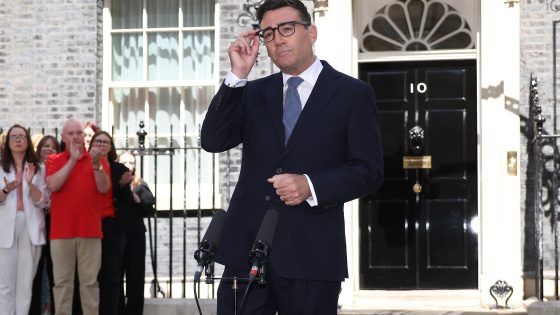
Andy Burnham was formally appointed the 59th Prime Minister of the United Kingdom today, July 20, 2026, succeeding Sir Keir Starmer in a dramatic political transition that has sent ripples across Westminster and the nation. Emerging from Buckingham Palace following his audience with His Majesty The King, the former Mayor of Greater Manchester delivered a concise yet potent inaugural address from the steps of 10 Downing Street, declaring, "We will make this moment a circuit breaker for Britain." This statement immediately set a tone of decisive action and a clear departure from the preceding administration, signaling a fresh chapter for a country grappling with persistent economic headwinds and a fractured social landscape.
Burnham’s ascension marks a significant shift in British politics, bringing a leader with a strong regional mandate and a reputation for direct, pragmatic engagement to the nation’s highest office. His appointment comes at a critical juncture, with public expectations high for immediate solutions to the cost of living crisis, stagnating public services, and the broader challenge of national unity.
The Path to Power: A New Era Dawns
The transition of power unfolded swiftly over the past week, culminating in today’s official appointment. Rumours of Sir Keir Starmer’s impending resignation had intensified following a series of disappointing by-election results and persistent internal party pressures. The most recent blow came with the devastating loss of the fictional "Northshire South" constituency on July 14, a seat held by the Labour Party for over two decades. This defeat, widely interpreted as a public rebuke of the government’s economic policies and its perceived inability to connect with working-class voters, proved to be the final straw for Starmer’s leadership.
On July 18, Sir Keir Starmer announced his resignation as Prime Minister and leader of the Labour Party, citing a need for "fresh leadership to tackle the profound challenges facing our nation." His departure initiated a rapid internal process within the Labour Party to select a successor capable of uniting the party and restoring public confidence. Andy Burnham, a long-standing figure in Labour politics and a popular regional leader, quickly emerged as the frontrunner, consolidating support from across the party’s various factions. His broad appeal and established track record of delivery in Greater Manchester made him an almost inevitable choice for many within the party keen to project an image of renewed vigor and a focus on grassroots issues.
The official appointment ceremony saw Burnham travel to Buckingham Palace, where His Majesty The King formally invited him to form a government. Following the traditional exchange, Burnham made his way to Downing Street, greeted by a throng of journalists and well-wishers, where he delivered his inaugural remarks, emphasizing the need for a radical shift in direction.
A Tumultuous Predecessor: Sir Keir Starmer’s Tenure
Sir Keir Starmer’s premiership, which began in late 2024 following a general election victory, was characterized by an earnest but often beleaguered attempt to steer Britain through a period of profound national and international instability. His government inherited a complex economic environment, marked by high inflation, slow growth, and significant pressure on public services exacerbated by global geopolitical tensions and the lingering effects of the post-Brexit economic realignment.
Despite initial hopes for stability and renewal, Starmer’s administration struggled to gain significant traction on key policy fronts. Economic data for early 2026 painted a challenging picture: inflation, while having peaked, stubbornly remained above 5%, eroding household incomes and exacerbating the cost of living crisis. GDP growth had stagnated at an average of 0.5% in the preceding two quarters, far below pre-pandemic levels. Public sector strikes, particularly in healthcare and education, continued to disrupt essential services, highlighting deep-seated issues in funding and workforce retention. Opinion polls consistently showed public dissatisfaction with the government’s handling of the economy, with Starmer’s personal approval ratings dipping to an average of 28% in July 2026, according to a recent Ipsos MORI survey.
Furthermore, Starmer faced persistent challenges in articulating a clear, compelling vision for the country that resonated beyond traditional Labour strongholds. While his focus on fiscal responsibility and incremental reform aimed to reassure cautious voters, it often left some segments of the party and the electorate feeling that bolder action was needed. The "Northshire South" by-election, where a significant swing of 15% to the Conservative Party occurred, was widely seen as a rejection of the status quo and a demand for more decisive leadership.
From Greater Manchester to Downing Street: The Rise of Andy Burnham
Andy Burnham’s journey to the premiership is a testament to a career defined by both ambition and a deep-rooted commitment to social justice and regional empowerment. Born in Liverpool, Burnham’s political career began as a Member of Parliament for Leigh in 2001. He quickly rose through the ranks, serving in various ministerial roles under Tony Blair and Gordon Brown, including Chief Secretary to the Treasury (2007-2008), Secretary of State for Culture, Media and Sport (2008-2010), and Secretary of State for Health (2009-2010). These roles provided him with invaluable experience across different facets of government, from economic policy to public service delivery.
After Labour’s defeat in 2010, Burnham remained a prominent figure, twice contesting the Labour leadership (in 2010 and 2015). While unsuccessful in these bids, his campaigns helped solidify his public profile as a compassionate and articulate voice for working-class communities. It was his pivot to regional politics in 2017, however, that truly transformed his political trajectory. As the inaugural Mayor of Greater Manchester, Burnham cultivated a powerful new brand of leadership. He championed devolution, regional investment, and a "levelling up" agenda long before it became a national policy focus. His hands-on approach during crises, particularly the COVID-19 pandemic, where he famously challenged central government over funding and restrictions, earned him widespread praise and established him as a powerful advocate for regional interests.
Under his leadership, Greater Manchester saw significant investment in public transport, housing, and digital infrastructure. His popular "Our Pass" scheme for young people and his consistent advocacy for fairer funding for the North cemented his reputation as a leader who delivers tangible results for his constituents. This success created a unique political platform, allowing him to bypass some of the traditional criticisms leveled at Westminster politicians. By July 2026, Burnham’s approval ratings as Mayor were consistently over 60%, a stark contrast to national political figures. His mandate as Prime Minister is thus viewed by many as a nationalization of his successful regional model – a focus on practical solutions, community empowerment, and a commitment to addressing the geographical inequalities that persist across the UK.
The "Circuit Breaker" Mandate: A Vision for Britain
Burnham’s "circuit breaker" declaration is more than just a catchy phrase; it encapsulates the urgent need for a decisive break from perceived political inertia and economic stagnation. The analogy suggests a deliberate and immediate intervention to halt a negative trend and reset the system. Political analysts interpret this as a commitment to bold, perhaps even radical, policy shifts aimed at stimulating economic growth, strengthening public services, and rebuilding social cohesion.
While specific policy announcements are awaited, Burnham’s past statements and his record as Mayor offer strong indications of his likely priorities. Expect a renewed emphasis on regional investment and an accelerated "levelling up" agenda, potentially including significant infrastructure projects and enhanced powers for local authorities. His focus on public services, particularly the National Health Service (NHS) and social care, is expected to be paramount. During his mayoral tenure, Burnham was a vocal advocate for integrating health and social care services, and he is likely to push for substantial reforms and investment in these critical areas, potentially funded by a revised approach to taxation.
Economically, the "circuit breaker" likely implies a move towards more interventionist policies. This could involve targeted industrial strategies, investment in green technologies, and measures to tackle the cost of living crisis, such as reforms to energy markets or increased support for low-income households. Burnham has also historically been a strong proponent of workers’ rights and fair wages, suggesting a potential shift towards strengthening trade union powers and ensuring a more equitable distribution of economic prosperity. On the international stage, while continuity in key alliances is expected, Burnham’s focus may lean towards pragmatic engagement and ensuring that international agreements directly benefit British industries and communities.
Reactions Across the Political Spectrum
The news of Andy Burnham’s appointment has elicited a range of responses from across the political spectrum, reflecting the magnitude of the change.
In a brief statement following his resignation, Sir Keir Starmer wished his successor "every success in leading our great nation," thanking his colleagues and the public for their support during his tenure. He emphasized the importance of party unity in facing the country’s challenges.
The Conservative Party leader, Dame Priti Patel, issued a statement acknowledging the "difficult period" but cautioning that "a change of leader does not change the underlying issues facing the Labour Party or the country." She pledged to hold the new government to account, stressing the need for "responsible economic management" and "tough decisions" rather than what she termed "unfunded promises."
Liberal Democrat leader, Sir Ed Davey, extended a "cautious welcome" to the new Prime Minister, stating that the Liberal Democrats would "work constructively where possible" but would challenge the government on issues of democratic reform and environmental protection. He called for a swift general election, arguing that the public deserved a direct say in who governs them.
Political commentators have offered immediate analysis. Professor Sarah Jenkins, a leading political scientist at the London School of Economics, noted, "Burnham represents a decisive shift for Labour, moving from Starmer’s more cautious, technocratic approach to a more populist, regionally-focused brand of social democracy. His challenge will be to translate his immense regional popularity into national electoral success and to unify a party that has been through a tumultuous period." Many analysts also highlighted the significant expectations now placed upon Burnham, arguing that his "circuit breaker" promise has set a very high bar for his premiership.
From the business community, initial reactions were mixed. While some expressed optimism about a leader known for his pragmatic approach to regional economic development, others voiced concerns about potential shifts towards more interventionist policies and their implications for investment and corporate taxation. Paul Chambers, Director General of the Confederation of British Industry (CBI), stated, "We look forward to engaging with the new Prime Minister and his government on policies that foster economic growth, support businesses, and create jobs across all regions of the UK."
Immediate Challenges and the Road Ahead
Andy Burnham steps into Downing Street facing an unenviable array of immediate challenges. Foremost among these is the persistent economic instability. Inflation, though cooling slightly, remains a significant burden on households, and the spectre of recession continues to loom. He must articulate a credible economic plan that reassures markets, supports businesses, and alleviates the pressure on ordinary families.
Beyond the economy, the new Prime Minister will inherit a public service infrastructure under severe strain. The NHS backlog, educational disparities, and an ongoing housing crisis demand urgent attention and significant reform. Burnham’s ability to deliver on his promise of strengthening these services will be a critical test of his leadership.
Politically, his immediate task will be to assemble a unified cabinet and consolidate his authority within the Labour Party. While he enjoys broad support, the party has seen internal divisions in recent years, and maintaining cohesion will be crucial. Furthermore, he faces a formidable opposition eager to exploit any missteps, particularly with the next general election potentially less than three years away. Internationally, Burnham will need to quickly establish his presence on the global stage, navigating complex relationships with the European Union, the United States, and other major powers amidst ongoing global conflicts and climate change pressures. His "circuit breaker" rhetoric will be closely scrutinized for how it translates into concrete policy and tangible improvements in the lives of ordinary Britons.
Historical Context: The 59th Prime Minister
Andy Burnham’s assumption of office as the 59th Prime Minister of the United Kingdom places him in a lineage that stretches back to Sir Robert Walpole. Each occupant of 10 Downing Street has faced unique challenges and opportunities, shaping the course of British history. His appointment represents not just a change of government, but potentially a fundamental shift in the approach to governance, moving towards a more decentralized and regionally focused model, influenced by his highly successful tenure as a metropolitan mayor. The "circuit breaker" phrase echoes historical moments when leaders have sought to profoundly reorient the nation, from Attlee’s post-war settlement to Thatcher’s economic reforms.
Data Snapshot: The Political Landscape of 2026
The political landscape Burnham inherits is defined by a blend of public fatigue and a desire for radical change. A YouGov poll conducted in early July 2026 showed that 68% of respondents felt the country was heading in the "wrong direction," while only 15% believed it was on the "right track." Furthermore, 72% expressed dissatisfaction with the current state of public services, with healthcare and transport topping the list of concerns.
Economically, the latest ONS figures for Q2 2026 reported annual wage growth at 4.2%, still lagging behind the persistent inflation rate of 5.1%. Unemployment stood at 4.0%, a slight increase from the previous quarter, indicating a softening labour market. These figures underscore the immense pressure on household budgets and the challenging economic environment that will dominate Burnham’s initial agenda. However, there is also an undercurrent of hope, with 55% of respondents in the same YouGov poll expressing optimism that a new leader could bring about positive change.
As the new Prime Minister settles into Downing Street, the weight of national expectation rests heavily on his shoulders. The "circuit breaker" he has promised is not merely a change in leadership, but a profound hope for a renewed sense of purpose and prosperity for Britain. His journey from regional champion to national leader culminates today, marking the beginning of a premiership that many believe could redefine the political landscape for years to come.