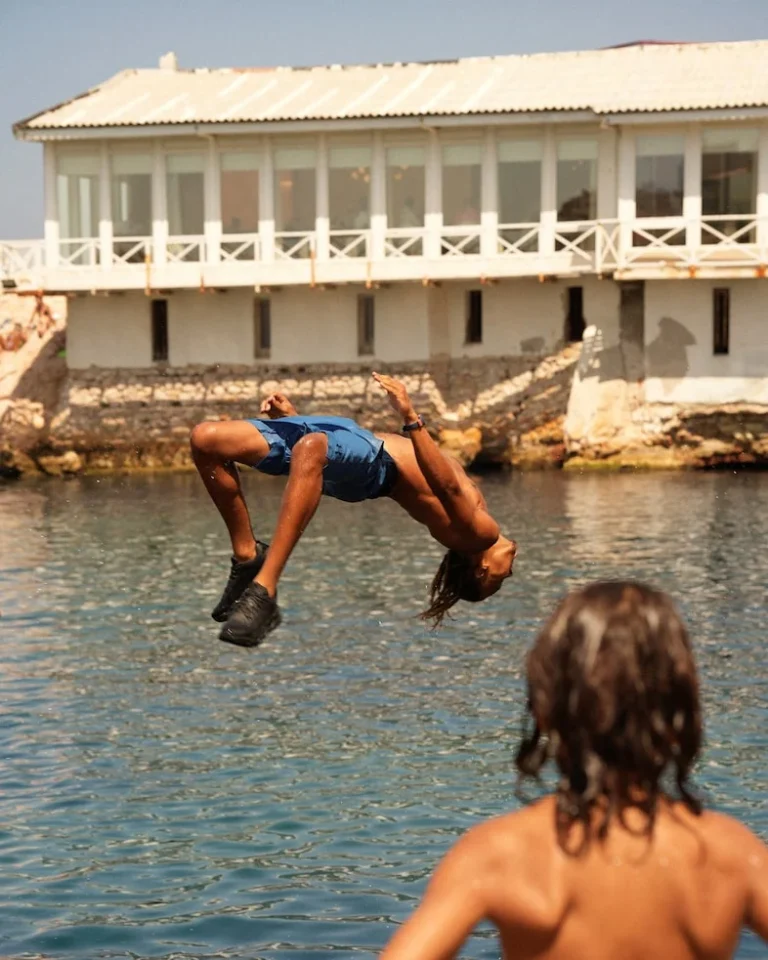






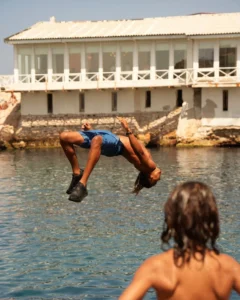

Winter Vandenbrink, the Dutch-born, Paris-based photographer, has released WOLVES, his third significant publication with IDEA, following the critically acclaimed VANDALS and TOBY. This latest photographic tome delves into the intricate dynamics of male youth, moving beyond superficial observations of style and appearance to explore the profound interplay between individual identity and collective belonging. Spanning nearly 15 years of photographic work, WOLVES represents a maturation in Vandenbrink’s artistic inquiry, challenging the very notion of singularity in adolescence and reflecting a significant evolution in his photographic methodology, shifting from detached observation to a more engaged, proximity-based practice.
The Evolution of a Vision: From Distance to Proximity
Vandenbrink’s initial approach to documenting his subjects was characterized by a deliberate distance. For years, he relied heavily on long lenses, a technique that allowed him to capture candid moments of strangers in public spaces without their immediate awareness. This method, often associated with traditional street photography, provided a degree of anonymity and non-intervention, enabling him to record authentic, unposed interactions. The resulting images frequently highlighted the "gap between a long lens and a stranger who doesn’t know they’re being watched," a signature of his early work. This observational stance, while yielding compelling results, was born, in part, from a personal discomfort with direct confrontation. "I started doing this work when I wasn’t really comfortable doing it," Vandenbrink explains. "I wanted to hide myself a little bit. That’s also why I started shooting with a long lens."
However, this initial comfort zone eventually gave way to a growing sense of ethical unease and artistic limitation. After several years, Vandenbrink found the detached approach to feel "a bit dishonest." This self-reflection prompted a fundamental shift in his practice. He began to intentionally reduce the physical and psychological distance between himself and his subjects, moving closer, becoming more visible, and fostering a potential for interaction. "I felt like I had to be in the middle of my subjects so they can see what I’m doing," he articulates. "They can ask what I’m doing. They are easy to approach." This evolution marks a significant turn, transforming his work from purely observational to a more collaborative or at least transparent engagement, allowing for a deeper, more nuanced exploration of his subjects’ realities. This transition resonates with contemporary discussions in documentary ethics, where the photographer’s role is increasingly scrutinized for its power dynamics and potential for exploitation. By embracing proximity, Vandenbrink appears to be navigating this ethical landscape with a commitment to greater transparency and mutual respect.
Chronicle of Creation: A Decade in Focus
Unlike many photographic projects conceived with a clear thematic framework from the outset, WOLVES emerged organically from an extensive archive of Vandenbrink’s work. The earliest photograph featured in the book dates back to approximately 2008, while the most recent was captured in Venice just a few months prior to publication, underscoring a nearly 15-year span of visual exploration. This long gestation period highlights the project’s roots as a retrospective excavation rather than a pre-meditated series.
The process of shaping WOLVES involved a collaborative effort that began with revisiting this vast photographic archive. Vandenbrink worked closely with his partner, Erjan, an art historian whose academic background proved instrumental. It was Erjan who introduced Vandenbrink to the seminal psychoanalytic text, One or Several Wolves? by philosophers Gilles Deleuze and Félix Guattari—a work that would ultimately provide a profound conceptual framework for the collection. This intellectual dialogue between artist and art historian was crucial in identifying the latent themes within the disparate images.
Following this initial thematic identification, a selection of photographs was passed to renowned designer Linda van Deursen. Her role was pivotal in transforming a chronological collection of images into a cohesive narrative. Van Deursen’s initial approach involved a thematic categorization based on the characteristics of wolves: "trekking, or packs, or resting, or howling, or playfulness." This analytical framework allowed for the emergence of recurring behaviors and visual rhythms that underscored the collective nature of Vandenbrink’s subjects. However, in a strategic move that elevated the book beyond a mere taxonomy, van Deursen ultimately disrupted this rigid structure. "It became more like an art photography book," Vandenbrink notes, suggesting a deliberate move towards a more fluid, evocative presentation that prioritizes artistic interpretation over scientific classification. This design choice mirrors the complex, non-linear nature of adolescent identity itself, where roles and allegiances are constantly shifting.
This creative process stands in contrast to Vandenbrink’s previous work, VANDALS, which he describes as "more portrait-heavy, more about the individual." While VANDALS focused on the visible markers of male youth culture—clothing, style, gesture—WOLVES ventures into a less tangible realm, concerned less with "what these boys wear so much as how they move," and crucially, "the individual contra group — or vice versa." This progression demonstrates Vandenbrink’s evolving interest from surface-level identification to a deeper exploration of relational dynamics.
"WOLVES" in Context: A Philosophical and Sociological Lens
The core conceptual underpinning of WOLVES draws a powerful parallel between the behavior of wolves and the intricate social dynamics of adolescent boys. Wolves are rarely perceived as solitary entities; their existence is fundamentally defined by relationships, pack formations, and collective behavior. This collectivity is central to their survival and identity. Vandenbrink’s work suggests that the same principle applies to adolescence, a period of profound identity formation where individuals often find themselves negotiating their place within a group rather than asserting absolute independence.
The Dutch-born photographer’s preoccupation with collectivity resonates deeply with the ideas presented in Deleuze and Guattari’s One or Several Wolves?, a text reprinted at the back of WOLVES. These influential psychoanalytic philosophers challenged conventional notions of individuality, proposing that identity is often an assemblage, a multiplicity, rather than a singular, fixed entity. Their provocative statement, "You can’t be one wolf, you’re always eight or nine, six or seven," encapsulates the essence of this idea. It suggests that identity, particularly within a group context, is not a monolithic self but a fluid, interconnected network of relations. For Vandenbrink’s subjects, drifting through the streets of Europe’s capitals in "loose alliances," identity is forged not through isolation but through "proximity to others," a constant negotiation of belonging within a larger social structure.
Sociologically, adolescence is a critical period for identity development, heavily influenced by peer groups. Theories by developmental psychologists such as Erik Erikson emphasize the search for identity during this stage, often expressed through social interactions and affiliations. Vandenbrink’s photographs visually articulate this developmental phase, capturing moments where boys are seen testing boundaries, establishing hierarchies, and finding comfort or challenge within their self-formed "packs." The book subtly critiques the Western cultural emphasis on radical individualism, proposing instead that for young men, identity is often a relational construct, shaped by shared experiences, unspoken codes, and the collective energy of the group. This provides a rich analytical layer to the visual narrative, inviting viewers to consider the deeper psychological and sociological undercurrents of the images.
Vandenbrink’s Oeuvre: A Trajectory of Observation
WOLVES solidifies Winter Vandenbrink’s position as a significant voice in contemporary photography, building upon the foundations laid by his previous publications with IDEA. His earlier work, VANDALS, established his keen eye for documenting male youth, focusing on the visible codes that defined their identity. VANDALS was characterized by a more direct, often portrait-heavy approach, meticulously cataloging the stylistic choices, gestures, and expressions that articulated individual and subgroup affiliations. This examination of "visible codes" — clothing, hair, posture — served as an initial inquiry into how young men present themselves to the world and to each other.
The transition from VANDALS to WOLVES represents a notable thematic and methodological progression. While VANDALS asked "what these boys wear," WOLVES probes a more elusive question: "how they move." This shift signifies a deeper dive into the intangible aspects of group dynamics, focusing on the choreography of interaction, the unspoken communication, and the subtle ways individuals coalesce into a collective entity. The book TOBY, Vandenbrink’s second publication with IDEA, further contributed to his exploration of youth portraiture, leading naturally to the more complex and nuanced group study presented in WOLVES. This trilogy demonstrates a clear artistic trajectory, evolving from the singular to the collective, from surface observation to underlying relational structures. His consistent engagement with youth culture across different European contexts underscores a sustained interest in the universal yet diverse experiences of male adolescence.
The Publisher’s Role: IDEA and Contemporary Photo Books
The publication of WOLVES by IDEA further underscores the book’s artistic merit and cultural relevance. IDEA is a London-based independent publisher renowned for its curated selection of art, fashion, and photography books, often championing works that push conceptual boundaries and offer unique visual perspectives. Their collaboration with Vandenbrink on three distinct projects—VANDALS, TOBY, and now WOLVES—testifies to the consistent quality and thematic depth of his artistic output.
Publishing in a limited first edition of 750 copies, WOLVES aligns with IDEA’s strategy of producing collectible and highly sought-after art books. This approach not only caters to a niche audience of photography enthusiasts and collectors but also reinforces the book’s status as a significant cultural artifact. The publisher’s decision to include Deleuze and Guattari’s One or Several Wolves? within the book itself is a testament to IDEA’s commitment to intellectual rigor and their understanding of the symbiotic relationship between visual art and critical theory. This integration elevates WOLVES beyond a mere collection of photographs, positioning it as a profound dialogue between image and philosophy. The publisher, by supporting such conceptually rich projects, actively contributes to the discourse surrounding contemporary photography and its capacity to illuminate complex social phenomena.
Broader Implications and Artistic Commentary
WOLVES offers more than just a photographic series; it presents a nuanced commentary on identity, belonging, and the evolving ethics of observation in photography. Vandenbrink’s journey from a distant, hidden observer to a photographer willing to place himself "in the middle of my subjects" reflects a broader shift within documentary practices. This evolution towards transparency acknowledges the agency of the photographed subjects, inviting interaction and potentially fostering a more equitable power dynamic. This approach stands in contrast to earlier photographic traditions that often privileged the photographer’s gaze, raising important questions about consent and representation.
The photographer’s position within the "pack" of his subjects remains a delicate one, embodying the very threshold described by Deleuze and Guattari: the challenge of maintaining attachment to a group without disappearing into it. Vandenbrink is "neither fully inside nor entirely outside," a precarious but ultimately honest stance that mirrors the fluid, often uncertain nature of adolescent belonging. His work invites viewers to consider not just the individuals depicted but the spaces between them—the unspoken bonds, the shared vulnerabilities, and the collective strength that defines their interactions.
Culturally, WOLVES contributes significantly to the ongoing discourse about masculinity, youth culture, and the formation of identity in an increasingly interconnected yet isolating world. In an era often characterized by curated online personas and the fragmentation of traditional communities, Vandenbrink’s work reminds us of the enduring human need for collective experience and the profound impact of peer groups on self-discovery. By focusing on European capitals, the photographs also subtly hint at the transnational nature of youth culture, where local specificities meet global trends. WOLVES is therefore not merely a documentation of young men; it is a profound visual meditation on the universal quest for belonging, rendered with empathy, philosophical depth, and a compelling artistic vision that challenges both the subject and the observer. Its contribution lies in its ability to bridge the gap between sociological observation and artistic expression, offering a powerful and timely reflection on the complexities of human connection.