









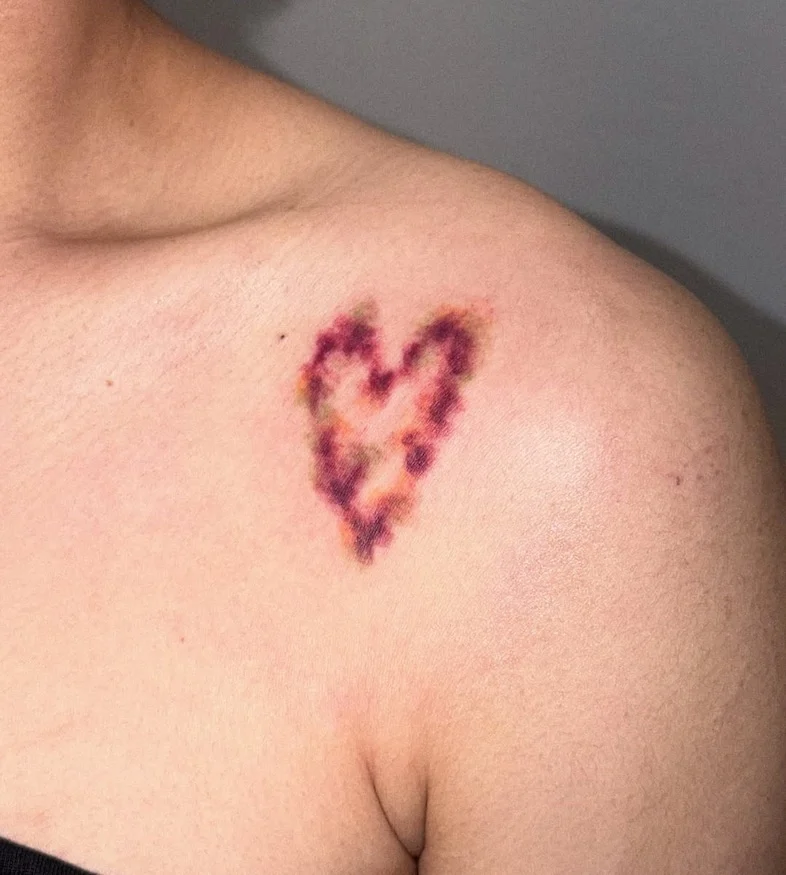
New styles emerge rapidly within contemporary tattoo culture, but few have drawn as much attention in recent years as bruise-like tattoos. Often incorporating the purples, pinks, greens, and yellows characteristic of actual contusions, these designs transcend traditional tattoo aesthetics. They can be arranged in whimsical heart shapes, filtered through softened pastel hues, or rendered as strikingly literal depictions of harsh bruising on the skin. This inherent versatility and realism, however, inspire a complex mix of reactions, with some people finding them deeply uncomfortable or distasteful due to their uncanny resemblance to real-world injury, while others laud them as a groundbreaking form of artistic expression.
The Genesis in Seoul: Pioneers of a New Aesthetic
Many of these polarizing designs first emerged from the vibrant and innovative tattoo scene of South Korea, before rapidly circulating and gaining global traction through the expansive reach of the internet. Seoul, a recognized hub for cutting-edge fashion and artistic trends, became the crucible for this unique form of body art. Among the early pioneers is the Seoul-based tattoo artist Limhanbee, whose distinctive designs frequently reimagine the often-unpleasant reality of bruises through soft washes of pink, green, and blue. In a reflective caption shared to their extensive Instagram following, Limhanbee articulated a profound affinity for these particular designs, stating, “a bruise is both a trace of pain and evidence of recovery. I came to appreciate that duality, and I wanted to leave that moment, where pain and healing coexist on the body.” This philosophical approach underscores an intention to capture a transient, yet deeply significant, human experience and render it permanent.
Another pivotal figure in this movement is Hyang-mong, also a Seoul-based tattoo artist, who found her inspiration for bruise-like tattoos through her personal experiences with pole dancing. She became fascinated by how the same athletic movements could leave an array of different shapes, colors, and patterns across her skin each time, a testament to the body’s dynamic response to physical exertion. “Many of them looked almost like small galaxies or pieces of the universe,” she remarked, highlighting the unexpected beauty she discovered in these temporary marks. Recognizing that real bruises eventually fade and disappear, Hyang-mong expressed a desire “to give that beauty a sense of permanence,” transforming ephemeral marks into enduring art.
Seoul-based tattoo artist Kim Daeo further contributes to this avant-garde movement, with designs that often resemble emblems of inflamed skin or clusters of bruising meticulously arranged across the body. His journey into this style was driven by a quest for artistic originality. “I was searching for a method that couldn’t be easily replicated by just anyone, which led me to experiment with layered color combinations and techniques,” Kim Daeo explained. This pursuit of unique technical mastery speaks to the innovative spirit driving many artists in this niche. He acknowledges that the public reaction to these tattoos is often immediate but frequently uncertain. “I think many people still find these kinds of color tattoos unfamiliar. People definitely react to them as something visually different and unexpected, but there are also people who respond very positively because it feels like something they’ve never seen before,” he noted, emphasizing the novelty and boundary-pushing nature of his work.
Beyond Skin Deep: The Artistic and Cultural Context
The adoption of bruise aesthetics extends beyond tattooing, signifying a broader cultural inclination to find beauty in the unconventional and even the uncomfortable. Removed from their immediate context of pain, the visual characteristics of bruises — their shifting hues, organic shapes, and textural qualities — make them visually fascinating to artists across various mediums. This fascination has led to their innovative adoption in fields such as make-up artistry and nail art, where the transient nature of real bruises can be recreated and stylized.
Kraków-based nail artist Danusia, known for her experimental approach, embodies this philosophy. Her extensive portfolio includes multiple bruised nail sets, alongside other intriguing concepts like mold-spore nails and dirty detritus designs. “I always try to find inspiration in things that aren’t conventionally beautiful,” Danusia states, encapsulating the ethos behind her work. For her, bruises offer a rich visual lexicon: “Bruises give you a beautiful color palette. I also appreciate the unpredictable shapes that your own body can create.” This perspective highlights a conscious move away from idealized, flawless aesthetics towards an appreciation of organic imperfection and the body’s natural processes.
The appeal of bruise-like tattoos and related aesthetics reflects a wider cultural trend in which signs of injury, discomfort, and the imperfect human condition are increasingly being utilized as aesthetic material. This phenomenon signifies a significant shift in contemporary beauty standards, moving beyond traditional notions of polished perfection. In a previous article for Dazed, SFX artist Tilda Mace eloquently described this as a deliberate move toward utilizing discomfort as a creative tool. “I think creating discomfort within a look brings us opportunities to step over that line of normality and comfort, wandering into new territory where we test how others react,” she explained. Mace further elaborated on the motivations of artists pushing these boundaries: “We are artists creating in a society where all typical beauty trends are being subverted, and we are testing the boundaries of what we can bring to the table artistically.” This analytical framework suggests that these aesthetic choices are not merely superficial but represent a conscious challenge to established norms, probing the limits of what is considered beautiful or acceptable in art and body modification.
The Digital Catalyst: Social Media’s Role in Globalizing Trends
The rapid global diffusion of bruise-like tattoos owes a significant debt to social media platforms, particularly Instagram. In an era where visual content dictates trends, platforms like Instagram provide an unparalleled stage for artists to showcase their work to a global audience instantly. South Korean tattoo artists, known for their adeptness in leveraging digital platforms, were able to bypass traditional art gatekeepers and directly connect with potential clients and enthusiasts worldwide. High-quality photographs and short videos showcasing these unique designs quickly went viral, attracting attention from international media, tattoo blogs, and individual users eager to explore novel forms of self-expression.
This digital virality created a feedback loop: increased exposure led to higher demand, which in turn encouraged more artists to experiment with the style. The visual distinctiveness of bruise tattoos made them highly shareable, sparking conversations and debates across online communities. This organic, social media-driven propagation accelerated what might have otherwise been a much slower, regional trend, transforming it into a global phenomenon in a remarkably short period. The timeline of this trend can be broadly traced from niche experimentation in Seoul in the late 2010s to widespread internet recognition and adoption by artists globally by the mid-2020s, a testament to the power of digital platforms in shaping contemporary culture.
Navigating Public Perception: Reactions and Dialogue
The public reception to bruise-like tattoos remains markedly divided, reflecting deeply held societal views on pain, injury, and aesthetic representation. On one hand, proponents celebrate the artistic innovation, the challenging of conventional beauty standards, and the poignant symbolism articulated by artists like Limhanbee and Hyang-mong. They see these tattoos as a form of reclaiming narratives around injury, transforming marks of vulnerability into statements of resilience or unique beauty. The subtle gradients and vibrant color palettes are appreciated for their artistic merit, independent of their representational meaning.
On the other hand, a significant segment of the public expresses discomfort or outright distaste. For some, the resemblance to actual physical harm can evoke feelings of unease, particularly for individuals who have experienced trauma or who find the aestheticization of injury problematic. Critics argue that such tattoos might inadvertently trivialize or romanticize suffering, or that they could be misinterpreted by others, leading to unwarranted concern or judgment. There are also concerns from a public health perspective regarding the potential psychological impact of constantly displaying what appears to be an injury, even if it is purely aesthetic. This divergence in opinion underscores the powerful emotional and psychological resonance that body art can carry, especially when it touches upon universal human experiences like pain and healing.
Textural Tattoos: A New Paradigm for Body Art
Bruise-like tattoos are not an isolated phenomenon but sit within the broader, growing popularization of textural tattoos. This emergent trend signifies a departure from the long-standing tradition of tattoos relying solely on clear-cut outlines and two-dimensional imagery. Instead, many contemporary approaches prioritize altering how the body appears at a surface level, introducing elements such as gradients that simulate depth, etchings that mimic natural surfaces, or scale-like patterns that suggest organic textures directly onto the skin.
This new emphasis on tactility and the body’s surface condition may reflect a broader cultural fatigue with a visual landscape saturated by images. In an age dominated by artificial intelligence-generated content, hyper-processed digital media, and an incessant cycle of images circulated, digested, and discarded at record speed, there is a growing yearning for authenticity and tangible experience. This context lends meaning to the interest in tattoos that make the skin appear as though it is in a particular condition — be it bruised, scarred, or textured — rather than simply serving as a flat canvas for displayed images.
In this way, bruise tattoos represent a profound expansion of how we conceptualize and interact with the body. They challenge the notion of the skin as a pristine, unchanging surface, instead presenting it as a dynamic medium capable of embodying diverse states and narratives. This trend signifies an increasing openness to exploring the various physical and emotional states the body inhabits, transforming temporary marks of experience into permanent, artistic expressions. It marks a significant shift in tattoo culture, moving towards a more experiential, nuanced, and perhaps more provocative form of self-expression that continually tests the boundaries of art, beauty, and public perception.
Implications for the Tattoo Industry and Future Trends
The rise of bruise-like and textural tattoos carries significant implications for the global tattoo industry. It necessitates that artists expand their technical repertoires, moving beyond traditional linework and shading to master complex color layering, gradient application, and the simulation of three-dimensional texture. This also opens new avenues for specialized training and artistic development within the industry.
From a market perspective, this trend signifies a diversification of client preferences, indicating a growing demand for unique, non-traditional tattoo styles that push artistic and conceptual boundaries. Tattoo studios that embrace and promote such innovative styles are likely to attract a clientele seeking bespoke and highly individualized forms of body art. Industry reports, which consistently show a steady growth in the global tattoo market (projected to reach approximately $2.7 billion by 2029, driven by increasing youth adoption and diversified aesthetic preferences), suggest that embracing niche yet impactful trends like bruise tattoos is crucial for continued innovation and market relevance.
Looking ahead, the emergence of bruise-like tattoos points towards a future where body art is increasingly experimental, introspective, and challenging. It suggests a continued evolution away from purely decorative or symbolic tattoos towards those that engage more deeply with the body’s narrative, its vulnerabilities, and its inherent beauty in all its forms. As artists continue to test the boundaries of what is considered tattooable, and as society continues to grapple with and redefine beauty, trends like bruise tattoos will undoubtedly remain a fascinating and important part of the ongoing dialogue surrounding art, identity, and the human form.