








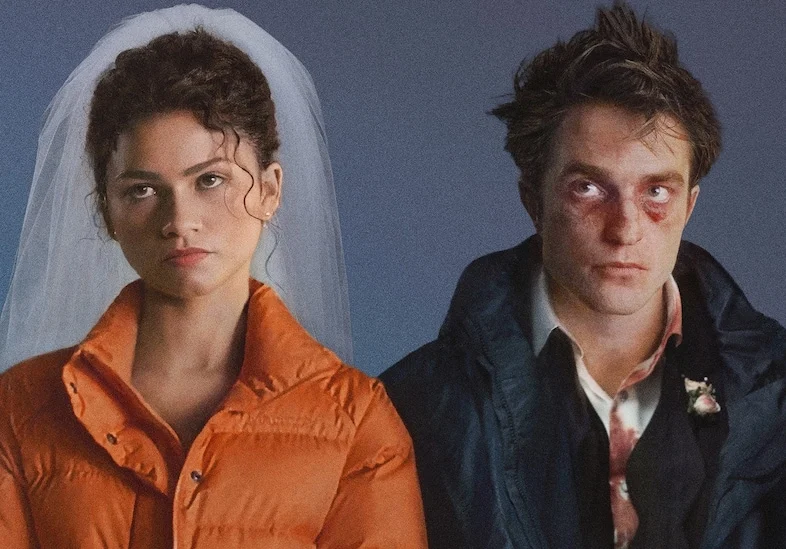
The 2026 film The Drama, directed by Kristoffer Borgli and starring Zendaya and Robert Pattinson, has ignited significant public discourse by delving into the complex and often uncomfortable intersection of adolescent identity, online culture, and the aestheticization of extreme violence, particularly school shootings. The film centers on Emma (Zendaya), a young woman who confesses to her fiancé, Charlie (Robert Pattinson), that as a teenager, she meticulously planned a school shooting but ultimately did not carry it out. Her unsettling motivation, as she explains, was primarily "the aesthetics of it," a revelation that forces both Charlie and the audience to confront the unsettling allure of transgression in contemporary society.
The Genesis of an Aesthetic: From Columbine to Online Subcultures
The film opens with a cultural touchstone that immediately grounds its premise in a recognizable, albeit disturbing, reality. An episode of the animated TV show Smiling Friends features an anthropomorphic shrimp attempting to adopt an "actual adult" look, only to emerge in an outfit—a leather trenchcoat, thick glasses, and a black metal t-shirt—that prompts the observation: "You look like you’re about to tell your friend not to come to school tomorrow, man." This satirical moment, noted in the original commentary, highlights the deeply ingrained visual stereotype of the school shooter, an image indelibly etched into the public consciousness since the Columbine High School massacre in 1999.
The Columbine tragedy, which claimed the lives of 12 students and one teacher, fundamentally altered the perception of school violence and, inadvertently, birthed an enduring aesthetic. The perpetrators, Eric Harris and Dylan Klebold, often wore trench coats and cultivated a dark, alienated image that was quickly sensationalized and stereotyped by media outlets. This initial framing, combined with the nascent power of the internet, led to the rapid proliferation and, disturbingly, the idolization of this aesthetic. Online forums, and later platforms like YouTube and Tumblr, became breeding grounds for communities that dissected, romanticized, and sometimes emulated the imagery associated with school shooters. This "Columbine effect" has been linked to numerous copycat incidents across North America and Europe, including the tragic Sandy Hook Elementary School shooting in 2012, demonstrating the profound and devastating real-world impact of online cultural phenomena.
Emma’s Journey: Performance, Aspiration, and Activism
The Drama explores Emma’s past with a nuanced lens, portraying her not as inherently malicious, but as a product of her environment, grappling with feelings of isolation and a desire for significance. Her confession reveals that her mild bullying and social marginalization at school led her not to seek revenge, but to be drawn to the "subculture" surrounding school shootings. Her interest, she clarifies, lay in the visual and symbolic power of the act, the perceived identity it offered, rather than the violence itself.
Borgli’s narrative makes Emma’s seemingly shallow motivation believable by illustrating her preoccupation with performance. She spends more time staging "swamp selfies" with her father’s rifle and recording cliché-laden confessions than in actual preparation for violence. Her eventual dissuasion from the act by a concurrent, unrelated mass shooting and her subsequent pivot to becoming a spokesperson for a gun violence prevention organization underscore this performative aspect. She appears less interested in committing a heinous act than in embodying "the kind of person" who might, and later, "the kind of person" who advocates against it. This raises a central question posed by the film: Is Charlie marrying the "real" Emma, or is her "normal" adult persona just another role in a lifelong series of performances, a form of live-action role-playing (LARPing) that extends deep into adulthood? This narrative arc resonates with contemporary discussions about identity formation in the digital age, where self-presentation and curated personas often blur the lines between authenticity and performance.
The Internet’s Influence and Generational Divides
The film explicitly implicates the internet as a significant catalyst for this fascination with transgression. As one X (formerly Twitter) user succinctly put it, "The Drama is all about what it’s like when a millennial starts dating someone from Gen Z and they find out what unsupervised internet access does to a mf." While Emma isn’t strictly Gen Z, the implied age gap highlights a generational divergence in online experiences. Older generations, including many millennials, encountered the internet in its nascent stages, gradually adapting to its evolving landscape. Younger generations, however, grew up with ubiquitous, often unsupervised, internet access, leading to different forms of cultural immersion, identity formation, and exposure to extreme content. This constant digital immersion fosters an environment where images and narratives, particularly those associated with counter-culture or transgression, can be consumed, recontextualized, and adopted with ease, often detached from their original gravity or real-world consequences.
The "Columbine effect" serves as a stark historical precedent for this phenomenon. The idolization of school shooters on platforms like YouTube and Tumblr in the years following the tragedy led to the formation of cultish online communities. These groups often romanticized the perpetrators, creating fan art, fictional narratives, and even "manifestos" that glorified violence and alienation. Such communities not only provided a sense of belonging for disaffected youth but also, as law enforcement agencies have documented, inspired numerous copycat plots and actual attacks. The film suggests that Emma’s aesthetic fixation is a continuation of this digital inheritance, a symptom of an online world where extreme acts can be stripped of their horror and re-packaged as a compelling, albeit dangerous, aesthetic.
Beyond the Screen: Art, Fashion, and the Allure of the Extreme
While the internet plays a crucial role, The Drama acknowledges that the attraction to transgression extends beyond digital realms. Offline, artists, designers, musicians, and filmmakers have long maintained a complex, often tangled, relationship with extreme subcultures. The film itself features a book titled Brain Rot on Charlie’s museum desk, depicting sexualized portraits of women with guns, contributing to his fantasies about Emma. This element subtly illustrates how even within ostensibly mainstream cultural institutions, disturbing imagery can pervade and influence perceptions.
Historically, this interplay has manifested in numerous public controversies. In the aftermath of Columbine, musician Marilyn Manson became a scapegoat, with moral panic linking his music to the shooters’ actions—a connection he vehemently rejected. Years later, in 2019, the fashion brand Bstroy faced widespread condemnation for promoting hoodies emblazoned with the names of school shooting sites like Columbine, Sandy Hook, and Stoneman Douglas, complete with bullet holes. Critics accused the brand of tasteless exploitation, while the designers claimed to be making a statement about gun violence.
More recent examples further illustrate this complex relationship. Kanye West, for instance, has controversially drawn inspiration from the violent, often racist subculture of European football ultras, long before his more explicit flirtations with antisemitic imagery. The Dimes Square cultural movement has also been scrutinized for its "edgelord" flirtations with far-right ideas and iconography, including the normalization of gun violence rhetoric. Perhaps one of the most visible recent instances involved the "looksmaxxing" influencer Clavicular, who walked the runway at an Elena Velez show in New York City, staged in collaboration with the notorious collective Remilia Corporation, despite (or perhaps because of) his connections to controversial figures like Nick Fuentes and Andrew Tate. These instances highlight a recurring tension in contemporary culture: the desire to provoke, to challenge norms, and to comment on societal ills often risks crossing the line into glorification or legitimization of harmful ideologies.
The Blurry Line: Critique, Glamorization, and Ethical Dilemmas
It is crucial to differentiate between these various examples in terms of their intent and impact. Not all transgressive art, fashion, or film is created equal. In many cases, aesthetics are employed as a tool for critique, a means to reflect or challenge the extremes of the culture we inhabit. Artists might utilize shocking imagery to force audiences to confront uncomfortable truths, provoke dialogue, or expose underlying societal issues. However, other instances might be better described as mindless provocation, a superficial attempt to generate outrage for attention, or, at worst, a wholehearted embrace of violence, xenophobia, or other harmful ideologies.
The challenge lies in discerning where the line between critique and glamourisation blurs, a task made exponentially more difficult in online spaces. On platforms like Tumblr or Instagram, images are often divorced from their original context, copied, pasted, and re-shared on mood boards, losing their intended critical commentary and potentially acquiring new, unintended meanings. This decontextualization can transform a nuanced artistic statement into a seemingly celebratory or neutral depiction of violence, making it easier for impressionable individuals to internalize dangerous aesthetics without understanding the underlying critical intent. The ethical responsibility, therefore, falls not only on the creators to be clear in their messaging but also on the audience to engage critically with the content they consume, particularly in an era where digital dissemination is instantaneous and pervasive.
Reactions and the Film’s Broader Implications
The Drama‘s engagement with these themes has, predictably, generated significant criticism. While the film’s nuanced portrayal of Emma’s motivations might make her past "forgivable" for some viewers—seeing her as a product of cultural immersion in glamorized gun violence—others have strongly condemned its approach. The anti-gun organization March for Our Lives issued a statement on Instagram, questioning: "What kind of conversation is this meant to start?" Similarly, a parent of a Columbine victim and gun reform activist told TMZ that the filmmakers’ choice was "awful," arguing that it could "normalize" shootings and "humanize" perpetrators, thereby undermining efforts to prevent future tragedies. These criticisms underscore the profound sensitivity surrounding the issue of gun violence, particularly in a country still grappling with its devastating consequences.
However, a more nuanced perspective was offered by Jackie Corin, a survivor of the Parkland school shooting and co-founder of March for Our Lives, in an interview with The Hollywood Reporter. Corin described The Drama as "an inevitable evolution in storytelling" as gun violence becomes increasingly embedded in public discourse. While acknowledging she hadn’t yet seen the film, she emphasized the capacity of art to "deepen public understanding and create emotional clarity and awareness." Yet, she also cautioned that art can "flatten and distort reality, especially when it leans on shorthand or tries to make something more palatable than it actually is. With something like a near school shooting, even small tonal choices can shift whether a story feels productive or dismissive."
Corin’s statement highlights the immense responsibility inherent in tackling such sensitive subjects. The "tonal choices" of a film, its visual language, its script, and its marketing—as evidenced by A24’s campaign—all contribute to how it is received and interpreted. Whether The Drama ultimately falls into the category of mindless provocation that exploits the imagery of America’s gun violence crisis, or whether it functions as a work of art that inspires genuine engagement with its causes and long-term fallout, remains a subject of intense debate. Borgli, through The Drama, forces audiences to confront the uncomfortable truth that aesthetics, and what we choose to do with them, carry profound weight and can have far-reaching ethical implications in a society grappling with the pervasive shadow of violence. The film serves as a potent reminder that in an increasingly visual and digitally mediated world, the power of imagery is not merely superficial but deeply interwoven with our understanding, and perhaps even our experience, of reality.