




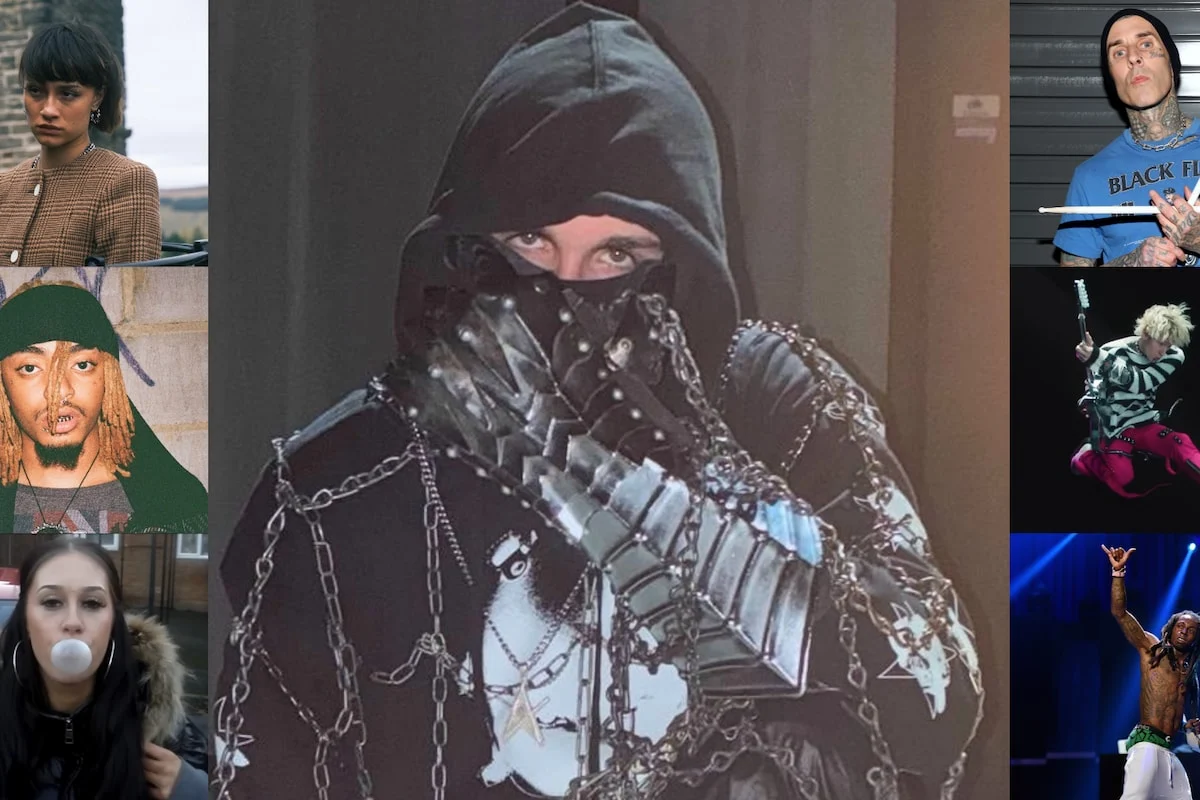
The spring 2026 issue of Dazed highlights a compelling cultural phenomenon epitomized by Liverpudlian MC EsDeeKid, whose debut album Rebel boldly self-identifies with the "emo" aesthetic. Far from the withdrawn, self-deprecating stereotype that defined mainstream emo in the 2000s, EsDeeKid, often seen "ballied up in luxury streetwear," declares on "Phantom" an "emo boy, I got the party lit," and boasts on "Mist" about his "long black hair like an emo" alongside references to high-calibre drugs. This unlikely juxtaposition of emo, trap, jerk, and drill influences, both sonically and visually, marks a significant evolution in youth culture, signalling a post-genre landscape where traditional cultural barriers have largely dissolved. The emergence of a masked artist rapping about working-class life while sporting antique silver gauntlets and a Benny’s Video shirt is, in this new context, remarkably coherent.
EsDeeKid: The Vanguard of a New Aesthetic
EsDeeKid’s artistry is a vivid manifestation of a pronounced culture clash: the gritty realism of working-class British life and lingo colliding with the introspective, often melancholic, aesthetics of alternative subcultures. This collision, as hinted by EsDeeKid himself in a November 2024 post on X – "chav bird said i’m sexy for a emo" – underscores a fascinating shift. By the mid-2020s, UK youth culture has become a complex tapestry woven from "chav" and "emo" touchstones, two subcultures that, despite their diametrically opposed origins in the 2000s, have made simultaneous comebacks, largely fueled by Gen Z’s nostalgia for an era perceived as less burdened by ubiquitous technology.
The 2000s saw chavs and emos as "natural opps." Chavs, often associated with perceived material excess and conventional beauty standards, were resented by emos. Conversely, emos, much like the goths before them, faced bullying from chavs for projecting emotional vulnerability and adopting unconventional fashion. British adolescence during this period was, for many, a protracted "turf war," with disputes often escalating to violence. This historical animosity, however, obscured deeper commonalities. Both were maligned subcultures, burdened with derogatory labels – "emo" often used as a homophobic slur, and "chav" as a demonizing caricature of the working class. Both subcultures utilized their distinct imagery as a form of armour against insecurities, and, perhaps surprisingly, both embraced the use of concealer as lipstick, albeit for different stylistic effects.
The Digital Age and the Dissolution of Subcultural Divides
Two decades later, this hostile relationship is barely recognizable. The advent and proliferation of the internet have fundamentally reshaped cultural consumption, largely obliterating rigid allegiances to specific "tribes" and the conflicts that once defined them. In this new era, driven by algorithms and an endless "grab-bag" of content, every historical movement or music genre has achieved a relatively equal footing within the collective cultural imagination. Divorced from their original social contexts and often the prejudices that accompanied them, cultural elements are now freely sampled and reinterpreted. This phenomenon is akin to William S. Burroughs’ cut-up technique, where disparate pieces are rearranged to form new narratives and aesthetics, fostering a frictionless blending that previous generations would have found unthinkable.
Emo’s Enduring Legacy and Its Embrace of Rap
Despite being frequently associated with the "Myspace days" of millennial youth, emo has maintained a consistent presence in pop culture for decades, fully integrating into the mainstream by the mid-2000s. Artists who honed their craft in underground hardcore shows found themselves sharing chart space with global superstars like Nelly and Beyoncé, their sounds fusing with genres previously thought incompatible. This commercial imperative often thrust disparate acts into the same ecosystem; a notable example being New Jersey emo legends Thursday signing with Island Def Jam in 2002, with Lyor Cohen, mentor to Kanye West, as a vocal advocate.
By the early 2010s, emo had transitioned from a distinct genre to a pervasive influence. Its DNA can be traced across a multitude of emerging subcultures, from K-pop’s dramatic aesthetics to hyperpop’s emotional intensity, and its resonance is palpable throughout the contemporary chart landscape. Artists such as Billie Eilish, The 1975, Olivia Rodrigo, and even Taylor Swift have demonstrably drawn inspiration from emo’s lyrical introspection and sonic textures. However, emo’s most profound and lasting impact has arguably been on the rap genre.
The late 2000s and early 2010s witnessed a significant blurring of the lines between emo and rap. This fusion manifested through high-profile collaborations, such as Fall Out Boy and Lil Wayne’s "Tiffany Blews," and the emergence of hybrid genres like crunkcore – an abrasive blend of crunk and hardcore. Even acts like Gym Class Heroes defied easy categorization, embodying this cross-pollination. While not directly emo in production, the rise of "backpack rap" introduced emo’s characteristic introspection and sensitivity into new lyrical territories. This lineage continued with Kid Cudi, who paved the way for Yung Lean and the Sad Boys collective, whose melancholic, avant-garde approach left a lasting impression. This trajectory further evolved with artists like Juice WRLD and Lil Peep, who mainstreamed "emo-rap," culminating in Machine Gun Kelly’s 2022 single "emo girl" featuring Willow Smith, notably produced by Blink-182 drummer Travis Barker. Of these movements, the solitary and avant-garde ethos of the Sad Boys era has left the most indelible mark on contemporary youth culture, profoundly influencing the new wave of UK Underground ("UK Ug") rappers, including EsDeeKid, who are now seamlessly integrating chav and emo aesthetics.
The UK Underground: A Regional Crucible of Hybridity
Beyond EsDeeKid, the UK Ug scene is fertile ground for this new cultural synthesis. His collaborators, Rico Ace and SINN6R, also draw from a vast array of references, spanning from David Bowie’s theatricality to Skrillex’s electronic aggression and the dark introspection of $uicide Boy$, crafting sonic worlds that are simultaneously deeply personal and defiantly antisocial. Jim Legxacy, hailing from Lewisham, has spent recent years meticulously blending emo, drill, glitch, and Afrobeats into a distinctive patchwork sound, a direct reflection of the chaotic circumstances of its creation; his debut mixtape, Homeless Ngga Pop Music*, was famously recorded during a period of homelessness.
From Norfolk, bedroom drill producer Ledbyher offers her own unique interpretation. Her 2024 track "LEECHES" opens with a satirical public service announcement about the criminalization of "colour," urging submission of "vibrant emissions to local enforcement centres." This plays over a monochrome montage of rave and riot footage, featuring youth with face tattoos, winged eyeliner, and mouth jewellery, before the camera transitions to a tower block where Ledbyher – strikingly reminiscent of a My Chemical Romance enthusiast – delivers a contemplative verse about feeling emotionally depleted. These artists collectively illustrate the rich tapestry of the UK Ug, where genre boundaries are not merely blurred but actively dismantled and rebuilt.
The Resurgence of Chav Culture: From Derision to Digital Rebellion
While the invocation of emo in the context of "getting the party lit" might be jarring to older generations, it is the re-emergence of "chav" references that feels particularly distinct within UK Ug. The resurgence of chav culture has been a broader phenomenon. Earlier in the decade, a viral "chav makeover" TikTok trend saw creators worldwide exaggerating eyebrows and applying heavy foundation in an attempt to emulate the "Nicole in Year 10" archetype of 2004. While this trend often felt laden with the same class-based prejudice that defined the 2000s, targeting a type of girl often demonized by wider society, it undeniably brought the archetype back into public consciousness.
More recently, chav-era signifiers – such as digicams, labret piercings, and cropped puffer jackets with fur hoods – have resurfaced with a greater degree of affection, re-contextualized as symbols of social dissidence and "digital rebellion." This affectionate re-appraisal is clearly visible in the music video for Sheffield rapper and producer Young Eman’s hit "pop star in da bits." Shot in the style of a classic Channel U broadcast, the video features young people in tracksuits and large hoop earrings, swigging cans and congregating in economy cars on a council estate, authentically capturing the essence of a bygone era.
Parallel to this, numerous text-over-video social media accounts, like @lordoldgen, humorously mine the aspirational, Grey Goose-drinking, bassline-loving British youth culture of the 2000s for "banter." Another notable example is @Vuncle205, an Alabama-based TikToker whose obsession with Scouse culture led him to spend summer 2025 attending matches at Anfield Stadium and experiencing Toby Carveries. While much of this engagement is tongue-in-cheek, it reveals a genuine affection for this "lost world" and its characters, unburdened by the self-awareness that pervasive digital existence has instilled. In fact, a significant part of the contemporary appeal of the chav stereotype lies in its perceived grit, fierce individuality, and utter disregard for external opinions – precisely the qualities for which it was initially admonished.
Regional Roots and Sociological Underpinnings
It is noteworthy that many prominent UK Ug artists originate from outside London, a detail highly relevant to their unique re-workings of turn-of-the-century subcultures. While not exclusively regional constructs, the chav-versus-emo binary was significantly more pronounced in smaller cities and towns. Their presence was more overt, and their tensions often heightened, partly due to the limited alternative cultural outlets available. The vast majority of UK emo artists historically hailed from rural and post-industrial areas, clustering prominently in South Wales and Northern England. These are precisely the economically abandoned regions where the "chav" construct thrived, often deployed as a means to mutate working-class identity from a proud and organized workforce into a caricatured, mindless group of criminals associated with knock-off luxury brands.
In places like Sheffield and Liverpool, the clash between chav and emo subcultures was particularly intense, yet paradoxically, they were also forced into closer proximity and coexistence. Over time, these two distinct identities were thrown into the same "cultural soup," where the intense emotional responses of their original enthusiasts have dissolved into an intriguing, frictionless "past." From a deeper sociological perspective, both identities initially exerted a gravitational pull on teenagers who felt alienated or failed by society, prompting them to forge their own distinct ways of rejecting it. Given the widespread "doomerism" and the perceived absence of opportunity that characterizes the economic landscape for Gen Z, it is hardly surprising that Y2K subcultures are resurfacing now, forming new hybrids that give us drill beats layered with midwestern guitar riffs, and trap-house anthems celebrating emo lads "doing packet" in a Lamborghini.
Ultimately, the resurgence of Y2K emo and chav aesthetics reflects their enduring appeal as longstanding subcultures with strong visual languages. These aesthetics are now readily accessible to a new generation of British teens for whom the rigid, pre-digital tribal allegiances hold absolutely no weight. They are simply part of the vast, ever-expanding cultural mix. This summer, EsDeeKid is scheduled to perform at the annual UK hardcore festival Outbreak, delivering lyrics in a thick Scouse accent about Jürgen Klopp at an event headlined by Deftones. This scenario is more than a mere curiosity; it is a profound declaration that the old world of rigid subcultural boundaries is dead, and the new world, in its vibrant, fluid embrace of everything, doesn’t even realize how radically it has transformed.