







Rosalía’s Evolving Aesthetic: From Motomami to Meditative to Movement
Rosalía Vila Tobella, globally recognized simply as Rosalía, has consistently leveraged fashion as a powerful extension of her artistic expression, with each musical era marked by a distinct visual identity. Prior to her current "Lux" phase, the artist captivated audiences with the futuristic, biker-chic, and highly stylized aesthetic of her groundbreaking Motomami era. This period, characterized by sleek silhouettes, racing gear-inspired elements, and a fierce, empowered femininity, solidified her reputation not just as a musical innovator but also as a fashion disruptor unafraid to challenge norms and embrace avant-garde trends. The Motomami aesthetic became a global phenomenon, influencing streetwear and high fashion alike, and demonstrating Rosalía’s profound impact beyond the charts.
Following the high-octane energy of Motomami, Rosalía transitioned into her "Lux" era, adopting a noticeably more introspective and pious aesthetic. This phase saw her incorporating elements reminiscent of monastic wear, religious iconography, and a more subdued color palette, often featuring flowing fabrics, veils, and minimalist designs. This shift was widely interpreted as a reflection of a deeper artistic exploration, perhaps a commentary on fame, spirituality, or a return to more traditional sartorial roots, albeit with a contemporary twist. The "neo-nun" persona, as it was colloquially termed, represented a deliberate move away from the overt sensuality of Motomami, showcasing Rosalía’s versatility and willingness to explore contrasting facets of her identity.
However, the "Lux" era itself has proven to be a dynamic canvas, with Rosalía’s style undergoing a gradual yet significant evolution within its framework. The meditative austerity began to intertwine with elements of movement and performance, leading to the emergence of a distinctive "balletcore" aesthetic. This transition was not abrupt but rather a thoughtful integration of new inspirations, seamlessly blending the solemnity of the "Lux" period with the grace and discipline of classical dance. The shift signaled a renewed focus on the body in motion, an intrinsic element of Rosalía’s electrifying live performances.
The Genesis of Balletcore: Onstage Performance and Personal Dedication
The seeds of Rosalía’s balletcore journey were first sown at the commencement of her world tour earlier this year. A dedicated segment within her concert for the album track "Porcelana" marked the debut of this new artistic direction. For this poignant performance, Rosalía embraced the traditional iconography of ballet, wearing a custom Ann Demeulemeester tutu. Her execution of fundamental ballet movements, including pliés and pirouettes, on stage was met with critical acclaim, showcasing not only her artistic commitment but also a surprising proficiency in an entirely new discipline. The choice of Ann Demeulemeester, a brand celebrated for its romantic yet often deconstructed and dark aesthetic, offered a subtle foreshadowing of the subversion to come, blending classicism with an underlying avant-garde sensibility.
As the tour progressed, Rosalía’s commitment to the ballet theme intensified, culminating in an elevated sartorial statement for the "Porcelana" section. She upgraded her stage attire to a custom Dior ensemble designed by Jonathan Anderson. Anderson, known for his innovative and often surrealist approach to design at both Loewe and his eponymous label, proved an ideal collaborator for Rosalía’s evolving vision. His ability to blend historical references with contemporary deconstruction allowed for a sophisticated reinterpretation of the ballet aesthetic, demonstrating a clear escalation in Rosalía’s engagement with high fashion houses for this specific artistic narrative. This collaboration underscored the serious intent behind her ballet exploration, positioning it as a significant artistic project rather than a fleeting trend.
Beyond the stage, Rosalía offered her global fanbase an intimate glimpse into her personal dedication to ballet. Through a series of progress pictures posted on her Instagram ahead of her Miami tour stop, she revealed herself diligently practicing in pointe shoes and comfortable sweats. These candid glimpses into her training regimen resonated deeply with followers, highlighting the physical discipline and authentic commitment required for such an endeavor. The images underscored that her embrace of balletcore was not merely a stylistic affectation but was rooted in genuine engagement with the art form. The authenticity of her efforts garnered an unexpected endorsement from the prestigious Miami City Ballet, which playfully hyped her up in the comments section, further cementing her credibility and cultural impact. The humorous online exchange, which included a meme reference to actor Timothée Chalamet, demonstrated the pervasive reach of Rosalía’s influence across diverse cultural spheres.
The New York Ensemble: A Radical Deconstruction of Ballet Tradition
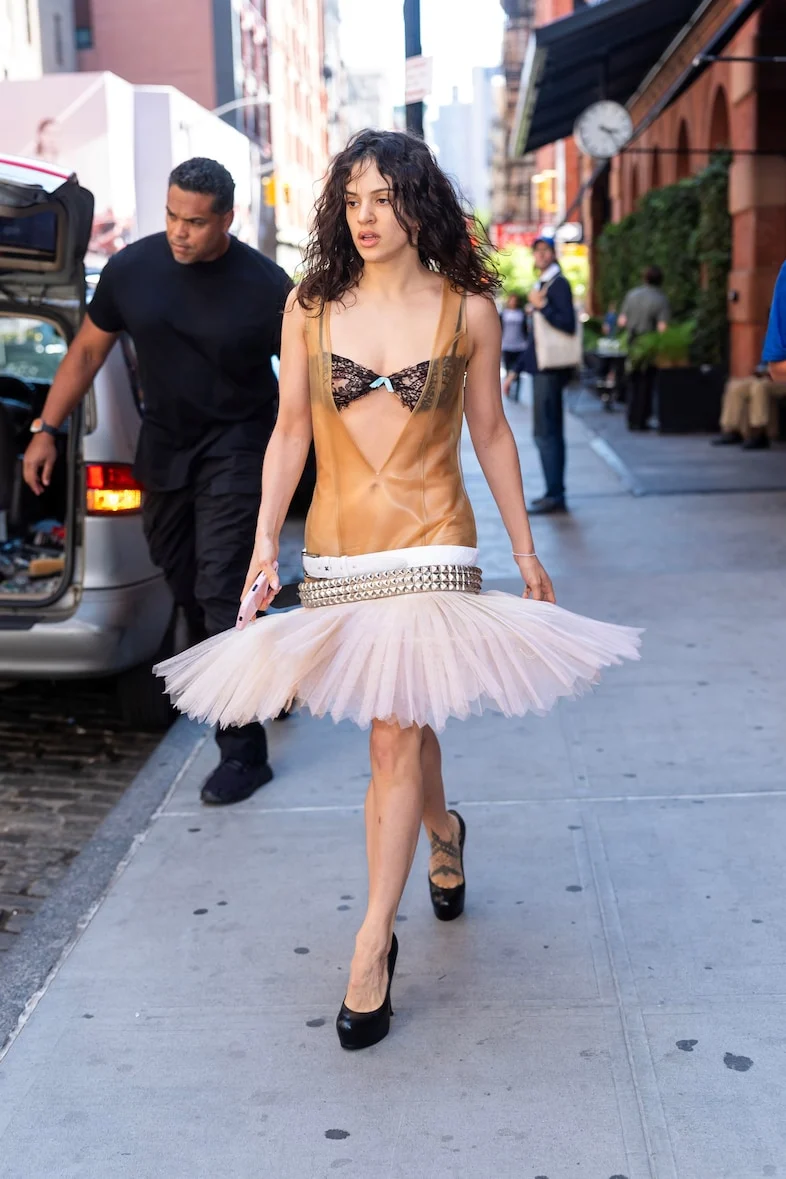
The culmination of Rosalía’s balletcore narrative manifested in her recent public appearance in New York, where she unveiled an outfit that provocatively challenged the very foundations of classical ballet aesthetics. This ensemble, meticulously styled by Jose Carayol, was a custom creation by emerging Nigerian designer Yasmina Atta, and it represented a radical departure from the reverent approach Rosalía had previously maintained.
The centerpiece of the look was a tutu, traditionally a symbol of ethereal grace, purity, and disciplined elegance, typically cinched high at the waist to accentuate the dancer’s form. Atta’s interpretation, however, deliberately subverted this convention. The tutu was designed to sit dramatically low, positioned far below Rosalía’s hip bones, creating an entirely different silhouette that elongated the torso and defied the classic proportions. This intentional displacement immediately disrupted the traditional visual language of ballet, signaling a departure from its strictures.
Further accentuating this deconstruction were two starkly contrasting belts that held the low-slung tutu in place. One was crafted from plain white leather, offering a minimalist yet unconventional material choice for ballet attire. The other, however, featured "emo metal studs," a bold, industrial detail that injected a raw, rebellious energy into the ensemble. The juxtaposition of delicate tulle with harsh metal studs and rugged leather epitomized the fusion of disparate aesthetics, creating a visual tension that was both jarring and compelling. This choice directly challenged the soft, seamless, and often understated accessories typically associated with ballet, instead embracing elements drawn from punk and alternative subcultures.
The bodice component of the ensemble pushed the boundaries even further. Crafted from translucent latex, a material inherently associated with fetishwear, modern sensuality, and a provocative edge, it offered a stark contrast to the demure, opaque fabrics of traditional ballet leotards. The latex bodice was strategically split open at the front, revealing a bra underneath – a seemingly minor detail that, in the context of ballet’s stringent dress codes, represented a profound act of defiance. In classical ballet, undergarments are meticulously concealed to maintain an illusion of seamless grace and modesty. Rosalía’s deliberate exposure of a bra, combined with the overtly suggestive material of the bodice, fundamentally shattered this illusion, introducing an element of raw, unvarnished sensuality into an art form historically characterized by idealized, almost asexual, beauty.
The collective impact of these design choices created an ensemble that would, as noted by observers, undoubtedly send a traditional Russian ballet instructor into "deep sensory shock." It was not merely a dress code violation for a barre class; it was a conceptual dismantling of ballet’s visual codes, its inherent symbolism, and its established aesthetic principles. Rosalía, through Atta’s design, transformed the tutu from an emblem of classical purity into a vehicle for avant-garde expression, intertwining high fashion with a rebellious, deconstructed sensibility.
The Collaborative Vision: Jose Carayol and Yasmina Atta
The audacious New York look is a testament to the synergistic creative partnership between Rosalía, her stylist Jose Carayol, and designer Yasmina Atta. Carayol, who commenced his collaboration with Rosalía during her "Lux" era, has been instrumental in shaping her evolving visual narrative. His work consistently demonstrates a sophisticated understanding of Rosalía’s artistic identity, translating her musical themes and personal growth into compelling fashion statements. Carayol’s ability to navigate the spectrum from the pious aesthetic to the provocative balletcore, while maintaining a cohesive yet dynamic vision, underscores his expertise in crafting iconic celebrity imagery. His role extends beyond mere clothing selection; it involves curating an entire visual language that resonates with Rosalía’s artistic output and global influence.
The custom tutu dress itself was the masterful creation of Yasmina Atta, a Nigerian designer whose work is rapidly gaining recognition for its unique blend of cultural influences and innovative design. Atta proudly announced her authorship of the design on Instagram, a significant moment for an emerging talent. A distinguished graduate of Central Saint Martins’ womenswear BA program, Atta’s educational background at one of the world’s most prestigious fashion institutions speaks to her foundational understanding of design principles and her capacity for pushing creative boundaries. Central Saint Martins is renowned for fostering designers who challenge conventions and develop distinctive, often avant-garde, voices.
Atta’s design philosophy is characterized by its eclectic inspirations, drawing from seemingly disparate references that she skillfully weaves into cohesive narratives. Her stated influences include classical ballet, African cinema, and her rich Nigerian roots, a heritage she has carried since moving to England at the age of eleven. In the New York tutu, the ballet influence is overtly present in the garment’s form, albeit radically reinterpreted. The infusion of African cinema and Nigerian roots, while perhaps less overtly visible in this specific piece, often manifests in her broader body of work through a nuanced approach to silhouette, draping, texture, and storytelling through clothing. These influences contribute to a unique perspective that challenges Western fashion norms, offering fresh interpretations of traditional garments and concepts. Atta’s designs often tell a story, reflecting cultural narratives and personal histories within their construction.
This collaboration with Atta is not an isolated incident; it signifies Rosalía’s consistent commitment to championing emerging talent and diverse voices in fashion. The singer had previously worn a woollen dress by Atta on a night out, a piece characterized by a deep cut V-neck and a drop-waist rara skirt. This earlier collaboration demonstrated Atta’s versatility and her penchant for reinterpreting classic forms (like the rara skirt, itself a symbol of 1980s playful rebellion) with a modern, sophisticated edge. Rosalía’s repeated endorsement of Atta’s work underscores her role as a tastemaker who not only follows trends but actively shapes them by spotlighting designers who are pushing the envelope.
Broader Implications: Fashion as Cultural Commentary and Trendsetting
Rosalía’s audacious balletcore ensemble extends beyond a mere fashion moment; it serves as a potent piece of cultural commentary and a significant marker in the evolving landscape of celebrity influence. Firstly, it reaffirms her status as a global fashion icon who utilizes her platform to provoke thought and spark dialogue. Her deliberate deconstruction of the traditional tutu challenges the inherent conservatism often associated with classical art forms, bringing them into a contemporary, often rebellious, context. This act of sartorial rebellion aligns with a broader trend in popular culture where established symbols are re-contextualized to reflect modern sensibilities, questioning notions of purity, tradition, and aesthetic boundaries.
Secondly, Rosalía’s interpretation pushes the boundaries of the "balletcore" trend itself. What began as a soft, romantic aesthetic characterized by delicate pastels, ribbon details, and cozy knits, has, through Rosalía, acquired a darker, more provocative, and explicitly subversive edge. She transforms balletcore from a nostalgic nod to childhood dreams into a statement of empowered, avant-garde sensuality. This evolution demonstrates how celebrity endorsement can rapidly accelerate and transform a nascent trend, infusing it with new meanings and expanding its stylistic vocabulary. Her take suggests that balletcore can be gritty, defiant, and experimental, not just ethereal.
Furthermore, this collaboration highlights the significant impact of celebrity endorsement on emerging designers. For Yasmina Atta, being championed by an artist of Rosalía’s global stature provides unparalleled visibility and credibility. It positions her at the forefront of contemporary fashion, attracting both critical attention and commercial opportunities. This dynamic underscores the crucial role that influential figures play in diversifying the fashion industry and providing platforms for fresh, innovative voices from diverse backgrounds. Atta’s unique blend of influences—ballet, African cinema, Nigerian heritage—gains a global stage, enriching the broader fashion narrative with new perspectives.
Finally, Rosalía’s consistent fusion of music and fashion underscores the performative nature of her artistry. Each outfit is not just clothing; it is a costume, a visual score that complements her musical narratives. Her fashion choices often mirror the themes, moods, and sonic landscapes of her albums, creating a holistic artistic experience. The balletcore phase, therefore, can be interpreted as a physical manifestation of grace, discipline, and perhaps even the vulnerability inherent in artistic creation, even when presented through a lens of radical subversion. It is a continuous narrative, where her wardrobe choices reflect her ongoing artistic and personal evolution.
As Rosalía continues to navigate her artistic journey, her fashion choices remain a compelling spectacle. The New York ensemble, crafted by Yasmina Atta and styled by Jose Carayol, stands as a testament to her unwavering commitment to innovation and her ability to challenge conventional aesthetics. The fashion world, and her legions of fans, eagerly anticipate what sartorial statements Rosalía will unveil next, assured that they will continue to be as thought-provoking and groundbreaking as her music.