



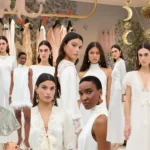



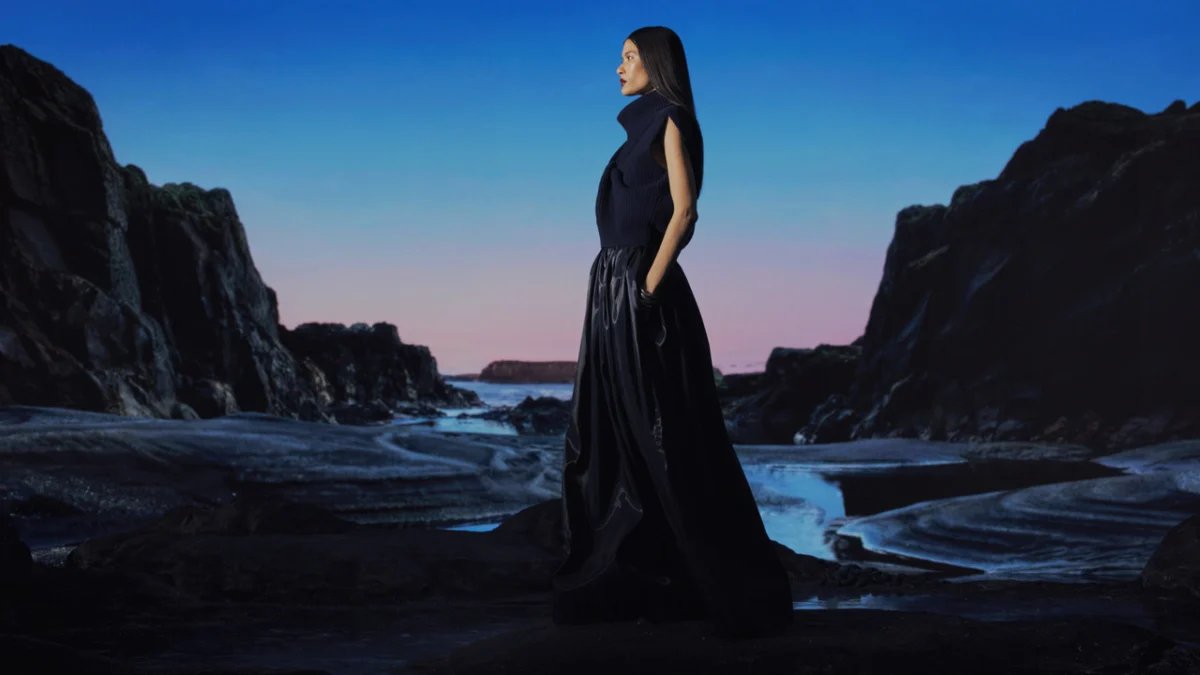
The intersection of high fashion and generative artificial intelligence reached a new milestone this Saturday as designer Kate Barton unveiled her latest collection at New York Fashion Week (NYFW). Moving beyond traditional runway presentations, Barton introduced a sophisticated technological layer to her showcase, debuting a multilingual AI agent designed to bridge the gap between avant-garde design and consumer accessibility. Developed in collaboration with Fiducia AI and powered by IBM’s watsonx platform on IBM Cloud, the initiative represents a significant shift in how luxury brands engage with audiences in a digital-first era.
The activation allowed guests and observers to interact with the collection in real-time through a visual AI lens. This system, capable of identifying specific garments from the new line, provided attendees with the ability to ask questions via voice or text in multiple languages and experience photorealistic virtual reality try-ons. By integrating these tools directly into the presentation, Barton sought to transform the viewing experience from a passive observation into an immersive, interactive narrative.
The Architecture of Interaction: IBM watsonx and Fiducia AI
The technical backbone of the presentation relied on a complex stack of enterprise-grade AI tools. Ganesh Harinath, the founder and CEO of Fiducia AI, spearheaded the development of the multilingual agent, utilizing IBM watsonx, IBM Cloud, and IBM Cloud Object Storage. The primary challenge, according to Harinath, was not merely the tuning of the underlying large language models (LLMs), but the "orchestration" of various data streams to ensure a seamless user experience.
Orchestration in this context refers to the synchronization of visual recognition software, natural language processing (NLP), and high-fidelity rendering engines. When a user points a device at a piece of clothing, the visual AI must instantly recognize the item, retrieve its specific metadata—such as fabric composition, design inspiration, and availability—and present that information in the user’s preferred language. This process requires low-latency processing and high-performance computing, which were facilitated by the IBM Cloud infrastructure.
The visual AI lens serves as a "production-grade activation," meaning it is designed to handle the high-traffic demands of a major event like NYFW without compromising on accuracy or speed. By using IBM watsonx, the team was able to ensure that the AI’s responses remained grounded in the specific data of Barton’s collection, reducing the risk of "hallucinations" or inaccurate information that can plague more generalized AI models.
A Designer’s Philosophy: Technology as a Narrative Portal
For Kate Barton, the integration of AI is not a gimmick but an extension of her creative process. Speaking to industry analysts and media ahead of the show, Barton emphasized that technology is "baked into" her conceptual framework. She views AI as a tool for world-building, comparing its utility to that of traditional set design or lighting.
Barton’s approach focuses on the "real and the unreal," a theme that resonates throughout her structural and often futuristic designs. The goal of the AI agent was to create a "portal into the collection’s world," rather than employing technology for its own sake. Barton noted that the modern role of tech in fashion is to expand the environment surrounding the clothes, helping to create a "double take" moment where the viewer is forced to question their perception of the garment.
This sense of curiosity is central to Barton’s brand identity. By allowing users to virtually "try on" pieces that might be physically inaccessible or structurally complex, she democratizes the experience of high fashion. The photorealistic quality of the virtual try-on (VTO) is a critical component of this, as it maintains the integrity of the fabric’s drape, texture, and light interaction, which are often lost in lower-fidelity augmented reality (AR) filters.
Chronology of Innovation and Past Experiments
Saturday’s presentation was not Barton’s first foray into the digital frontier. The designer has established a track record of experimenting with emerging technologies to enhance her runway presence. In previous seasons, Barton collaborated with Fiducia AI to experiment with AI-generated models, a move that sparked significant conversation within the industry about the future of digital representation in fashion.
The evolution from using AI for static imagery to a live, interactive, multilingual agent demonstrates a rapid progression in Barton’s technological maturity. This timeline reflects a broader trend in the fashion industry:
- Phase 1: Experimental Visualization (2023-2024): Brands began using AI for mood boards, marketing campaigns, and digital lookbooks.
- Phase 2: Operational Integration (Current): AI is widely used in the "back office" for supply chain optimization, inventory management, and trend forecasting.
- Phase 3: Consumer-Facing Interactivity (Barton’s 2025/2026 Showcase): High-end designers begin deploying "production-grade" AI to enhance the customer journey and storytelling at the point of discovery.
Market Context: The "Quiet" Adoption of AI in Fashion
The fashion industry’s relationship with AI is currently characterized by a dichotomy between public hesitation and private implementation. While Barton has chosen a highly visible path, she noted that many of her peers are using AI "quietly," primarily within operations. This stealthy adoption is often driven by a fear of "reputational risk."

The concern among luxury houses is that AI might be perceived as a cost-cutting measure that devalues the "human touch" or the artisanal craftsmanship associated with high fashion. There are also ongoing legal and ethical debates regarding data privacy, copyright in training sets, and the displacement of human creative talent.
However, Barton draws a parallel between the current AI skepticism and the early days of the internet. In the late 1990s and early 2000s, many luxury brands were hesitant to launch websites, fearing that an online presence would dilute their exclusivity. Eventually, the question shifted from "should we be online?" to "is our online presence any good?" Barton suggests that AI is currently undergoing a similar transition toward inevitability.
Supporting Data: The Economic Impact of AI in Retail
The deployment of AI at NYFW is supported by significant economic trends. According to industry reports from McKinsey & Company, generative AI could add between $150 billion to $275 billion to the apparel, fashion, and luxury sectors’ profits over the next three to five years.
Key areas of growth include:
- Virtual Try-Ons: Reducing return rates by up to 30% by providing customers with a more accurate understanding of fit and style.
- Hyper-Personalization: Increasing conversion rates by 10-15% through tailored recommendations and interactive storytelling.
- Global Accessibility: Multilingual agents, like the one used by Barton, allow brands to engage with a global audience without the overhead of massive localized support teams.
Ganesh Harinath of Fiducia AI predicts that by 2028, the use of AI in fashion will be normalized, and by 2030, it will be deeply embedded into the operational core of the entire retail sector. The differentiator for brands moving forward will not be the technology itself—which is becoming increasingly commoditized—but the ability to assemble the right partners and operationalize the tech responsibly.
Official Responses and Industry Implications
The collaboration has garnered attention from global technology leaders. Dee Waddell, Global Head of Consumer, Travel and Transportation Industries at IBM Consulting, highlighted the strategic value of the project. Waddell noted that when product intelligence and consumer engagement are connected in real-time, AI evolves from a "feature" into a "growth engine" that provides a measurable competitive advantage.
From IBM’s perspective, the Barton showcase serves as a proof-of-concept for how enterprise AI can be applied to creative industries. By using watsonx, the project demonstrates that AI can be both powerful and ethical, providing clear attribution and maintaining the integrity of the creator’s data.
Barton herself remains adamant that the goal is not "automated fashion." She emphasized that the most exciting future for the industry is one where new tools are used to heighten craft and deepen storytelling. "If the technology is used to erase people, I am not into it," Barton stated. She believes that audiences are sophisticated enough to distinguish between "invention"—the use of tech to expand creative horizons—and "avoidance"—the use of tech to bypass the costs of human labor.
Looking Ahead: The Future of the Runway
As New York Fashion Week concludes, the success of Kate Barton’s AI-enhanced presentation provides a blueprint for other designers. The move toward "clear discourse, clear licensing, and clear credit" will be essential as the industry navigates the integration of human creativity and machine intelligence.
The focus now shifts to how these interactive elements will translate from the runway to the retail floor. If Barton’s vision holds true, the future of fashion will not be found in a purely digital vacuum, but in a hybrid space where technology serves to amplify the human effort that makes a garment "worth wearing."
By 2030, the "multilingual AI agent" may no longer be a headline-grabbing "twist" at Fashion Week, but a standard expectation for any brand looking to communicate its story to a global, tech-savvy audience. For now, Kate Barton stands at the forefront of this transition, proving that the "portal" to the future of fashion is already open.