









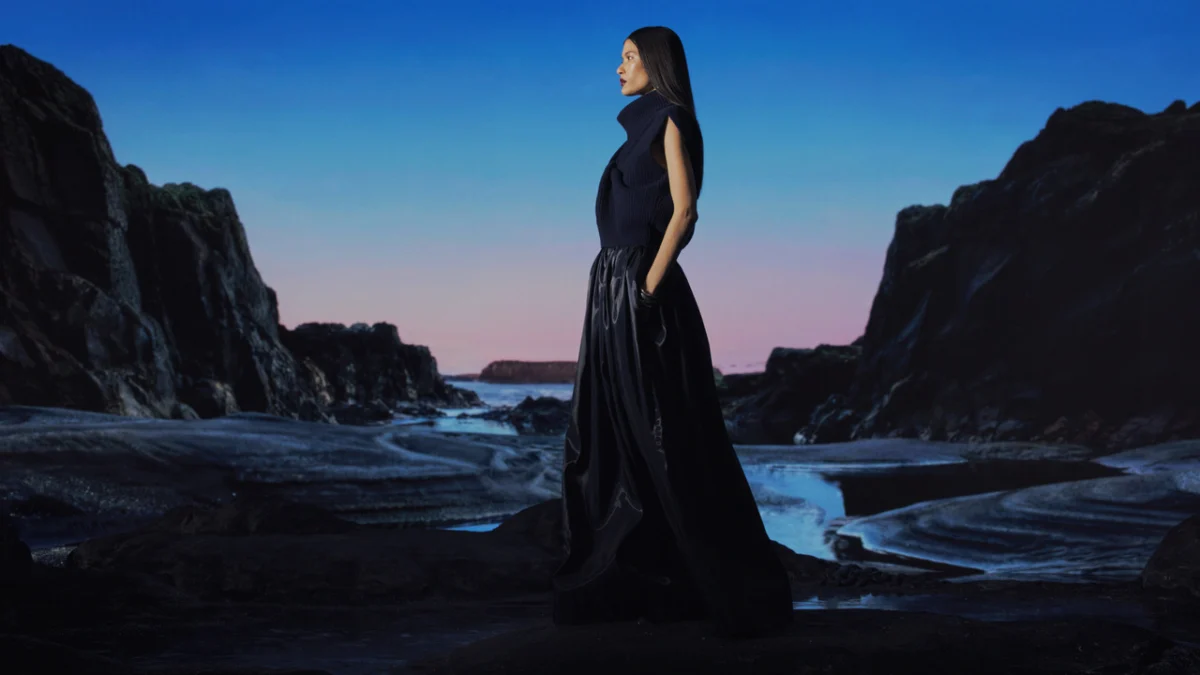
The intersection of high fashion and generative artificial intelligence reached a new milestone this week as designer Kate Barton prepared to unveil her latest collection at New York Fashion Week (NYFW). In a strategic collaboration with Fiducia AI, Barton is introducing a sophisticated, multilingual AI agent built on the IBM watsonx platform and hosted on IBM Cloud. This digital integration is designed to transform the traditional runway experience into an interactive, tech-enabled environment where guests can identify specific garments, engage in real-time dialogue with an AI curator, and utilize photorealistic virtual reality (VR) to "try on" pieces from the collection.
The presentation represents a significant shift in how the fashion industry approaches emerging technology. Rather than utilizing AI as a gimmick or a standalone spectacle, Barton and her technical partners have integrated these tools into the very fabric of the brand’s storytelling. By leveraging production-grade AI, the collaboration seeks to solve long-standing friction points in the luxury retail experience, including accessibility, language barriers, and the gap between viewing a garment and understanding its fit and movement.
The Architecture of an AI-Driven Fashion Experience
At the core of this technological activation is a visual AI lens developed by Fiducia AI. This system is trained to detect and recognize individual pieces from Barton’s new collection with high precision. When a guest interacts with the AI agent—either via voice or text—the system utilizes IBM watsonx to provide detailed information about the materials, inspiration, and craftsmanship of the specific garment.
Ganesh Harinath, the founder and CEO of Fiducia AI, emphasized that the project’s complexity lay not in the individual AI models, but in the "orchestration" of various technological layers. The infrastructure utilizes IBM Cloud and IBM Cloud Object Storage to manage the massive datasets required for photorealistic VR try-ons and real-time multilingual processing. This orchestration ensures that the transition from identifying a piece on a model to seeing it on a digital avatar is seamless and visually consistent with the high standards of a luxury fashion house.
The multilingual capability is particularly noteworthy for an event like NYFW, which attracts a global audience of buyers, journalists, and influencers. By removing language barriers, the AI agent allows international attendees to engage with Barton’s narrative in their native tongues, democratizing the often-exclusive world of high-fashion presentations.
Evolution of a Digital Strategy: A Chronology of Innovation
Kate Barton’s integration of AI at NYFW is not an isolated experiment but the latest step in a clear chronological progression toward digital maturity.
- Early 2024: Preliminary AI Exploration. During the previous fashion season, Barton began her partnership with Fiducia AI by experimenting with AI-generated models. This initial phase focused on the visual aesthetics of AI and how synthetic imagery could complement physical collections.
- Late 2024: Development of the AI Agent. Following the success of the initial experiment, Barton and Harinath began developing a more robust "production-grade" tool. The focus shifted from mere imagery to utility, leading to the selection of IBM watsonx as the foundational platform due to its enterprise-level reliability and data governance features.
- February 2025: The NYFW Launch. The current activation introduces the "portal" concept, where the AI serves as an entry point into the collection’s world. This stage marks the transition from AI as an aesthetic choice to AI as a functional interface.
- 2025–2027: Projected Scaling. Industry analysts expect Barton’s model to be adopted by other mid-to-large-scale designers looking to bridge the gap between runway presentations and direct-to-consumer sales.
- 2028–2030: Normalization and Core Integration. Ganesh Harinath predicts that by 2028, these technologies will be standard across the industry, and by 2030, AI will be the primary operational engine for retail and fashion logistics.
Bridging the "Website Moment": Industry Implications and Data
The current hesitation some fashion houses feel toward AI mirrors the industry’s initial resistance to the internet in the late 1990s. At that time, luxury brands were concerned that an online presence would dilute their exclusivity and prestige. However, as Barton noted, the question eventually shifted from whether a brand should be online to how high the quality of that online presence could be.
Market data supports this inevitable shift. According to recent industry reports, the global market for AI in fashion is projected to grow at a compound annual growth rate (CAGR) of over 35% through 2030. This growth is driven by several factors:
- Sustainability: Virtual try-ons can significantly reduce return rates, which currently plague the fashion industry and contribute to a massive carbon footprint.
- Personalization: AI-driven insights allow brands to tailor their offerings to individual consumer preferences, increasing conversion rates.
- Operational Efficiency: Beyond the consumer-facing AI agent, brands are increasingly using AI to optimize supply chains and predict inventory needs, reducing waste.
Despite these benefits, "reputational risk" remains a primary concern for many brands. The fear of "erasing" human workers or producing "uncanny valley" content has led some designers to use AI only in back-office operations. Barton’s approach challenges this by positioning AI as a tool that "heightens craft" rather than replaces it.

Official Responses and Strategic Perspectives
The collaboration has drawn praise from technology leaders who see fashion as a prime testing ground for sophisticated AI orchestration. Dee Waddell, Global Head of Consumer, Travel and Transportation Industries at IBM Consulting, highlighted the strategic value of real-time engagement.
"When inspiration, product intelligence, and engagement are connected in real time, AI moves from being a feature to becoming a growth engine that drives measurable competitive advantage," Waddell stated. This perspective aligns with a broader shift in the tech sector, where the focus is moving away from "chatbots" and toward "agents" that can perform complex, multi-step tasks.
Barton herself maintains a firm stance on the ethical deployment of these tools. She argues that the audience can discern the difference between "invention and avoidance." For Barton, the technology is only successful if it deepens the storytelling and brings more people into the experience without "flattening" the human artisans who create the physical garments.
Analysis: The Future of the Fashion Ecosystem
The Kate Barton and Fiducia AI partnership serves as a case study for the future of the fashion ecosystem. As the industry moves toward 2030, several key trends are likely to emerge from this foundation:
1. The Death of the Passive Runway
The traditional runway show, where an audience sits and watches models walk in a linear fashion, is being disrupted. Interactive AI agents allow for a non-linear exploration of a collection. A buyer from Tokyo and a stylist from Paris can now interact with the same collection simultaneously, receiving personalized data that assists in their specific professional roles.
2. Responsible AI and Intellectual Property
As AI becomes more prevalent, the industry will need to address what Barton calls "clear discourse, clear licensing, and clear credit." The use of AI to recognize and replicate designer styles raises significant questions regarding intellectual property. Brands that lead with transparency—using AI to highlight their own original work rather than scrape the work of others—will likely maintain higher brand equity.
3. Hyper-Realistic Prototyping
Beyond the consumer experience, the technology used by Barton and Fiducia AI has profound implications for the design process. High-fidelity visualization allows designers to prototype garments in a virtual space with such accuracy that physical samples may become less necessary, saving thousands of dollars in material costs and shipping.
Conclusion: Fashion as a Human-Centric Tech Frontier
The unveiling of Kate Barton’s latest collection at New York Fashion Week serves as a reminder that technology is most effective when it serves a human purpose. By integrating IBM’s watsonx and Fiducia AI’s orchestration capabilities, Barton is not just showing clothes; she is building a portal into a world where tech and textile coexist.
The success of this activation suggests that the future of fashion will not be "automated." Instead, it will be an era of "augmented creativity," where the tools of the digital age are used to amplify the oldest human tradition: the art of dress. As the industry watches Barton’s AI agent assist guests on Saturday, the conversation will likely move past the "reputational risk" of AI and toward the immense possibilities of a truly connected, global, and interactive fashion landscape.
While many brands may continue to use AI quietly in their operations, Barton’s public embrace of the technology sets a new standard for transparency and innovation. It signals to the industry that the "inevitable" has arrived, and the only remaining question is how to use these new tools to make the fashion experience more inclusive, more sustainable, and more imaginative than ever before.