








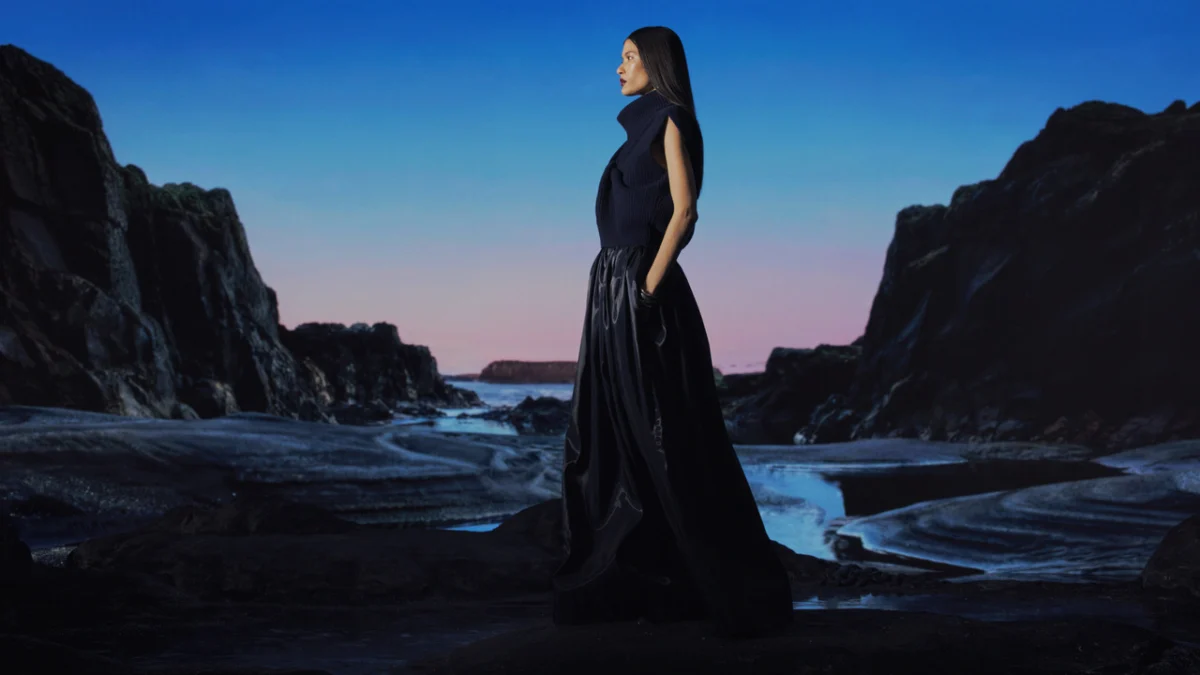
The intersection of high fashion and advanced computational intelligence reached a new milestone this Saturday as designer Kate Barton unveiled her latest collection at New York Fashion Week (NYFW). Moving beyond traditional runway presentations, Barton collaborated with Fiducia AI to introduce a sophisticated, multilingual AI agent designed to bridge the gap between avant-garde design and consumer engagement. Built on the robust framework of IBM watsonx and hosted on IBM Cloud, the activation represents a significant shift in how luxury brands utilize generative technology to enhance storytelling rather than merely streamlining logistics.
The presentation offered guests an interactive experience that allowed for real-time identification of specific garments within the collection. Through a visual AI lens, attendees could engage with an agent capable of answering complex inquiries regarding fabric, construction, and design inspiration in multiple languages via both voice and text. Furthermore, the partnership introduced photorealistic virtual reality try-ons, providing a digital layer to the physical event that allowed observers to envision the sculptural pieces on themselves instantaneously. This move signals a departure from "AI for AI’s sake," as Barton described it, positioning the technology instead as a "portal" into the creative world of the designer.
The Technological Architecture of the Barton-Fiducia Collaboration
The technical execution of the NYFW activation required a sophisticated stack of enterprise-grade tools. Ganesh Harinath, the founder and CEO of Fiducia AI, emphasized that the primary challenge of the project was not merely the tuning of the models, but the complex orchestration of various AI components to ensure a seamless user experience in a high-pressure environment like Fashion Week. By leveraging IBM watsonx, Fiducia AI was able to deploy a production-grade visual AI lens capable of high-accuracy object detection.
This system relied on IBM Cloud and IBM Cloud Object Storage to manage the massive datasets required for photorealistic rendering and real-time response generation. Unlike standard consumer chatbots, the AI agent used in Barton’s show was designed with a specific focus on "visual intelligence." This allowed the software to recognize the unique silhouettes and textures of Barton’s work—which often features experimental materials and structural geometries—and provide contextually relevant information. The multilingual capability was particularly vital for an international event like NYFW, ensuring that global buyers, journalists, and influencers could interact with the brand without linguistic barriers.
A Chronology of Innovation: Kate Barton’s Evolution
Kate Barton’s integration of technology is not a sudden pivot but a continuation of a career-long fascination with the boundary between the "real and the unreal." Last season, the designer experimented with AI-generated models, also in partnership with Fiducia AI, to explore the aesthetic possibilities of digital fashion representation. This earlier experiment served as a proof-of-concept for the more integrated, guest-facing activation seen this year.
Historically, the fashion industry has followed a predictable pattern of technology adoption. Barton noted that the current skepticism surrounding AI mirrors the early days of the internet, when luxury houses were famously hesitant to launch websites for fear of diluting their brand exclusivity. Over time, the conversation shifted from whether a brand should have an online presence to whether that presence was of sufficient quality. The designer suggests that AI is currently in a similar "inevitability phase." While many brands are currently using AI behind the scenes for supply chain optimization and trend forecasting, Barton is among the few designers bringing the technology into the public-facing creative process.
Market Context and the Shift Toward "Quiet AI"
The broader fashion landscape is currently grappling with the implications of generative AI. According to industry data, the global market for AI in fashion is projected to grow at a compound annual growth rate (CAGR) of over 35% through 2030. However, much of this growth is hidden from the consumer. Many heritage brands utilize AI for "operational excellence"—managing inventory, predicting demand, and reducing waste—while remaining cautious about public-facing applications.

Barton highlighted a "reputational risk" that prevents many of her peers from being transparent about their use of AI. There is a persistent fear that technology might be perceived as a replacement for human craftsmanship or as a tool for "avoidance" rather than "invention." By contrast, the Barton-Fiducia collaboration seeks to use AI to "heighten craft" and "deepen storytelling." This transparent approach aims to demystify the technology, presenting it as a tool that supports the human artisans who, as Barton noted, "actually make the clothes worth wearing."
Industry Responses and the Strategic Advantage of Real-Time Intelligence
The move toward integrated AI has garnered support from major technology consultants who view fashion as a ripe field for "growth engines." Dee Waddell, Global Head of Consumer, Travel and Transportation Industries at IBM Consulting, noted that the true value of AI is realized when inspiration and product intelligence are connected in real-time. According to Waddell, when a brand can offer immediate, personalized engagement through AI, it moves from a novelty feature to a measurable competitive advantage.
From a retail perspective, the implications of Barton’s virtual try-on technology are profound. One of the primary hurdles in luxury e-commerce is the "fit and feel" gap, which leads to high return rates and consumer hesitation. By providing photorealistic VR try-ons that accurately reflect the drape and structure of a garment, designers can potentially increase conversion rates while reducing the environmental impact of returned goods. Harinath predicts that while these tools are currently experimental, they will be normalized across the industry by 2028. By 2030, he anticipates that AI will be so deeply embedded in the operational core of retail that it will no longer be viewed as a separate "tech spin" but as a standard component of the fashion ecosystem.
Ethical Considerations and the Future of Human Creativity
Despite the optimistic projections for AI integration, the Barton presentation did not shy away from the ethical tensions inherent in the technology. The designer was vocal about the necessity of maintaining a "human-centric" approach. She argued that the future of fashion depends on clear discourse regarding licensing, credit, and the recognition that human creativity is a vital asset, not an "annoying overhead cost."
The concept of "erasing people" through automation remains a central concern for the creative community. Barton’s stance is that audiences are sophisticated enough to distinguish between brands using AI to expand their creative horizons and those using it to bypass the need for human labor. This distinction is crucial as the industry moves toward more routine use of artificial intelligence. The goal, according to Barton, is to use these new tools to "bring more people into the experience without flattening the people who make it."
Conclusion: Toward a 2030 Vision for Fashion
As the dust settles on this season’s New York Fashion Week, the collaboration between Kate Barton, Fiducia AI, and IBM serves as a template for the responsible and creative application of generative technology. The event demonstrated that when enterprise-grade AI like watsonx is placed in the hands of a visionary designer, it can do more than just process data—it can create a "moment when your eyes do a double take."
The transition from AI as a backend operational tool to a frontend storytelling medium marks a new chapter in the luxury sector. While the industry remains cautious, the success of Barton’s activation suggests that the path forward lies in "orchestration"—the careful blending of human artistry with the efficiency and reach of machine intelligence. As Harinath noted, the technology already exists; the differentiator now is the ability to assemble the right partners and operationalize it in a way that respects the heritage of the craft while embracing the possibilities of the future. For Barton, the most exciting future is not one of "automated fashion," but one where technology serves as a bridge, connecting the designer’s intent with a global audience in more immersive and inclusive ways than ever before.