








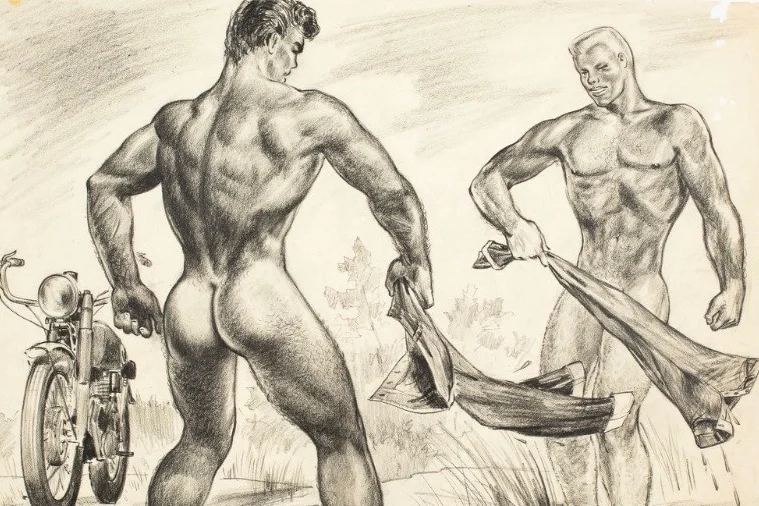
In a significant cultural initiative coinciding with global Pride celebrations, acclaimed Northern Irish designer Jonathan Anderson has curated a unique exhibition of rare illustrations from Bob Mizer’s seminal Physique Pictorial magazine. Hosted at the JW Anderson flagship store in Soho, London, from June 25 to July 6, the display shines a spotlight on the work of the anonymously known artist "Spartacus," whose homoerotic depictions profoundly influenced a generation of artists despite the severe censorship of his era. This curatorial endeavor by Anderson, who simultaneously helms his eponymous label and the Spanish luxury house Loewe, underscores his commitment to intellectual engagement, historical reclamation, and the ongoing dialogue between fashion, art, and social commentary.
A Legacy Unveiled: The World of Physique Pictorial
At the heart of the exhibition lies Physique Pictorial, a quarterly publication that ran from 1951 to 1990. Founded by Bob Mizer, a pioneering figure in queer photography, the magazine ingeniously navigated the restrictive obscenity laws of mid-20th century America by masquerading as a bodybuilding journal. In an era where overt depictions of homosexuality were illegal and socially condemned, Physique Pictorial offered its predominantly gay male audience a vital, albeit thinly veiled, visual language for desire and community. It became a cornerstone of what was then known as "beefcake" magazines, celebrating the male physique through photography and illustration.
Mizer’s strategy was a delicate tightrope walk. By presenting his models in poses that could ostensibly be interpreted as athletic or artistic studies, he provided a plausible deniability that aimed to circumvent legal persecution. However, the underlying homoeroticism was unmistakable to its target demographic, who understood the coded messages within its pages. This allowed for the clandestine circulation of images that affirmed gay male identity and provided a rare glimpse of desired forms in a world that largely denied their existence. The magazine’s existence itself was a quiet act of defiance, a testament to the ingenuity required to foster queer culture under duress.
Navigating Censorship: The Mid-Century Queer Landscape
The operational context of Physique Pictorial was defined by a pervasive atmosphere of moral panic and legal strictures against homosexuality. In the United States, federal and state obscenity laws were rigorously enforced, with postal regulations often used to target publications deemed "lewd" or "immoral." The Comstock Act of 1873, though amended, cast a long shadow, prohibiting the mailing of "obscene" materials. For publications like Physique Pictorial, this meant constant vigilance and the risk of raids, arrests, and financial ruin. Bob Mizer himself faced multiple arrests and legal battles throughout his career, highlighting the perilous environment in which he operated.
The legal landscape began to shift, albeit slowly, with landmark Supreme Court cases like Roth v. United States (1957) attempting to define obscenity, and later Miller v. California (1973) establishing the "three-prong test" for obscenity. However, for decades, any content explicitly or implicitly depicting homosexuality was almost automatically deemed obscene. This historical backdrop makes the endurance and influence of Physique Pictorial all the more remarkable. It served not just as a source of imagery but as a lifeline, a mirror reflecting an identity that society attempted to erase. Its pages became a clandestine gallery, introducing readers to the works of artists who pushed boundaries, including the iconic Tom of Finland, the romantic George Quaintance, and the dynamic Dom Orejudos (also known as Etienne), all of whom would later achieve significant recognition in queer art history.
The Enigmatic "Spartacus": A Pioneer’s Anonymous Art
While Physique Pictorial featured a roster of talented artists, the JW Anderson exhibition zeroes in on the illustrations of "Spartacus." This artist’s anonymity was not a choice but a necessity, a protective measure against the very real threat of persecution in an era when overt expressions of homosexuality could lead to social ostracization, loss of employment, and even criminal charges. Like many contributors to Physique Pictorial, Spartacus’s true identity remains a mystery to this day, a poignant reminder of the sacrifices made by pioneers in queer art.
Spartacus’s illustrations were renowned for their brazenly homoerotic nature, pushing the boundaries of what was permissible even within the "beefcake" genre. His work depicted male figures in highly stylized, often theatrical, and undeniably sexualized scenarios, challenging the prevailing norms of masculinity and desire. This radical approach, while requiring anonymity, paradoxically amplified its impact. The raw, unfiltered expression of gay desire resonated deeply within the underground queer community and, perhaps more surprisingly, caught the attention of mainstream artists. Figures like Robert Mapplethorpe, known for his provocative and often controversial explorations of sexuality and the body, and David Hockney, whose iconic pool paintings and male nudes are celebrated, are among those whose work Spartacus is credited with influencing. This influence suggests that Spartacus’s art, despite its clandestine origins, transcended its initial context to shape broader artistic discourse on the male form and sexuality. The exhibition features 40 works by Spartacus, offering an extensive look at his significant, yet historically suppressed, output.
Jonathan Anderson’s Curatorial Vision
Jonathan Anderson’s decision to dedicate a significant exhibition to Spartacus and Physique Pictorial is emblematic of his broader approach to fashion and culture. Known for his intellectual curiosity and his ability to fuse high art with contemporary design, Anderson consistently challenges conventions. His brands, JW Anderson and Loewe, are celebrated for their innovative silhouettes, artisanal craftsmanship, and their engagement with artistic narratives. This exhibition during Pride Month is not merely a commercial endeavor but a profound statement, aligning the JW Anderson brand with a commitment to historical reclamation and cultural advocacy.
Anderson himself articulated the impetus behind the exhibition, stating, "It felt important to bring these artworks into the open, and give them the visibility they were once denied because of the censorship of the time." This highlights a central theme: the re-contextualization and validation of art that was historically marginalized. He further noted, "What’s interesting as well is how much influence these works carried, despite being produced under restriction." This observation speaks to the enduring power of art to transcend its limitations and shape cultural currents, even when created in the shadows. For Anderson, the exhibition is a testament to the resilience of queer creativity and its undeniable impact on the wider artistic landscape. His curatorial choice serves as a powerful acknowledgment that what was once deemed subversive and unmentionable is, in fact, foundational to certain aspects of modern art and identity.
Art, Fashion, and Activism: A Modern Convergence
The exhibition represents a compelling convergence of art, fashion, and social activism. In an increasingly interconnected world, luxury brands are evolving beyond mere purveyors of goods to become cultural institutions, hosting galleries, sponsoring artistic endeavors, and engaging in social discourse. By presenting Spartacus’s work, JW Anderson is not only celebrating Pride but also actively contributing to the ongoing project of LGBTQ+ visibility and historical acknowledgment. This move positions the brand as a thoughtful participant in contemporary cultural conversations, appealing to a discerning clientele that values authenticity and progressive values.
Such initiatives extend beyond brand positioning; they serve a vital educational role. For many, especially younger generations, the history of queer struggle and the clandestine nature of early LGBTQ+ cultural production remain largely unknown. By bringing these artworks into a prominent commercial space, Anderson makes this history accessible, sparking dialogue and fostering a deeper understanding of the foundations upon which contemporary queer identities and freedoms have been built. The act of viewing these once-forbidden images in an open, celebrated context is, in itself, an act of liberation. It underscores how far society has come in recognizing and appreciating diverse forms of expression, while simultaneously reminding us of the fragility of these gains and the continuous need for advocacy.
The Enduring Relevance of Queer Art History
The legacy of Physique Pictorial and artists like Spartacus extends far beyond their original context. Their work laid critical groundwork for subsequent generations of artists and activists, contributing to a visual lexicon of queer desire and identity that continues to evolve. In a contemporary landscape that, despite significant progress, still grapples with issues of representation, censorship, and prejudice against LGBTQ+ individuals, revisiting these historical artifacts holds profound relevance. They remind us of the courage required to express one’s truth, the resilience of marginalized communities, and the transformative power of art to challenge and change societal norms.
The exhibition at JW Anderson’s Soho store, therefore, is more than just an art show; it is a historical intervention. It invites reflection on the journey of queer visibility, from clandestine magazines circulated under the threat of arrest to celebrated exhibitions in high-fashion retail spaces. It highlights the often-overlooked contributions of queer artists to the broader artistic canon and champions the idea that all forms of human expression, regardless of their origin or initial reception, deserve recognition and respect. As the global community continues to celebrate Pride, Jonathan Anderson’s initiative serves as a powerful reminder that true pride is rooted in understanding and honoring a rich, complex, and often courageous history.
The exhibition of Spartacus’s illustrations from Physique Pictorial is open to the public at the JW Anderson Soho store, located at 27-28 Wardour Street, London, W1D 6PR, from June 25 until July 6. Admission is free, offering an invaluable opportunity to engage with a pivotal, yet historically underrepresented, chapter in queer art history.