






The recent appearance of global pop phenomenon Harry Styles on Saturday Night Live has once again ignited a fervent public discussion surrounding celebrity authenticity, gender-fluid fashion, and the contentious accusation of "queerbaiting." Styles, performing double duty as both host and musical guest for the premiere of his new album, Kiss All the Time. Disco, Occasionally, utilized the iconic late-night platform to directly address the persistent scrutiny of his public persona and sartorial choices, delivering a monologue and sketches that blended humor with pointed social commentary.
The SNL Intervention: A Direct Response
Styles’ return to the SNL stage, a familiar haunt for the artist, was marked by an immediate and deliberate engagement with the "queerbaiting" narrative that has shadowed much of his solo career. During his opening monologue, following performances of tracks from his latest album, the conversation swiftly pivoted to his flamboyant tour outfits and the subsequent accusations. With a characteristic blend of charm and theatricality, Styles recounted, "Back then, people seemed to pay a lot of attention to the clothes I was wearing, and some people accused me of something called ‘queerbaiting’." He paused, building anticipation, before dramatically bellowing, "But did it ever occur to you, that maybe you don’t know everything about me, Dad!?". The mock anger, directed seemingly at an imagined patriarchal figure representing public judgment, elicited a passionate eruption of applause from the studio audience, signaling a collective appreciation for his directness and humor.
The evening’s performance continued to deconstruct the obsession with his sexuality. In a move that directly parodied the very concept of queerbaiting, Styles was later joined on stage by SNL cast member Ben Marshall. In a moment designed for maximum impact and irony, Styles honored the name of his new album by kissing Marshall live on national television. Turning to face camera one, he delivered the punchline with a pointed finger and a knowing wink: "Now that’s queerbaiting." This self-referential act served as a potent, albeit satirical, reclaiming of the narrative, daring critics to apply their label to an overtly performative gesture.
Beyond the monologue, a notable sketch titled "Harry for Him" further satirized the commercialization and gendered expectations surrounding his style. Presented as a quasi-QVC segment, Styles introduced a line of Target-branded "dupes" aimed at "middle-aged househusbands" aspiring to emulate his fashion. The sketch featured SNL cast members parading in exaggerated knockoffs of his most iconic looks. Ben Marshall reappeared in a replica of the striking Egonlab jumpsuit Styles wore to the 2023 Grammys, prompting Styles to comically marvel at how good Marshall’s "tushy" looked. Another cast member donned a rendition of Styles’ memorable 2019 Met Gala ensemble – the sheer Gucci blouse paired with a pearl drop earring – leading Styles to playfully ask him to leave his wife. Ironically, throughout this segment, Styles himself was dressed in a cropped, collarless jacket, reminiscent of a "grannycore" aesthetic, subtly referencing his own recent stylistic shifts.
The Evolution of a Fashion Icon: A Chronology of Style and Scrutiny
Harry Styles’ fashion journey has been as dynamic and scrutinized as his musical career. From his early days in One Direction, where he adhered to a more conventional, boy-band aesthetic, his solo career has been marked by a deliberate and increasingly bold embrace of gender-fluid fashion. This evolution has not merely been a personal expression but has also become a significant cultural touchstone, influencing mainstream fashion trends and sparking widespread debate.
The "Fine Line" Era (2019-2021): Challenging Masculinity
The release of his second solo album, "Fine Line," in 2019 coincided with a more pronounced shift in Styles’ public image. He began incorporating traditionally feminine elements into his wardrobe, frequently appearing in flamboyant suits, wide-leg trousers, and accessories like pearl necklaces. A pivotal moment arrived in December 2020 when Styles became the first solo male to grace the cover of Vogue, famously posing in a custom Gucci gown and a tailored jacket. This cover instantly went viral, garnering both widespread praise for challenging conventional masculinity and significant backlash from conservative commentators who criticized his "feminization" of men. It was during this period that the term "queerbaiting" began to be more frequently associated with him, as critics questioned whether his adoption of queer-coded aesthetics was authentic or merely a marketing strategy to appeal to an LGBTQ+ fanbase without explicitly identifying as queer.
"Love on Tour" (2021-2023): The Zenith of Extravagance
His subsequent "Love on Tour," which spanned from 2021 to 2023, solidified Styles’ reputation as a maximalist fashion icon. Each performance was a spectacle of custom-made Gucci outfits, often featuring sequined jumpsuits, feather boas, vibrant colors, and theatrical silhouettes. These ensembles, frequently designed by Alessandro Michele, Gucci’s former creative director, drew clear inspiration from rock legends like Elton John and David Bowie, artists renowned for their gender-bending stage personas. While celebrated by many fans for its joyful defiance of gender norms, the tour also intensified the "queerbaiting" discourse. Critics argued that Styles, a cisgender man, was profiting from an aesthetic deeply rooted in queer history and culture without explicitly aligning himself with the LGBTQ+ community, thus potentially diluting authentic representation.
The "Grannycore" and "Byrne-esque" Shift (2023-2026): A New Chapter
Following the conclusion of "Love on Tour," Styles’ sartorial choices have undergone another notable transformation, moving towards what some fashion commentators have dubbed "Chanel grannycore" or a "David Byrne cosplay." This shift has been characterized by more understated, yet still gender-fluid, looks.
- 2023 Grammys: While the Egonlab jumpsuit was a highlight, it marked a transitional period.
- 2026 Grammys: Styles appeared in a pair of jeans paired with a Dior bar jacket – a garment traditionally synonymous with Christian Dior’s revolutionary New Look, designed for the female form. This choice subtly recontextualized a classic feminine silhouette within a masculine framework.
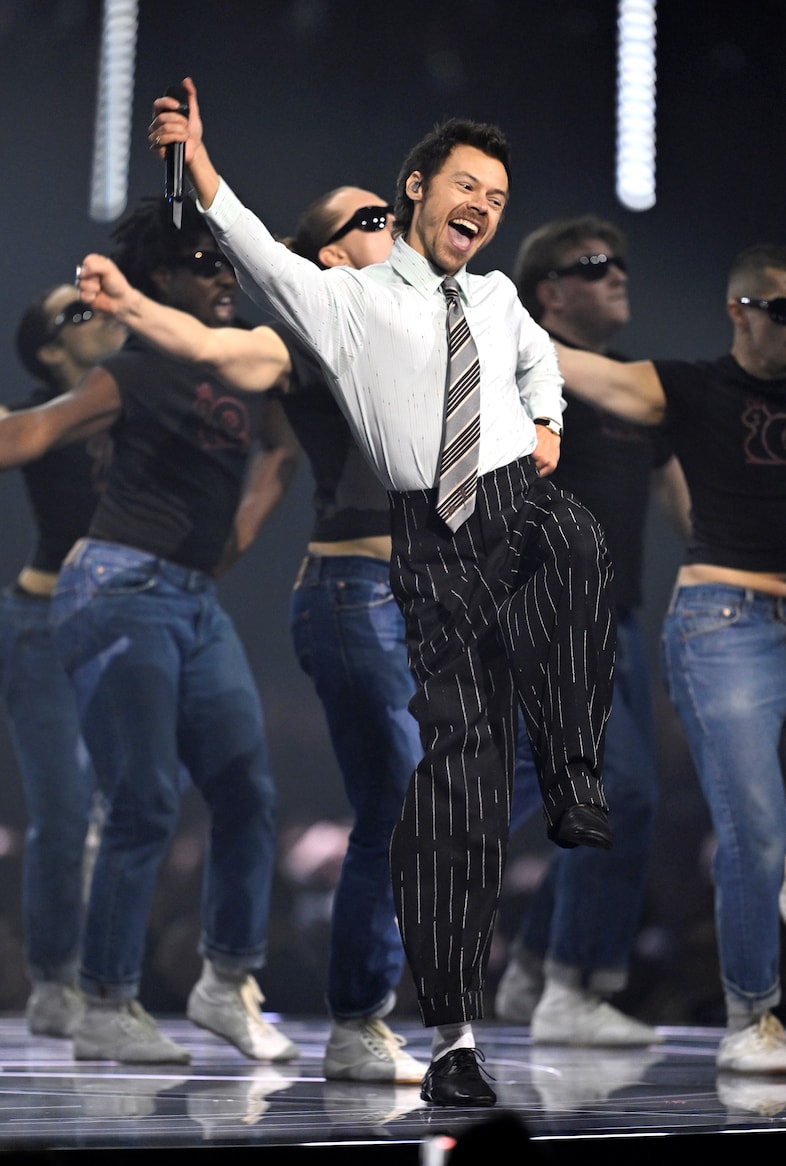
- 2026 Brit Awards: He sported a slouchy Chanel zoot suit, evoking the iconic, oversized suits worn by David Byrne of Talking Heads, known for his eccentric and intellectual style. This move was perceived by some as a departure from his previous hyper-feminine aesthetic towards a more intellectualized, retro-masculine fluidity.
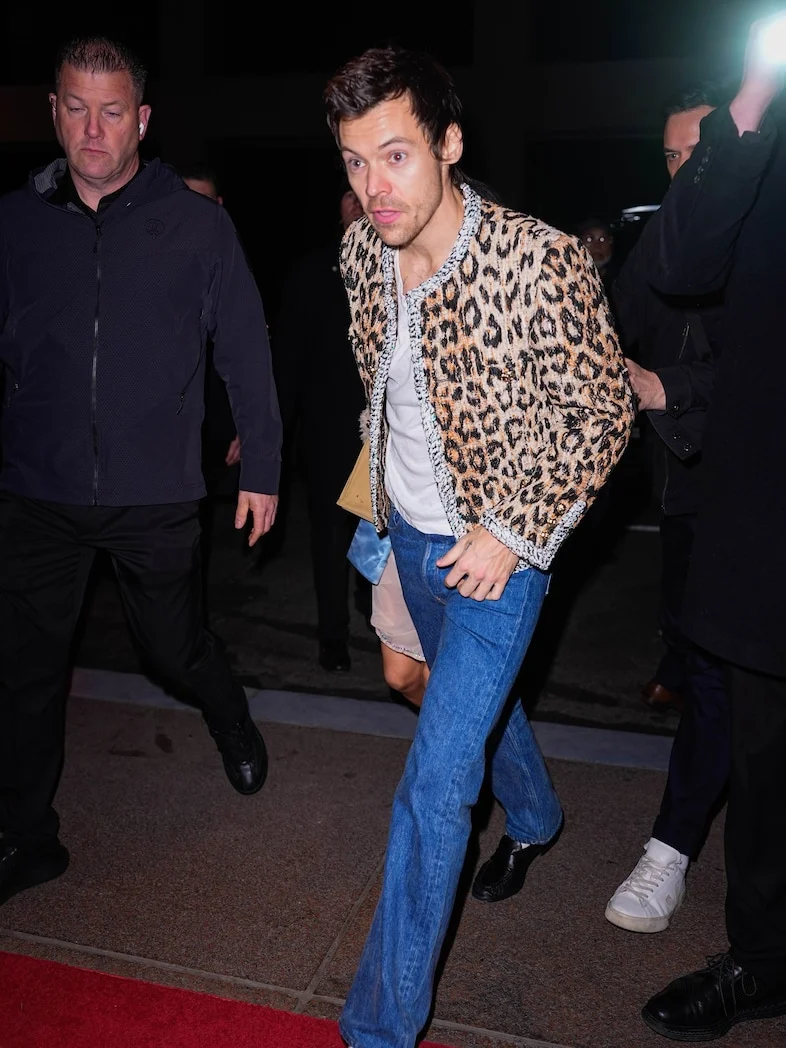
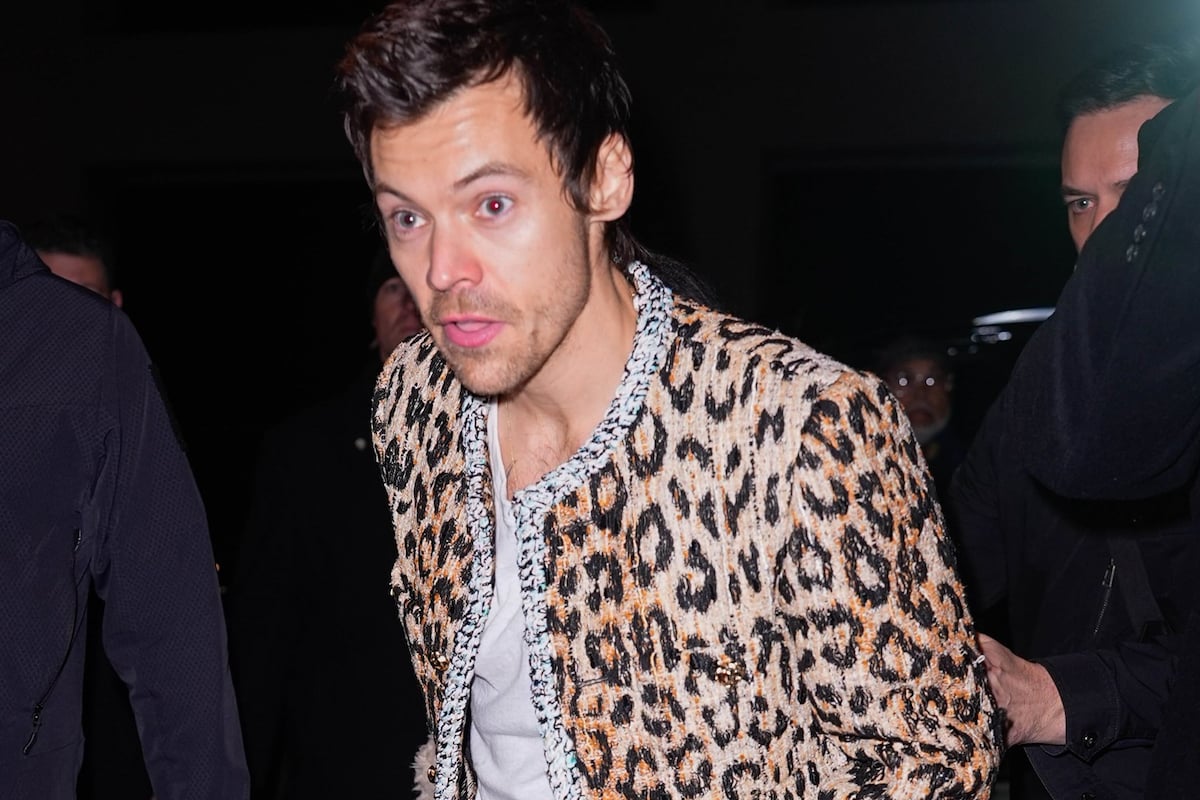
- Recent Appearances: At an SNL afterparty, Styles was seen in a leopard print Chanel women’s jacket from the recent Métiers d’Art show, completing the look with a matching leopard handbag he had carried a week prior. This demonstrated a continued, albeit more subtle, engagement with traditionally feminine accessories and luxury womenswear.
This recent stylistic evolution has not escaped scrutiny. While some see it as a natural progression or a mature refinement of his aesthetic, others on social media, like one disgruntled X user, have speculated, "Ditched the dresses and nail polish cause the gender bending isn’t as profitable in the current anti-trans climate." This sentiment reflects a deeper concern among some critics that Styles’ fashion choices might be dictated by commercial viability and shifting social climates rather than genuine self-expression or allyship.
The Broader Discourse: Queerbaiting and Celebrity Authenticity
The debate surrounding Harry Styles’ fashion and alleged queerbaiting is not merely about one celebrity’s wardrobe; it taps into profound cultural discussions about gender identity, sexual orientation, authenticity, and the responsibilities of public figures.
Defining Queerbaiting:
Queerbaiting, in the context of media and celebrity, refers to the practice of hinting at, but never explicitly depicting, queer romance or identity to attract an LGBTQ+ audience and gain cultural capital, without committing to actual representation. For many within the LGBTQ+ community, it represents a frustrating form of tokenism or exploitation, where queer aesthetics and appeal are commodified without genuine solidarity or identification, particularly when the celebrity benefits from the ambiguity while maintaining a heteronormative public image.
Social Media as a Battleground:
Platforms like X (formerly Twitter) and TikTok serve as digital battlegrounds for this discourse. A quick search for "Harry Styles queerbait" reveals countless posts reflecting polarized opinions. Supporters laud Styles for promoting gender fluidity and challenging toxic masculinity, asserting that artists should be free to express themselves without being forced to label their sexuality. They argue that policing his identity is itself a regressive act. Conversely, critics, often from within the LGBTQ+ community, voice concerns that Styles’ ambiguous presentation, coupled with his immense mainstream popularity, allows him to profit from queer aesthetics without facing the real-world discrimination and marginalization experienced by openly queer individuals. They argue that true allyship or representation would involve more explicit identification or advocacy.
Fashion as a Cultural Barometer:
Styles’ influence on fashion is undeniable. His choices, whether a Gucci gown or a Chanel bar jacket, have helped normalize gender-fluid dressing in mainstream culture. Major fashion houses like Gucci, Chanel, and Dior have increasingly embraced gender-neutral collections and campaigns, and Styles is often cited as a key figure driving this trend. This cultural shift is evident in everyday life; the original article notes an observation of a young man in Wembley wearing a "Sheinel" (AliExpress Chanel-style) cardigan, clearly inspired by Styles. This anecdote highlights how celebrity fashion trickles down, influencing how people dress and express themselves in their daily lives, regardless of their sexual orientation.
The Challenge of Authenticity:
The core of the queerbaiting debate lies in the elusive concept of "authenticity" in celebrity culture. How can the public discern genuine self-expression from strategic branding? For Styles, who has consistently maintained a private stance on his personal relationships and sexual identity, his fashion becomes the primary lens through which the public interprets his identity. His SNL monologue and kiss can be interpreted as a defiant, humorous pushback against the demand for explicit labels, asserting his right to self-expression without public interrogation of his private life.
Broader Impact and Implications
Harry Styles’ recent SNL performance and his ongoing fashion evolution carry significant implications for celebrity culture, gender expression, and LGBTQ+ representation.
Redefining Masculinity: Styles has undeniably played a pivotal role in broadening the mainstream definition of masculinity. By consistently wearing skirts, dresses, and traditionally feminine accessories, he has challenged rigid gender norms, making it more acceptable for men to explore diverse forms of self-expression. This has had a positive ripple effect, particularly among younger generations, encouraging greater fluidity in personal style.
The Commercialization of Identity: The "Harry for Him" sketch, while comedic, underscores a serious underlying tension: the commercialization of identity. As gender fluidity becomes more accepted in fashion, brands are quick to capitalize. The debate surrounding queerbaiting questions whether this commercialization truly benefits the LGBTQ+ community or if it merely appropriates their culture for profit without offering genuine support or representation.
The Right to Privacy vs. Public Expectation: Styles’ "Dad!" retort on SNL highlights the perennial conflict between a celebrity’s right to privacy and the public’s insatiable desire for personal details, especially regarding identity. While some argue that public figures who benefit from adopting queer aesthetics have a responsibility to be transparent, others contend that no one should be pressured to label their sexuality, regardless of their public profile. This tension is particularly acute in an era where social media fosters both connection and intense scrutiny.
The Ongoing Evolution of Discourse: Styles’ direct engagement with the queerbaiting accusation on SNL did not definitively resolve the debate, but it certainly shifted its tenor. By turning the accusation into a punchline, he demonstrated a savvy understanding of media dynamics and a willingness to confront his critics on his own terms. This act could be seen as an artist asserting control over his narrative, challenging the audience to consider the performative nature of celebrity and the absurdity of demanding explicit labels for artistic expression.
Ultimately, Harry Styles remains a complex figure at the intersection of music, fashion, and identity. His journey continues to provoke thought and discussion, pushing the boundaries of what is considered conventional and challenging society to re-examine its expectations of public figures and their personal expressions. While the questions surrounding authenticity and representation will undoubtedly persist, Styles’ impact on mainstream culture, particularly in fostering a more fluid approach to gender and fashion, is a significant and evolving legacy. The debate, far from being settled, continues to reflect the dynamic and often contentious landscape of modern identity politics.