








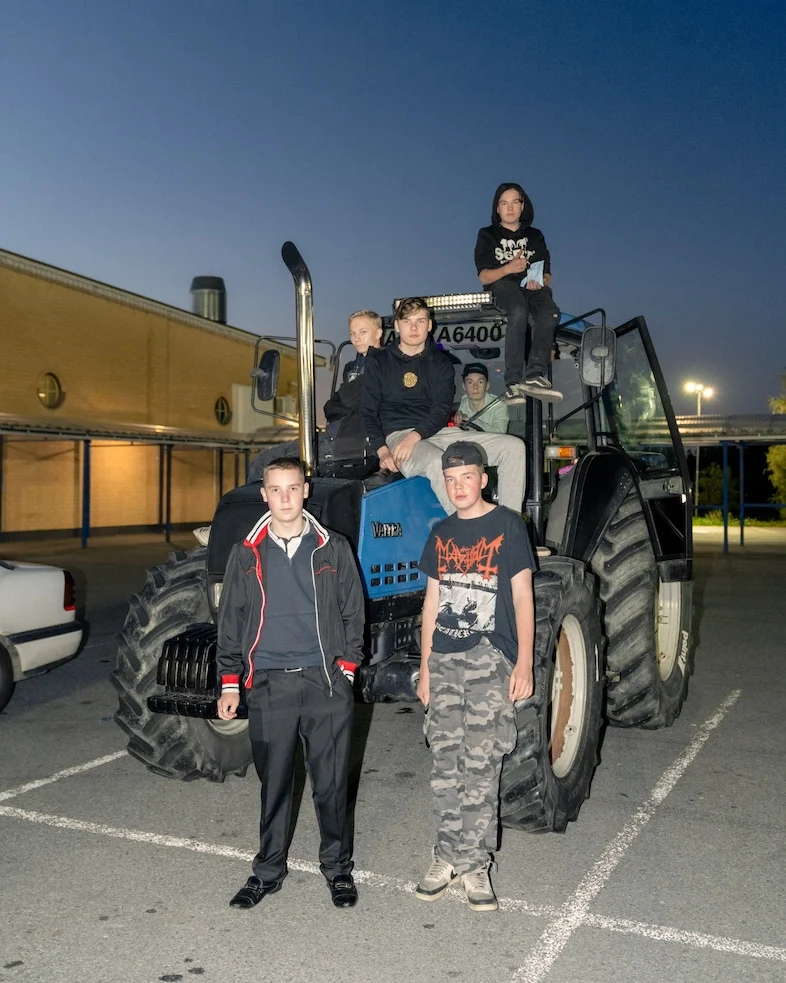
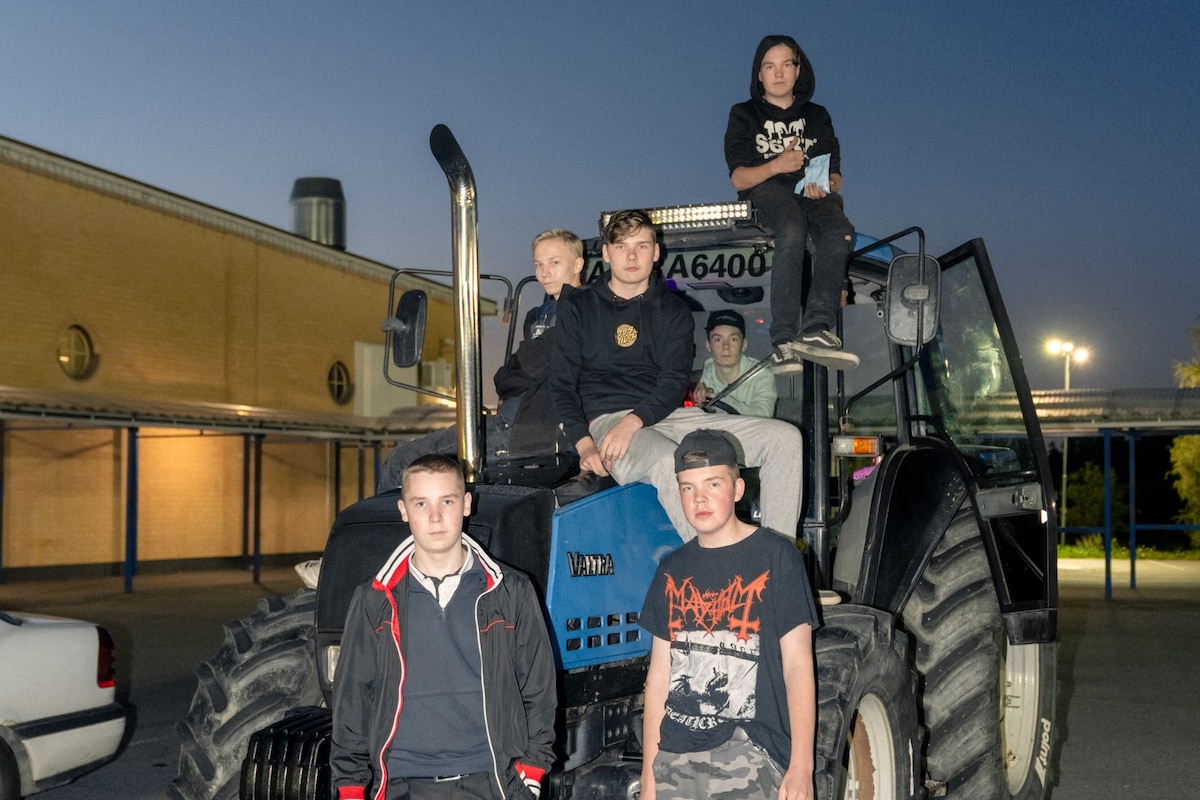
"Cruise," a compelling new photo book by Finnish photographer Jussi Puikkonen, published by Garret Publications, offers an intimate and nuanced look into the subculture of pilluralli. Shot between 2020 and 2024, the series meticulously documents the unique social ritual observed by young people in provincial Finland, where weekend nights are dedicated to gathering with cars, driving loops through town, or simply hanging out in a collective display of identity and community. Puikkonen’s lens captures this often-misunderstood phenomenon with a subtle yet richly vivid color palette, creating a powerful mixture of portraits—his subjects engaging directly with the camera, their expressions ranging from shy vulnerability to defiant self-possession—alongside evocative suburban landscapes and striking close-ups of the cars themselves. Details like a fuchsia door handle or a car door laden with multiple speakers become emblematic, crafting a depiction of provincial Finland that is at once desolate in its vastness and humming with the vibrant, if sometimes overlooked, life of its youth.
Understanding Pilluralli: A Finnish Rite of Passage
At its core, pilluralli transcends mere leisure; it functions as a profound social ritual, enabling its participants to construct meaning, forge identity, and cultivate a sense of belonging in environments where traditional outlets might be scarce. Puikkonen, in an interview with Dazed, articulates this insight, describing pilluralli as a crucial "right of passage." He explains, "It’s when they become adults, when they get their first car, and when they have their own private space for the first time." This statement underscores the transformative power of the automobile in these young lives, moving beyond a simple mode of transport to become a mobile sanctuary, a symbol of newfound autonomy, and a catalyst for social interaction.
Puikkonen’s own background provides a unique perspective on the subject. Born and raised in Finland, where he also pursued his photography studies, he has spent the last 15 years living in Amsterdam. Despite growing up in a small town where pilluralli was prevalent, he never directly participated, having moved to Helsinki at a young age. This distance, both geographical and temporal, allowed him to view the culture with a fresh, appreciative eye—a perspective often lacking among those living within Finland. While pilluralli is ubiquitous across the country, except notably in the capital city, it is widely dismissed by many Finns as noisy, antisocial, and generally undesirable. Puikkonen’s work, however, challenges these preconceived notions, inviting viewers to see the inherent beauty and social significance embedded within this often-maligned tradition.
Societal Perceptions and Socio-Economic Undercurrents
The prevailing societal view of pilluralli is largely negative, often branding it as a public nuisance and a symbol of social exclusion. Puikkonen acknowledges this perception: "In many small towns, the young kids don’t have anything to do, so they just sit in their cars, and they end up doing nothing – that’s how it’s viewed." This simplification, however, overlooks the complex social dynamics at play. While it might appear to outsiders as an unproductive use of time, for the participants, it serves as a vital social hub, a place where friendships are cemented, relationships blossom, and the shared experience of youth is celebrated.
Initially, as a coming-of-age ritual, pilluralli largely operates as a cross-class phenomenon. "It’s not literally everyone who does it, but in smaller towns it’s often the main way young people spend their time," Puikkonen clarifies. In many of Finland’s smaller, more remote communities, which face challenges like rural depopulation and limited economic opportunities, organized youth activities or alternative social venues can be scarce. The car, therefore, becomes an accessible and customizable platform for social engagement. However, as young people mature and pathways diverge, a visible socio-economic divide can emerge. Those who move away for higher education or better job prospects in larger cities leave behind a cohort who, for various reasons, remain in their hometowns, often still frequenting the pilluralli scene on the edges of town. This demographic shift highlights the underlying socio-economic factors that can shape participation and perception of the subculture over time, subtly reinforcing the narrative of pilluralli as a haven for those with fewer options.
A Return Home: Rediscovering Passion and Finnish Identity
The catalyst for Puikkonen’s deep dive into pilluralli was an unexpected return to his home country during the global COVID-19 lockdown. This period of enforced stasis and introspection allowed him to look at the phenomenon with fresh eyes, unburdened by past biases or the common local dismissals. He found himself drawn to the sheer passion exhibited by the young participants. "This is their passion, and I find it interesting when people are passionate about something," he states, emphasizing the authentic human drive behind the activity.
Puikkonen also identifies pilluralli as a distinctly Finnish form of socializing, particularly suited to the national temperament. "Generally, we are quite reserved, so it fits that mentality quite well," he explains. The car, in this context, offers a unique blend of proximity and personal space. "Because you’re sitting in your car, you have that protection, and you can observe from there, and slowly, you can get to know other people who are doing it." This observational, gradual approach to social interaction resonates deeply with the reserved nature often associated with Finnish culture, providing a comfortable buffer for initial encounters that can eventually lead to deeper connections.
Beyond the social aspect, pilluralli is also a canvas for considerable creative expression. Many young participants invest significant time, effort, and often disproportionate financial resources into painstakingly modifying their vehicles. Puikkonen’s photographs capture this dedication, exemplified by a striking shot of an inner car door fitted with five powerful speakers. This commitment to personalization can be quite remarkable. "It’s funny, because the cars might be worth €500, and the sound system they put in might cost €10,000," he observes. This disparity highlights not just a passion for sound and aesthetics, but also a strategic investment in the very infrastructure of their social scene, demonstrating a clear prioritization of their chosen lifestyle over conventional material value. This level of dedication speaks volumes about the importance of pilluralli as a creative outlet and a source of pride for these young individuals.
The Artist’s Vision: Authenticity and Cinematic Echoes
Puikkonen’s artistic methodology is rooted in a guiding principle of authenticity: he strives for his work to be real, minimizing artificial setups. "I try not to set things up too much," he affirms, indicating a commitment to capturing moments as they unfold naturally. This approach fosters a genuine connection with his subjects, who, by and large, welcomed his presence. He adopted an open and honest communication strategy, explaining his interest without a "hidden agenda" and acknowledging the uncertain final format of the project, whether it would become a book or an exhibition. This transparency yielded exceptional trust, with approximately 95 percent of those he approached readily agreeing to be photographed and even inviting him into their cars, a testament to his respectful engagement.
His photographic lineage draws inspiration from celebrated American documentary photographers such as Alec Soth and Joel Sternfeld, artists renowned for their ability to weave narratives and reveal the subtle complexities of landscapes and human subjects. Beyond still imagery, Puikkonen also cites significant influence from filmmakers who prioritize visual storytelling over dialogue. Charlotte Wells’ acclaimed film Aftersun, a slow-burning, languorous account of a holiday shared between a father and his young daughter, was a "huge influence." The film’s atmospheric quality, its ability to convey deep emotion and memory through evocative imagery rather than explicit narrative, likely informed Puikkonen’s own quest to imbue his photographs with a similar emotional depth and resonant, understated storytelling. This cinematic sensibility allows "Cruise" to transcend mere documentation, transforming it into a meditative exploration of youth, place, and the passage of time.
The Unique Light of the North: Capturing the Elusive

A subtle but crucial element of Puikkonen’s photographic achievement in "Cruise" lies in its mastery of light. What might not be immediately apparent to the casual observer is that most of the images were made at night. However, due to the unique geographical context of northern Finland during the height of summer, these night-time shots are not shrouded in darkness but are instead flooded with a moody, crepuscular light. Puikkonen consciously sought to "emphasise the nightless night," harnessing the ethereal glow of the midnight sun to create an atmosphere that is both dreamlike and starkly real. This choice of lighting lends an almost otherworldly quality to the scenes, highlighting the liminal space these young people occupy, both physically on the edge of towns and metaphorically on the cusp of adulthood.
Eventually, Puikkonen expanded the scope of his project to include shooting during the winter months, further enriching the visual narrative and thematic depth. This decision led to one of the series’ most striking images: a photograph taken on a foggy evening where the fluorescent lights emanating from a nearby harbour cast a deep, burning orange glow across the sky. This particular shot encapsulates the essence of "Cruise": it finds extraordinary beauty and profound significance in a subject matter that is too often, and too easily, dismissed as mundane or banal. Through his sensitive observation and expert photographic technique, Puikkonen transforms the everyday rituals of pilluralli into a compelling visual poem, revealing the magic inherent in the lived experiences of provincial Finnish youth.
Broader Implications and Cultural Resonance
"Cruise" serves as more than just a photographic collection; it is a vital sociological document that challenges superficial judgments and invites a deeper appreciation for an often-misunderstood cultural phenomenon. By meticulously capturing the nuances of pilluralli, Puikkonen’s work offers a valuable contribution to the understanding of contemporary Finnish youth culture, particularly in rural and provincial areas. It provides a counter-narrative to the prevailing negative stereotypes, portraying the participants not as aimless youths, but as individuals actively engaged in building community, asserting identity, and finding creative expression within their specific circumstances.
The book’s publication by Garret Publications signifies a broader recognition of the artistic merit and cultural importance of this niche subject. It elevates pilluralli from a localized curiosity to a topic worthy of international photographic and cultural discourse. In an increasingly urbanized world, the social dynamics of smaller towns often go undocumented, making "Cruise" an essential record of how youth adapt, socialize, and thrive when faced with limited conventional options. As a testament to the enduring human need for connection and self-expression, pilluralli, as seen through Puikkonen’s empathetic and discerning lens, offers a timeless reflection on coming-of-age rituals and the universal quest for belonging. It reminds us that magic often resides in the most unexpected and seemingly ordinary corners of our world, waiting for an artist like Jussi Puikkonen to illuminate it.
Cruise by Jussi Puikkonen is published by Garret Publications and is available from your bookshop.