





The vibrant cultural landscape of Shanghai recently became the stage for a profound exploration of identity, memory, and the intricate connections between art and fashion, as Mexican designer Bárbara Sánchez-Kane unveiled her latest exhibition, Coro de Soles Menores (Chorus of the Minor Suns), at the esteemed CHERUBY arts and culture centre. This immersive showcase marks a significant milestone in Sánchez-Kane’s career, encapsulating a decade of her genre-defying practice and reaffirming her commitment to a holistic, interdisciplinary approach that consistently challenges conventional boundaries.
Bárbara Sánchez-Kane: A Decade of Interdisciplinary Innovation
Bárbara Sánchez-Kane’s trajectory in the creative world has been anything but conventional. A graduate of Florence’s prestigious Polimoda school, her initial training as a fashion designer served as a foundational discipline rather than a definitive category. From the outset, Sánchez-Kane’s work has deliberately navigated the liminal space between fashion and art, resisting easy classification. This refusal to be confined extends even to her personal expression, as the designer embraces both ‘he’ and ‘she’ pronouns, mirroring her fluid approach to creative identity and challenging binary definitions within her practice.
A decade ago, following her graduation from Polimoda, Sánchez-Kane founded her eponymous brand, Sánchez-Kane. The label quickly garnered attention for its bold conceptual depth, often delving into complex socio-cultural themes embedded within Mexican identity. Early collections notably explored the pervasive influence of machismo in Mexican culture, as well as the underexplored territories of female sexuality. These profound investigations were articulated through a distinctive visual language, employing sculptural suits that defied traditional tailoring, iconic Lucha Libre masks that blended anonymity with cultural symbolism, and a unique series of objects and sculptures she provocatively termed "objetos absurdos" (absurd objects).
Her presentations during this formative period were as unconventional as her designs. Sánchez-Kane deliberately chose disparate settings, showcasing her inspired collections at high-profile events like LA Fashion Week one month, and then shifting to contemporary art galleries such as the Museo Experimental El Eco in Mexico City the next. This early predilection for diverse venues underscored her belief in the inherent interdisciplinary nature of her work, a philosophy that has only deepened with time. "I never felt a strong separation between art and fashion," Sánchez-Kane articulates, emphasizing her conviction that the two realms are intrinsically linked. "If you turn off the lights, what remains is a silhouette. A garment can behave like a sculpture, and a sculpture can feel like something worn." This core principle continues to inform every facet of her creative output, positioning her as a pivotal voice in the ongoing dialogue between fashion and contemporary art.
Coro de Soles Menores: A Deep Dive into Inner Landscapes
The genesis of Coro de Soles Menores is rooted in Sánchez-Kane’s recent two-month residency at CHERUBY, a Shanghai institution renowned for its commitment to fostering dialogue at the intersection of art and fashion. This residency marked a significant departure for the artist, representing her first extended period of working outside her familiar studio environment. Reflecting on this experience, Sánchez-Kane noted, "My work only really exists when it’s shared. Coro de Soles Menores comes from my time at CHERUBY. It was my first residency program and the first time I’ve truly worked outside my own studio." This physical displacement from her established creative space proved to be a fertile ground for new perspectives. She confessed to an earlier fear of leaving her first studio in Mexico City, believing her creative process might "dissolve" if she stepped away. However, the Shanghai residency proved transformative, leading her to conclude, "Now I think what we really need is to let life interrupt us. We cannot pretend to be isolated." This embrace of external influence and the disruption of routine are central to the exhibition’s spirit.
Coro de Soles Menores, or ‘Chorus of the Minor Suns,’ is an exhibition that attempts to articulate a profound internal journey: "the desire to find new ways to ‘descend into hell’ and make sense of a ‘better place,’ through our inner volcanoes: the minor suns." The evocative phrase "descend into hell" is a direct reference to the Apostles’ Creed, a foundational Christian doctrine. In this theological context, Christ’s descent into the underworld after death symbolizes a passage through ultimate darkness, ultimately leading to rebirth, redemption, and the triumph of life over death. Sánchez-Kane repurposes this ancient concept, translating it into a contemporary framework of personal introspection and psychological exploration. Her "minor suns" represent the latent, often volatile, forces within each individual – personal challenges, suppressed emotions, or unexplored potentials – which, when confronted and navigated, can lead to profound self-discovery and transformation.
The Genesis of "Chorus of the Minor Suns": Inspirations and Philosophies
The exhibition’s conceptual framework is a rich tapestry woven from diverse intellectual and philosophical threads. The initial spark came during a flight to China, where Sánchez-Kane began reading a book on volcanoes by renowned volcanologist Clive Oppenheimer. She became fascinated by the idea of how a single volcanic eruption could have ripple effects across the entire planet, with consequences felt years later and even at the antipodes of the initial event. This concept of "delayed collectivity" and "invisible connections" — how seemingly isolated events can resonate across vast distances and timeframes — deeply resonated with her, forming a core metaphor for the interconnectedness of human experience and the unseen forces that shape our lives. Oppenheimer, known for his work in volcanology and as a scientific consultant for films like Werner Herzog’s Into the Inferno, provided a compelling scientific lens through which to view universal impact and interconnectedness.
Further shaping her artistic vision were the philosophical insights of Fred Moten, a prominent American scholar, poet, and cultural theorist. Moten’s work often explores themes of blackness, improvisation, and the radical potential of the "undercommons." Sánchez-Kane cites Moten’s idea that "listening to noise means recognising that there is always a wild outside beyond the structures we inhabit – and that inhabit us." This notion encourages an openness to the unconventional, the unarticulated, and the liminal, suggesting that profound understanding often lies beyond established frameworks and conventional narratives. It speaks to Sánchez-Kane’s own practice of breaking free from established categorizations in fashion and art.
The Italian philosopher Franco "Bifo" Berardi also played a significant role in the development of Coro de Soles Menores. Berardi’s theories often address the psychological and social impacts of digital communication and the overwhelming deluge of information in contemporary society, coining terms like "semiocapitalism." Sánchez-Kane engaged with Berardi’s ideas on how individuals are "surrounded by more information than we can possibly retain." She observed that after much of this information is forgotten, a "remainder" often persists, and it is precisely this residue that can transform into creativity. The exhibition, she explains, emerges from this very condition: "fragments, signals, and encounters that stay with you without fully explaining themselves." This suggests that art can be born from the subconscious processing of residual data, a poetic reassembly of the forgotten.
Another crucial influence was the concept of "one step, one view," gleaned from Sánchez-Kane’s visits to traditional Chinese gardens. This ancient principle of garden design dictates that with every physical step, a new perspective or visual composition is revealed, encouraging mindful observation and an appreciation for shifting viewpoints. This philosophy directly informed her approach to physical and metaphorical "tilting the body" within the exhibition, forcing new paths and renegotiating how one moves and perceives.
Key Installations: Weaving Narratives Through Form and Material
The artworks within Coro de Soles Menores are not merely static objects; they are conceptual propositions, each piece a carefully considered manifestation of the exhibition’s overarching themes.
One striking piece is the translucent blazer with calla lilies encased within its fabric. This garment directly embodies Berardi’s theory of information residue. The transparent material allows the viewer to "see through" to the delicate, preserved flowers, symbolizing the fragments of beauty and meaning that persist after an overload of sensory input. The calla lily itself carries rich symbolism, often associated with purity, resurrection, and transformation, and notably featured prominently in the works of Mexican artists like Diego Rivera and Frida Kahlo. The piece invites contemplation on what remains visible and valuable after the ephemeral rush of information fades, presenting a "garden" of persistent beauty within a structured form.
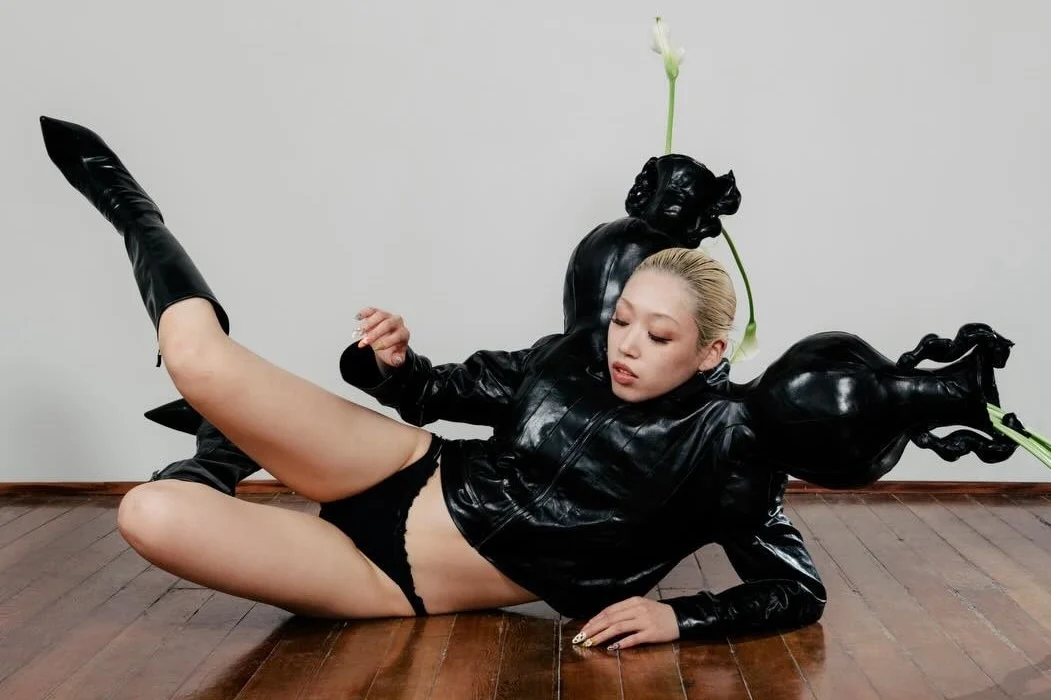
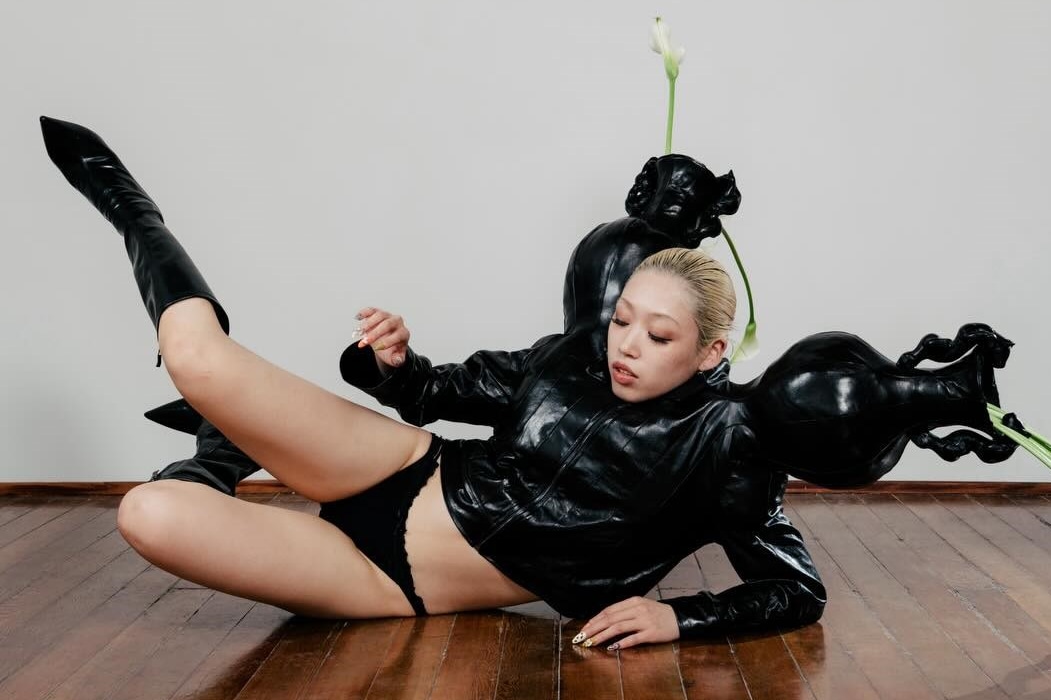
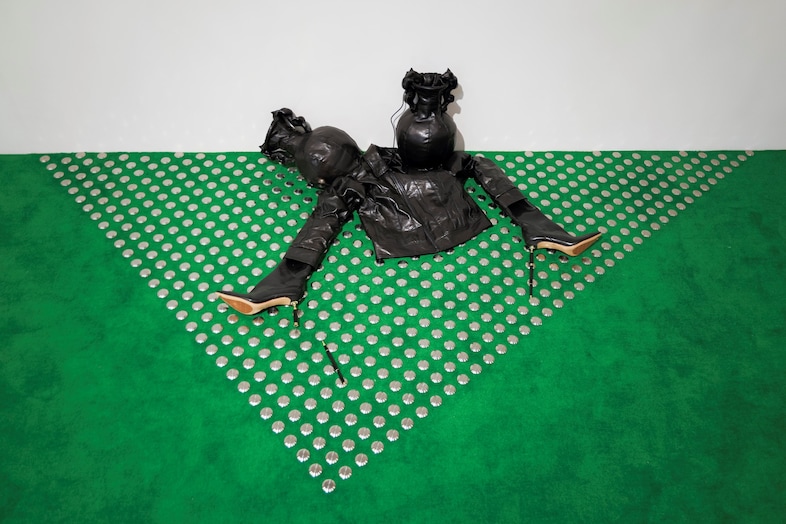
Equally compelling is the leather jacket adorned with ceramic vases protruding from the shoulders. This piece is a literal and metaphorical interpretation of Sánchez-Kane’s interest in "tilting the body." By attaching these fragile, yet rigid, extensions, the garment fundamentally alters the wearer’s posture and balance. This physical disruption compels a renegotiation of movement and perception, aligning with the "one step, one view" principle of Chinese gardens. The vases, traditional vessels of containment and display, become disruptive elements that force new ways of interacting with space and one’s own physicality, suggesting that disequilibrium can open avenues to new possibilities and unforeseen perspectives.
A series of crumpled shirts hanging from gold rails presents a poignant commentary on history, value, and cultural exchange. These shirts feature enlarged images of Diego Rivera and Frida Kahlo, figures who previously graced the Mexican 500 peso bill that went out of circulation in 2018. Sánchez-Kane highlights a subtle but significant detail: on the original banknote, Frida Kahlo appeared at a different, smaller scale than Diego Rivera. By expanding both figures to occupy the same dimension on her shirts, Sánchez-Kane subtly rectifies this historical imbalance, asserting Kahlo’s equal stature and challenging inherent patriarchal narratives embedded even in national currency.
This intervention is informed by the writings of Helena Chávez Mac Gregor, whose work on Frida Kahlo explores how "images carry historical tensions inside them." Sánchez-Kane repeatedly returned to André Breton’s famous description of Kahlo’s work as “a ribbon around a bomb,” a phrase that perfectly encapsulates the artist’s ability to combine beauty and fragility with explosive emotional and political content.
The shirts also draw a fascinating connection to the contemporary economic landscape of China. Sánchez-Kane was struck by the "near absence of physical money" in China, where digital transactions have largely replaced cash. This observation prompted her to reflect on older forms of circulation, specifically the historical Silk Road. She posits that the defunct Mexican banknotes, now rendered obsolete by digital currency, serve as a modern parallel to the historical "circulation of materials, images, and bodies between Asia and Mexico" that characterized the ancient trade routes. The crumpled, discarded appearance of the shirts further emphasizes the transient nature of value and the constant flux of economic and cultural exchange.
Beyond the Runway: Challenging Fashion’s Conventional Calendar
Bárbara Sánchez-Kane’s commitment to an interdisciplinary practice extends to her deliberate eschewal of the traditional seasonal fashion calendar. In an industry driven by relentless cycles of production and presentation, her decision to operate outside this system is a powerful statement. She unequivocally states, "Being forced into a rigid calendar doesn’t fit my curiosity or my rhythm." This stance is not merely a personal preference but a critique of a system often criticized for its environmental impact, its fostering of creative burnout among designers, and its emphasis on rapid consumption over thoughtful creation.
For Sánchez-Kane, the traditional fashion calendar represents a constraint on artistic freedom. It prioritizes commercial expediency and trend cycles over the organic development of ideas and the meticulous crafting of pieces. By liberating herself from these demands, she gains the space and time necessary to delve into complex conceptual projects like Coro de Soles Menores, allowing her work to evolve at its own pace and to be presented in contexts that align with its artistic intent, whether that be a gallery, a performance space, or an immersive installation. Her method allows for deeper intellectual engagement and a more sustainable creative output, offering a model for how fashion can transcend its commercial imperatives to become a vehicle for profound cultural discourse.
Her approach fosters a unique dialogue with her audience, inviting them to engage with her creations not just as wearable items but as art objects imbued with narrative and philosophical depth. This positions her brand in a distinctive niche, appealing to both fashion connoisseurs who appreciate avant-garde design and art collectors seeking conceptual works that blur traditional boundaries.
The Future Horizon: Celebrating a Decade of Artistic Evolution
As Bárbara Sánchez-Kane reflects on a decade since the founding of her eponymous brand, her creative momentum shows no signs of abating. Looking ahead, she is poised to present Aguas Frescas at Performance Space New York, an event slated to mark the 10-year anniversary of Sánchez-Kane. Described as "an installation like a fountain of poetry," Aguas Frescas promises to be another immersive, collaborative experience. It will bring together "different artists, performers, and musicians," creating a dynamic space where diverse creative practices can converge, interact, and translate into one another. Performance Space New York, known for its dedication to experimental and avant-garde performance, provides an ideal platform for such a multidisciplinary celebration. This upcoming project reinforces Sánchez-Kane’s enduring belief in collaboration and the transformative power of interdisciplinary dialogue, serving as a vibrant testament to her evolving artistic vision.
Beyond specific projects, Sánchez-Kane also expresses a desire to explore "works on paper," indicating a potential return to more intimate, foundational artistic mediums that complement her larger-scale installations and wearable art. This pursuit suggests a continuous process of experimentation and an openness to new forms of expression, ensuring her artistic journey remains dynamic and unpredictable.
Sánchez-Kane’s Enduring Influence on Art and Fashion
Bárbara Sánchez-Kane’s work, exemplified by Coro de Soles Menores, holds significant implications for the broader landscape of contemporary design and art. Her consistent blurring of disciplinary lines challenges the rigid categorizations that have historically separated fashion from fine art, contributing to a growing movement that views clothing as a legitimate medium for conceptual expression. By refusing to conform to industry norms, she empowers other designers and artists to pursue their visions authentically, fostering a more experimental and less commercially driven creative environment.
Her thoughtful engagement with themes of identity, culture, and societal structures, particularly through the lens of her Mexican heritage in dialogue with global contexts (like the Shanghai exhibition’s connection to Chinese culture), enriches the global cultural conversation. Sánchez-Kane’s ability to imbue garments and objects with deep philosophical meaning ensures that her work resonates far beyond the superficial trends of the moment, offering enduring insights into the human condition and the power of artistic expression. Her journey underscores the profound potential of a holistic creative practice, where personal conviction and intellectual curiosity drive a continuous evolution of form and concept.