









The landscape of the watch industry is in constant flux, marked by the enduring legacy of established maisons and the disruptive rise of nimble microbrands. A particularly intriguing development in recent times has been the remarkable success of Kiwame Tokyo, a Japanese microbrand that has achieved sold-out status with astonishing regularity since its inception less than a year ago. The latest testament to this phenomenon is the Kiwame Tokyo Mune Usuki and Mune Kurotsuki watches, which, despite being reviewed after their initial production run sold out, offer a compelling case study in the modern watch market’s dynamics.

The Enigma of Sold-Out Success
In an era where even venerable watch brands often struggle to maintain waiting lists, the rapid sell-out of Kiwame Tokyo’s offerings presents a stark contrast. This success is particularly noteworthy given that the brand operates in a segment where newness and unproven track records can be significant hurdles. The Mune Usuki and Mune Kurotsuki models, priced around $690 USD, enter a market segment saturated with established Japanese and Swiss brands offering substantial value. The question then arises: what is driving this fervent demand for a brand that, until recently, was largely unknown to the wider watch community?

Kiwame Tokyo was founded by Masami Watanabe, a veteran of Japanese watch distribution. His personal brand, launched less than a year prior to these models, has demonstrated an uncanny ability to translate fresh concepts into market-ready products that resonate with consumers. The brand’s output has, thus far, primarily consisted of watches featuring minimalist black or off-white dials, yet each iteration has seemingly vanished from availability shortly after its launch. This pattern suggests a strategic approach that prioritizes design appeal, perceived value, and a connection with the target audience, rather than relying on historical prestige.
Design Philosophy: A Harmonious Blend of Tradition and Modernity

The Kiwame Tokyo Mune Usuki, with its warm ivory dial, and the Mune Kurotsuki, featuring a sophisticated black dial, are testaments to a design philosophy that carefully balances aesthetic appeal with thoughtful execution. The author’s personal inclination towards the Mune Usuki initially, evolving into a deeper appreciation for the Mune Kurotsuki, highlights the nuanced charm of both models. This shift in preference underscores the subtle yet impactful differences that can sway a collector’s sentiment.
At the core of the Mune watches’ appeal are their impeccable proportions. Measuring 38mm in diameter, a mere 9.5mm in thickness, and with a lug-to-lug measurement of 46mm, these watches align perfectly with contemporary trends favoring more restrained sizing. This dimension is a departure from the larger cases that dominated the market in previous decades and represents a refined sweet spot between vintage aesthetics (34-36mm) and the more robust sizes of the early 21st century. The 20mm lug width, generous for a 38mm watch, contributes to a confident and balanced stance on the wrist, a design choice that enhances perceived quality and presence.

The case itself is a masterclass in understated elegance. Constructed from 316L stainless steel, it features a thoughtful interplay of surface treatments. The bezel’s top surface and the case profiles are vertically brushed, providing a matte, textured contrast to the polished bevels and the gently curved lugs. This meticulous attention to finishing, even on a microbrand, elevates the perceived value and contributes to a refined appearance that belies the watch’s price point.
The Dial: A Canvas of Intricate Detail and Cultural Resonance

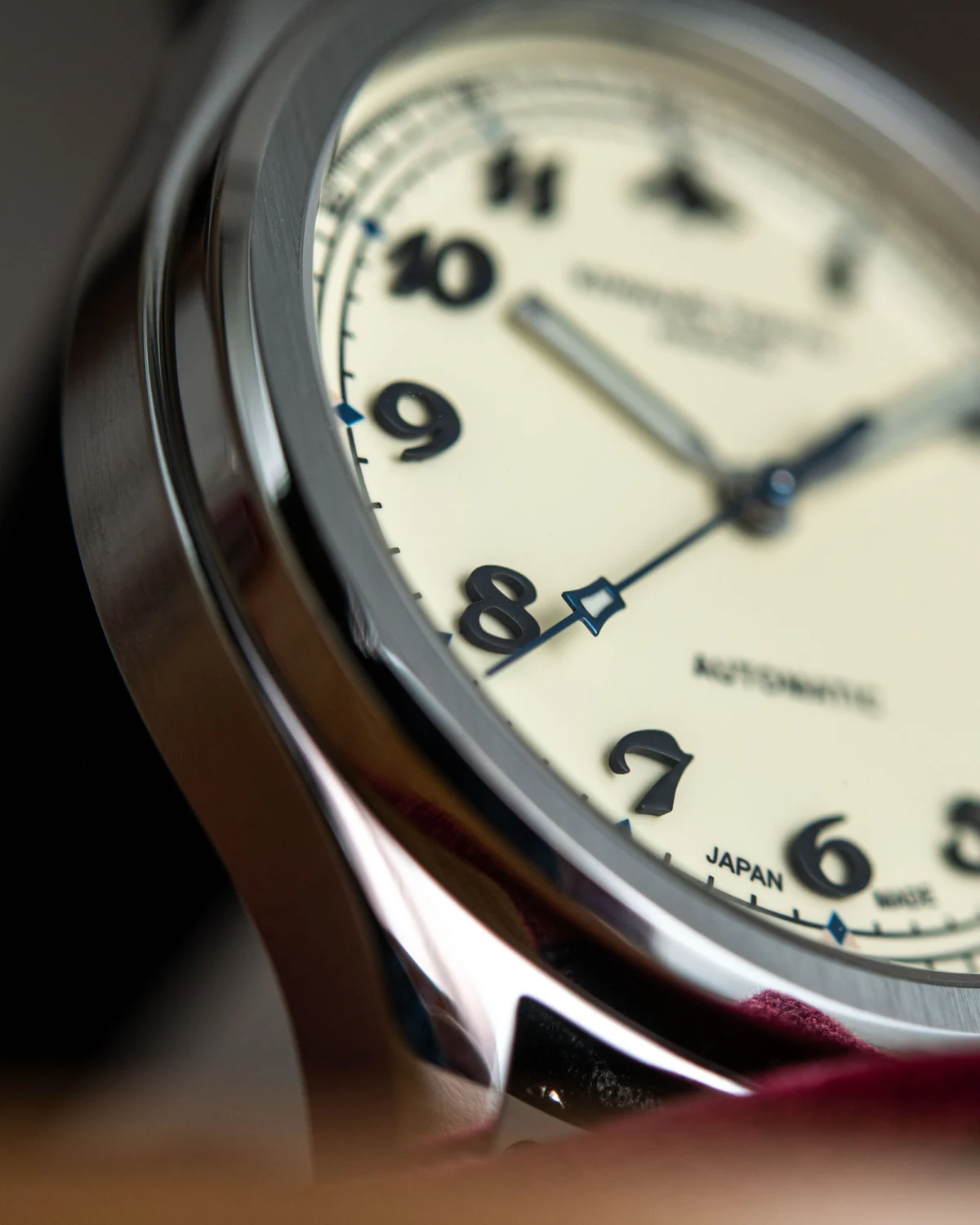
The dial is arguably the most captivating element of the Kiwame Tokyo Mune series, particularly on the Mune Usuki. Its ivory hue offers an elegant backdrop for the carefully curated dial furniture. The Breguet-inspired numerals, rendered in a slightly more cursive and italicized style than their historical counterparts, are a sophisticated choice. These numerals appear to be black powder-coated, providing a uniform and homogenous texture that remains flawless even under close inspection. This modern interpretation of a classic design element seamlessly integrates into the overall aesthetic.
A distinctive feature at the 12 o’clock position is a marker described as resembling a "mune," the apex roof ridge of historic Japanese structures, symbolizing strength and definition. This architectural motif subtly connects the watch to its cultural heritage. Further architectural inspiration is drawn from the Kaminarimon Gate in Asakusa, Tokyo’s historic "low city" district where Kiwame Tokyo is headquartered. The lumed tip of the seconds hand is designed to echo the grand roof of this iconic landmark.

The dial’s finishing touches further enhance its visual appeal. A subtle bluing on the seconds hand complements the small, blue diamond-shaped hour markers that adorn the periphery. At the cardinal points (3, 6, 9, and 12), these blue diamonds are ingeniously completed into triangles by the addition of two small, beige triangles, creating a balanced and visually engaging dial. The use of only two distinct typefaces for all dial text demonstrates a commitment to design coherence, a detail often overlooked by emerging brands.
Legibility and Functionality: Balancing Form and Practicality

While the Mune Usuki’s light dial offers superior legibility, the Mune Kurotsuki also maintains solid readability. The faceted hands, a carryover from previous Kiwame Tokyo models, are well-sized and provide excellent contrast against the dial, though reflections on the sapphire crystal, even with decent anti-reflective coating, can occasionally pose a minor challenge on the darker dial. The hour hand has been updated with a squared-off end, a subtle refinement that contributes to its modern appeal. The angularity of these hands surprisingly harmonizes with the more organic flow of the applied hour markers, a testament to the thoughtful design process.
The watch is equipped with a Japan-made Miyota 9039 automatic movement. Kiwame Tokyo further regulates these calibers in-house to achieve an accuracy of within 10 seconds per day, a notable improvement over the standard factory specifications. The case boasts a water resistance rating of 10 ATM (100 meters), offering a degree of everyday robustness. However, the absence of a screw-down crown means these watches are not intended for significant water-based activities, especially when paired with the Italian genuine calf leather strap.

The Microbrand Ecosystem: Value Proposition and Manufacturing Realities
Kiwame Tokyo’s success highlights a critical aspect of the modern microbrand movement: the ability to deliver high perceived value at accessible price points. While the watches are marketed as "Japan Made" on their casebacks, the reality, as is common in this segment, involves sourcing components from various international suppliers to maintain cost-effectiveness. The case, crown, and hands may appear on other microbrands, but Kiwame Tokyo’s strength lies in their meticulous assembly and stringent in-house quality control procedures. The spotless condition of the review samples is a direct indicator of their commitment to delivering a polished final product.

The strategic decision to utilize a reliable and widely available movement like the Miyota 9039, combined with carefully selected external components, allows Kiwame Tokyo to focus its resources on design refinement and dial execution. This approach is not unique to Kiwame Tokyo but is a common and effective strategy employed by many successful microbrands aiming to capture the attention of budget-conscious yet discerning watch enthusiasts.
Broader Implications and Future Outlook

The rapid sell-out of the Kiwame Tokyo Mune Usuki and Mune Kurotsuki signifies a broader shift in consumer preferences within the watch market. Enthusiasts are increasingly drawn to brands that offer a compelling combination of fresh design, excellent value, and a relatable narrative. The ability of a young brand like Kiwame Tokyo to capture attention and generate such demand suggests that established players may need to re-evaluate their strategies to remain competitive. The focus on provenance and heritage, while important, is no longer the sole determinant of success.
The demand for these watches has been so high that frustrated comments have flooded online forums, underscoring the scarcity and desirability. While the initial pre-orders are sold out, Kiwame Tokyo has confirmed that future production runs are planned. Interested buyers are encouraged to sign up for notifications on the brand’s website for future releases and restocks. The Mune Kurotsuki is estimated for delivery in mid-July, while the Mune Usuki was slated for late May, indicating ongoing production and fulfillment efforts.

Conclusion: A Model for Modern Watchmaking
The Kiwame Tokyo Mune Usuki and Mune Kurotsuki watches represent more than just attractive timepieces; they embody a successful model for microbrand watchmaking in the 21st century. Their appeal lies in a harmonious blend of contemporary design, historical inspiration, meticulous execution, and a keen understanding of market dynamics. The brand’s ability to consistently deliver products that sell out rapidly suggests a deep connection with its audience and a promising future in the competitive horological landscape. For those seeking a stylish, well-proportioned, and thoughtfully designed watch at an accessible price point, Kiwame Tokyo has undoubtedly made its mark. The question now is not if they will release more sought-after models, but rather, what will come next from this dynamic Japanese microbrand.