









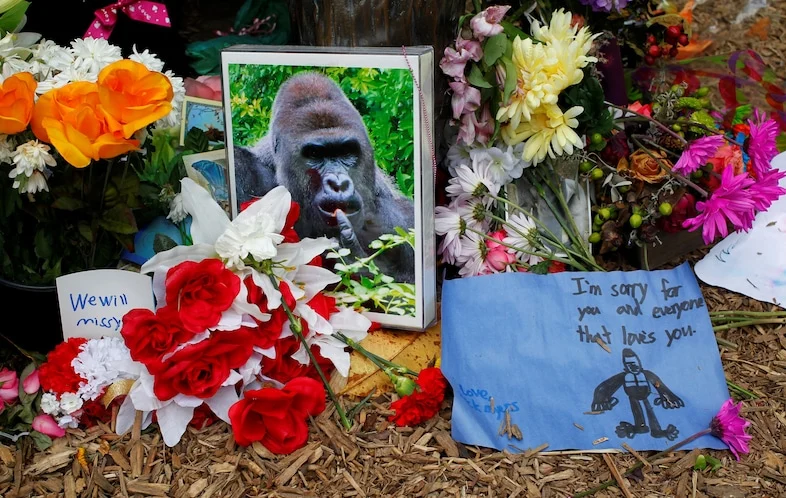
This week marks ten years since Harambe, the 17-year-old western lowland gorilla, was tragically shot and killed at the Cincinnati Zoo & Botanical Garden. The incident, which unfolded on May 28, 2016, after a three-year-old boy fell into his enclosure, swiftly transcended its immediate tragic circumstances to become a global phenomenon, igniting intense debate, profound grief, and an unprecedented surge of internet meme culture that continues to resonate a decade later. The death of the magnificent silverback, initially a stark reminder of the inherent risks and ethical complexities of zoos, quickly morphed into a bizarre and enduring cultural touchstone, reflecting the rapidly shifting landscapes of digital communication, political discourse, and collective societal anxieties.
The Tragic Incident: A Detailed Chronology
On that fateful Saturday, the Cincinnati Zoo was bustling with visitors enjoying Memorial Day weekend. Harambe, a 400-pound (180 kg) male gorilla, had been born at the Gladys Porter Zoo in Brownsville, Texas, and transferred to Cincinnati in 2015 with the hope that he would contribute to the critically endangered western lowland gorilla breeding program. Known for his intelligence and imposing presence, he was a significant asset to the zoo’s conservation efforts.
The Gorilla World exhibit, where the incident occurred, was designed to immerse visitors in a naturalistic habitat, featuring a public viewing area separated from the gorilla enclosure by a three-foot-tall fence, a series of bushes, and a 15-foot (4.6-meter) wide moat. Around 4:00 PM EDT, a three-year-old boy, who had reportedly climbed over the barrier, slipped through the bushes, and fell approximately 15 feet into the moat, landing directly in front of Harambe.
Eyewitness accounts and subsequent video footage captured the harrowing ten-minute ordeal. Initially, Harambe appeared to exhibit curiosity, approaching the boy and even gently nudging him. However, as onlookers screamed in panic and distress, the atmosphere became highly agitated. Harambe, a powerful animal in an unfamiliar and stressful situation, began to drag the child through the water of the moat and across the concrete ground of the enclosure. While some observers interpreted his actions as protective, primatologists later clarified that gorillas, even when not intending harm, possess immense strength that could easily be fatal to a small child, particularly under stress. The dragging behavior, combined with the escalating panic, presented an immediate and life-threatening danger.
The zoo’s Dangerous Animal Response Team (DART) quickly assessed the situation. Facing a rapidly evolving crisis, and with the child’s life hanging in the balance, they made the difficult decision to use lethal force. Tranquilizer darts were considered but dismissed due to the time delay in their effect and the risk of further agitating the gorilla, potentially leading to a more violent reaction. At 4:15 PM, a DART member fatally shot Harambe with a single rifle shot. The boy was subsequently rescued and transported to Cincinnati Children’s Hospital Medical Center with minor injuries, primarily a concussion and some scrapes.
Immediate Aftermath and Public Scrutiny
The immediate aftermath was a maelstrom of shock, grief, and outrage. Thane Maynard, the director of the Cincinnati Zoo, held a press conference defending the DART team’s actions, stating unequivocally that the decision was made to save the child’s life. "We are heartbroken about losing Harambe," Maynard said, "but the child’s life was in danger. We made the right call." He emphasized the gorilla’s strength and the imminent threat posed to the boy.
Public reaction was polarized and intense. Animal rights activists and a significant portion of the general public condemned the zoo’s decision, arguing that Harambe should have been tranquilized or that the enclosure’s security was insufficient. Petitions demanding "justice for Harambe" garnered hundreds of thousands of signatures, and calls for an investigation into both the zoo’s protocols and the parents’ supervision of the child proliferated online. Conversely, many supported the zoo, asserting that human life always takes precedence and that the DART team had no other viable option.
Renowned primatologist Dr. Jane Goodall, in a statement released shortly after the incident, called it an "awful" tragedy for all involved: "the child, the parents, Harambe, the zoo, the keepers and the public." She acknowledged the difficult position of the zoo staff but also raised critical questions about the security of such enclosures and the broader implications of keeping powerful wild animals in captivity. Other experts, such as Dr. Tara Stoinski, president and CEO of the Dian Fossey Gorilla Fund, echoed the sentiment that while Harambe’s death was tragic, the zoo’s primary responsibility was the child’s safety, and the behavior observed was consistent with an animal under extreme stress, not necessarily aggressive intent, but still incredibly dangerous.
A police investigation concluded that the boy’s parents would not face criminal charges, finding no evidence of neglect. The U.S. Department of Agriculture (USDA) also investigated the zoo’s compliance with the Animal Welfare Act, ultimately finding no violations related to the enclosure or the incident itself. However, the tragedy reignited a global debate on the ethics of zoological parks, animal welfare standards, and the perceived safety of such exhibits for the public. Zoos worldwide reviewed their safety protocols, with some implementing additional barriers or modifying exhibit designs to prevent similar occurrences.
The Digital Explosion: From Grief to Meme
What began as a profound tragedy quickly transformed into an unprecedented cultural phenomenon, largely fueled by the internet. Initially, online platforms were awash with genuine grief, heartfelt tributes, and sincere calls for reflection on animal welfare. Hashtags like #RIPHarambe and #JusticeForHarambe trended globally, accompanying thousands of shared images, eulogies, and calls for accountability.
However, within weeks, the narrative began to shift dramatically. The sheer volume of emotional responses, coupled with the internet’s inherent capacity for irony and absurdity, saw Harambe’s image co-opted into a vast and complex meme. The phrase "Dicks Out for Harambe," coined by comedian Brandon Wardell, became a viral sensation, initially intended as an over-the-top, almost nonsensical expression of solidarity, but rapidly evolving into a symbol of internet culture’s penchant for dark humor and ironic detachment.
This memeification of Harambe was unique in its scale and rapidity. It moved beyond simple remembrance to become a vehicle for a wide range of online expressions: from genuine attempts at humor to elaborate, multi-layered satirical commentary on public grief, internet virality, and the nature of online communities. Harambe became a symbol of everything and nothing, a blank canvas onto which various online subcultures projected their own meanings. This rapid evolution from sincere mourning to ironic meme underscored the internet’s power to both amplify and distort narratives, transforming a real-world tragedy into a digital legend.
Harambe’s Unforeseen Political and Cultural Resonances
As 2016 progressed, a year marked by significant political upheavals globally—including the United Kingdom’s Brexit vote and the escalating U.S. presidential campaign that would ultimately see Donald Trump elected—Harambe’s legacy took an even stranger turn. The meme began to be appropriated by various fringe groups, most notably elements of the burgeoning alt-right movement.
White nationalists and conspiracy theorists latched onto the Harambe meme, leveraging its viral reach and inherent absurdity to spread their messages. The meme’s malleable nature allowed it to be infused with racist dog whistles, anti-establishment sentiments, and thinly veiled political agendas. Brandon Wardell, who popularized "Dicks Out for Harambe," publicly expressed his discomfort, telling the BBC at the time, "I didn’t love that there were Nazis that were all of a sudden into a meme that I created." This co-option highlighted a concerning trend where internet memes, seemingly innocuous, could be weaponized to normalize extremist ideologies and introduce them to wider audiences through ironic detachment.
Beyond the alt-right, some commentators and internet users began to retroactively frame Harambe’s death as a pivotal moment, an "anchor being" event that heralded a decade of unprecedented global instability and chaos. This theory, often presented with a mix of earnestness and dark humor, suggested that the killing of Harambe somehow "broke" the timeline, leading directly to the political turmoil, climate crises, and social anxieties that have defined the years since 2016. While clearly not a literal cause, this narrative reflects a collective sense of spiritual malaise and a yearning for a singular explanation for a complex, turbulent world.
Even prominent public figures engaged with the Harambe phenomenon. Donald Trump, whose 2016 campaign masterfully utilized internet memes like Pepe the Frog, offered his thoughts on the incident in 2016. He described Harambe’s actions as "almost like a mother holding a baby… so beautiful and calm," while also admitting, "There were moments where [it] looked pretty dangerous." This seemingly contradictory statement, typical of Trump’s rhetorical style, further cemented Harambe’s place in the political consciousness. The hypothetical scenario, as depicted in future-dated social media content, where official White House accounts might even memorialize Harambe as a "true patriot" and a "symbol of loyalty, strength, chaos, unity," underscores the extent to which this gorilla’s image became intertwined with American political and cultural identity, even as a satirical or ironic construct.
The phenomenon extended to tech billionaires as well. Elon Musk, known for his attempts to engage with internet culture, released an autotuned track titled "RIP Harambe" on SoundCloud three years after the meme’s initial peak. His continued references to Harambe years later, often perceived as attempts to garner attention or demonstrate his "funny guy" persona, further illustrated how deeply the gorilla had permeated various strata of online and public life, becoming a convenient, if often cringeworthy, touchstone for those seeking viral relevance.
Ethical and Zoo Management Implications
The Harambe incident provoked a significant re-evaluation within the zoological community. While the USDA found no direct violations at the Cincinnati Zoo, the tragedy served as a stark reminder of the inherent risks associated with housing powerful wild animals in close proximity to the public. The Association of Zoos and Aquariums (AZA), which accredits over 230 zoos and aquariums in North America, saw renewed discussions on enclosure design, emergency protocols, and visitor safety. Many zoos subsequently reviewed and often reinforced their barriers, adding extra layers of protection to prevent unauthorized access to animal habitats.
Beyond physical barriers, the incident intensified debates about the role of zoos in modern society. Critics argued that Harambe’s death was a tragic consequence of keeping highly intelligent and powerful animals in captivity, where their natural instincts could pose a danger in unusual circumstances. Proponents of zoos, however, emphasized their crucial role in species conservation, education, and scientific research, particularly for critically endangered species like the western lowland gorilla. The incident underscored the delicate balance zoos must strike between providing enriching environments for their animals, ensuring visitor safety, and contributing to global conservation efforts.
The public’s perception of zoos was undoubtedly affected. For many, Harambe became a symbol of the ethical dilemmas surrounding animal captivity, fueling calls for more robust animal welfare standards and a critical re-examination of the benefits versus costs of zoological displays. The tragedy forced a broader conversation about human responsibility towards wildlife, both in the wild and in managed environments.
The Enduring Legacy: A Mirror to Our Times
A decade after his death, Harambe’s legacy remains complex and multifaceted. He is remembered not only as a tragic figure whose life was cut short but also as an unlikely cultural icon whose story became a lens through which to view the peculiarities of the digital age.
Harambe’s journey from a beloved zoo resident to a global internet meme, and then to a symbol co-opted by political movements and cultural figures, offers a profound insight into the mechanics of modern media. His story encapsulates the internet’s capacity for instantaneous global communication, its ability to transform earnest grief into ironic humor, and its darker potential for disseminating fringe ideologies under the guise of absurdity.
The Harambe phenomenon reflects a society grappling with rapid technological change, political polarization, and a collective search for meaning in an increasingly chaotic world. Whether viewed as a sincere expression of animal rights advocacy, a testament to the internet’s boundless creativity, a harbinger of global decline, or simply a bizarre footnote in history, Harambe’s story continues to evolve. He remains a powerful, if often bewildering, symbol of the strange beauty and disorienting power of the internet to bring millions of people together—for grief, for laughter, and for a cause that, ten years on, few can fully define, yet everyone remembers.