










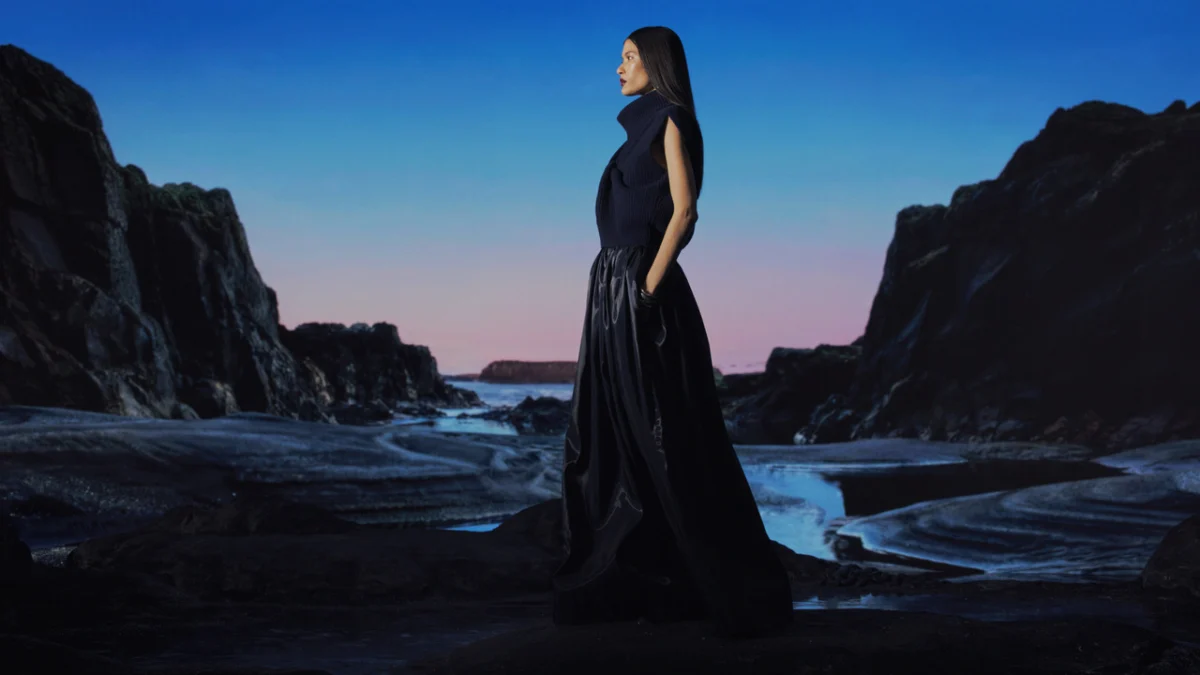
The intersection of high fashion and cutting-edge technology reached a new milestone this week as designer Kate Barton unveiled her latest collection at New York Fashion Week, fundamentally altering the traditional runway experience through a sophisticated integration of artificial intelligence. In a strategic partnership with Fiducia AI and powered by IBM’s watsonx platform, Barton introduced a multilingual AI agent designed to bridge the gap between avant-garde design and consumer engagement. This activation, which debuted on Saturday, represents a significant shift in how luxury brands approach digital transformation, moving beyond back-end logistics into the heart of the creative presentation.
The centerpiece of the event was a production-grade AI agent built on IBM Cloud, utilizing IBM watsonx to provide guests with a seamless, interactive portal into Barton’s creative world. Unlike standard fashion presentations where the audience remains passive observers, this collaboration allowed attendees to use a visual AI lens to identify specific pieces from the collection in real-time. The system, capable of processing inquiries in multiple languages via both voice and text, offered photorealistic virtual reality try-ons, allowing the "unreal" elements of digital fashion to merge with the tactile reality of the physical garments.
The Genesis of a Technological Partnership
The collaboration between Kate Barton and Fiducia AI is not a sudden pivot but rather the evolution of a long-standing curiosity regarding the role of technology in design. Last season, Barton experimented with AI models in partnership with Fiducia, laying the groundwork for the more robust, IBM-backed deployment seen this year. Ganesh Harinath, the founder and CEO of Fiducia AI, emphasized that the current iteration is a significant leap forward in terms of technical complexity and reliability.
According to Harinath, the primary challenge of the project was not merely the tuning of the AI models but the intricate orchestration required to make the technology function flawlessly in a high-pressure live environment. To achieve this, Fiducia AI leveraged the full spectrum of IBM’s enterprise-grade tools, including IBM watsonx, IBM Cloud, and IBM Cloud Object Storage. The result was an ecosystem capable of handling high-resolution visual data and complex natural language processing simultaneously, ensuring that the AI could act as an intuitive extension of the brand rather than a distracting gimmick.
Barton’s philosophy regarding technology is rooted in the concept of "heightened craft." She views AI not as a replacement for human ingenuity but as a tool for expanding the narrative surrounding the clothes. For Barton, the goal was to create a sense of curiosity and a "double take" moment for the audience, using technology to build a portal into the collection’s specific aesthetic world. This approach distinguishes her work from many other brands that have adopted AI more quietly for operational efficiency or internal productivity.
Technical Infrastructure and the Visual AI Lens
At the core of the New York Fashion Week activation was the Visual AI Lens, a bespoke tool developed to recognize the unique silhouettes and textures of Barton’s latest collection. The training of this lens required a sophisticated dataset of the designer’s work, processed through IBM watsonx’s foundation models. This allowed the AI to identify garments even under the varying lighting conditions of a fashion show, providing instant metadata and styling suggestions to the user.
The multilingual capabilities of the AI agent were particularly critical for an event with an international audience. By utilizing IBM’s advanced natural language processing, the agent could communicate the nuances of Barton’s design philosophy in various languages, ensuring that the "story" of the collection was accessible to global buyers, journalists, and influencers. The integration of voice-to-text and text-to-voice features created a conversational interface that felt personal and responsive, a far cry from the static QR codes or basic chatbots often seen in retail environments.
Furthermore, the photorealistic virtual try-on feature utilized high-fidelity rendering to superimpose digital versions of the garments onto the user’s likeness. This required significant computational power and low-latency processing, facilitated by the IBM Cloud infrastructure. By providing a "try-on" experience that looked and felt realistic, Barton and Fiducia AI addressed one of the primary hurdles of digital fashion: the loss of material presence and fit visualization.

Industry Context and the Evolution of Digital Fashion
The integration of AI at New York Fashion Week comes at a time when the fashion industry is grappling with its digital identity. For decades, the industry has followed a predictable cycle of adoption. In the late 1990s and early 2000s, luxury houses were notoriously hesitant to embrace e-commerce, fearing it would dilute the exclusivity of their brands. Eventually, the question shifted from whether a brand should be online to how high the quality of that online presence should be.
Barton observes a similar trajectory with artificial intelligence. While many brands currently use AI for supply chain management, trend forecasting, and customer service automation, few have been willing to make it a public-facing component of their creative output. The hesitation often stems from reputational risks, including concerns over intellectual property, the potential for "uncanny valley" visual errors, and the broader ethical debate regarding the replacement of human labor.
However, market data suggests that the momentum is irreversible. Industry analysts project that the global market for AI in fashion will grow at a compound annual growth rate (CAGR) of over 35% through 2030. By 2028, experts like Harinath predict that AI-driven experiences will be the norm for high-end fashion shows, and by 2030, these technologies will be deeply embedded into the core operations of global retail. The differentiator for brands moving forward will be the ability to assemble the right technical partners and build teams capable of operationalizing AI in a responsible and creative manner.
Ethical Considerations and Human Centric Design
A recurring theme in Barton’s discourse is the preservation of human creativity. She remains steadfast in her belief that technology should not be used to "erase" the people who make fashion worth wearing. "If the technology is used to erase people, I am not into it," Barton stated during her conversation with TechCrunch. This sentiment reflects a growing movement within the creative industries to establish clear licensing, credit, and ethical guidelines for the use of generative AI.
The designer argues that audiences are increasingly sophisticated and can discern the difference between "invention"—using tools to create something new—and "avoidance"—using tools to cut costs or bypass human talent. For Barton, the value of the AI agent lies in its ability to deepen storytelling and bring more people into the experience without flattening the roles of the artisans, seamstresses, and designers who are the lifeblood of the industry.
Dee Waddell, Global Head of Consumer, Travel and Transportation Industries at IBM Consulting, echoed this sentiment, noting that the most successful applications of AI are those that connect inspiration, product intelligence, and engagement in real-time. When these elements are aligned, AI ceases to be a mere feature and becomes a growth engine that provides a measurable competitive advantage.
Timeline of the NYFW Activation and Future Implications
The journey toward Saturday’s unveiling followed a rigorous development timeline:
- Conceptualization (Post-Previous Season): Barton and Fiducia AI identified the need for a more immersive, "production-grade" interaction following their initial AI experiments.
- Partnership Integration: IBM joined the collaboration, providing the watsonx platform and cloud infrastructure necessary for high-scale deployment.
- Development and Orchestration: Over several months, the team focused on model training for the Visual AI Lens and the multilingual agent, prioritizing seamless orchestration between different technical modules.
- Live Activation: The system was deployed at New York Fashion Week, offering real-time identification and virtual try-ons for the new collection.
Looking ahead, the success of Barton’s presentation provides a blueprint for other luxury houses. The focus on "responsible AI"—characterized by clear discourse, licensing, and a focus on enhancing human craft—will likely become the standard for the industry. As retail moves toward a more personalized, data-driven future, the ability to offer "photorealistic" and "conversational" digital experiences will be a key factor in maintaining consumer loyalty and driving sales in a competitive global market.
The ultimate takeaway from Barton’s latest showing is that the future of fashion is not "automated" fashion, but "augmented" fashion. By using new tools to heighten the craft and broaden the accessibility of her work, Barton has demonstrated that technology, when applied with intention and respect for human creativity, can enhance the magic of the runway rather than diminish it. As the industry looks toward 2030, the "double take" moments created by designers like Barton will likely become the foundation of the modern luxury experience.