







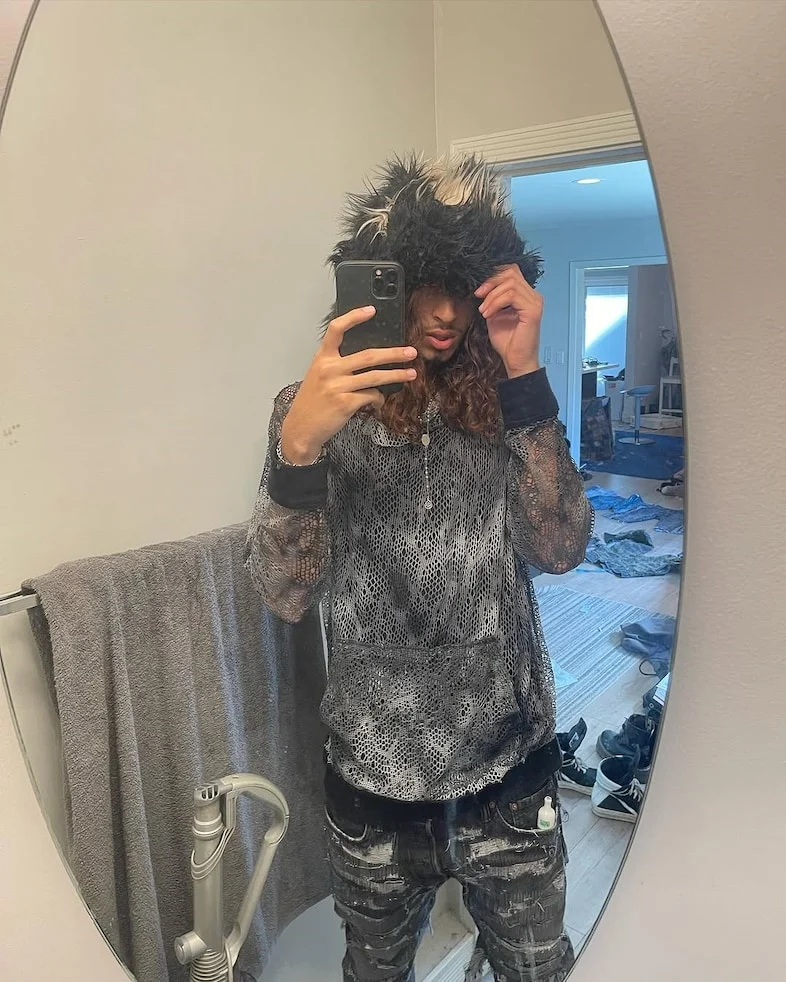
The fashion world is witnessing a compelling shift, with independent designers leveraging digital platforms to disrupt traditional narratives and introduce fresh perspectives. At the forefront of this movement is Elias Faizi, a young creative whose recent Instagram reel, captioned "Making things I don’t want to buy," swiftly captivated a global audience. The viral post showcased his unique rendition of a luxury accessory, a Chrome Hearts-inspired bag, where the brand’s iconic cross motifs were meticulously replaced with elegant Islamic calligraphy scrawled across rich black leather. This piece, now a featured item on his burgeoning online store, epitomizes Faizi’s distinctive blend of audacious design, cultural homage, and a steadfast commitment to a do-it-yourself (DIY) philosophy that has characterized his journey from its inception. Alongside this viral sensation, his collection boasts an array of other innovative pieces, some featuring similar Islamic cultural motifs, while others display heavily distressed, cut, and washed fabrics, reflecting a raw, deconstructed aesthetic that challenges conventional notions of luxury and perfection.
The Genesis of a DIY Aesthetic: From High School Dreams to Viral Success
Faizi’s distinctive approach to fashion design is deeply rooted in his personal journey, commencing in 2020 shortly after his high school graduation. Faced with a burgeoning desire for high-end garments, such as those from Dior, but lacking the financial means to acquire them, he embarked on a pragmatic yet creatively charged path. "I had just graduated from high school, and there were a lot of clothes I wanted, but I had no money and no way of getting them. I couldn’t buy Dior straight out of the aisle, so I was just kind of trying to make the designs myself," Faizi recounts from his Alameda studio, just outside Oakland. This pivotal moment marked the acquisition of his first sewing kit, a seemingly modest purchase that would become the cornerstone of his self-taught design empire.
His initial foray into fashion, however, predates this hands-on experimentation. As early as 2015, during his high school years, Faizi was captivated by the nascent trend of distressed denim, observing a friend’s entrepreneurial efforts in selling such pieces. "One of my friends in high school was selling distressed denim back in like 2015, and at the time, it seemed like the coolest thing in the world to me," he recalls. Despite repeated failed attempts to replicate the technique himself, this early fascination proved instrumental, laying the groundwork for his later mastery of distressing and reconstruction, skills that would become central to his signature style, particularly in crafting Undercover-style denim. This early exposure instilled a persistent curiosity and a foundational understanding of garment manipulation, even without formal instruction.
Despite his growing passion for fashion, Faizi initially pursued an academic route, enrolling in a Sociology degree program at UCLA. This decision, however, did not deter his creative endeavors. Instead, it ran in parallel, allowing him to cultivate his design skills independently. During this period, he organically connected with a loose-knit network of young designers, many of whom, like him, were self-taught and operating outside the traditional confines of the formal fashion industry. This burgeoning community became a crucial incubator for experimentation and collaboration. Among his peers was Kyle Cole, the founder of Ends Repair, with whom Faizi and others began to rigorously experiment. Their collective focus was on distressed denim, the intricate reconstruction of garments, and drawing archive references from revered Japanese labels such as Undercover and Kapital.
Faizi elaborates on this period of creative exploration, stating, "We found a really good niche copying and reworking those styles." He vividly remembers a specific series based on Undercover denim, a period when the original pieces from the Japanese brand were fetching prices as high as $10,000 on resale platforms like Grailed, underscoring the high demand and cultural capital associated with these styles. This early success in reinterpreting established designs not only honed his technical skills but also solidified his understanding of market trends and consumer desires. From these foundational experiments, Faizi’s design repertoire expanded dramatically. He moved into creating distinctive balaclavas, oversized fur backpacks, and an ever-growing collection of entirely handmade pieces, all produced within the intimate confines of his own studio. The evolution from replicating admired styles to conceptualizing and executing original, handcrafted items marked a significant turning point in his creative trajectory.
The recent viral success of his Chrome Hearts-inspired bag with Islamic calligraphy is a testament to this sustained creative momentum and his growing ability to tap into contemporary cultural conversations. The instantaneous spread of the Instagram reel, featuring a bold fusion of Western luxury aesthetics with deeply personal and cultural motifs, catapulted his work into the mainstream consciousness. This virality was not merely a fleeting moment but a strategic amplification of his brand, translating into heightened demand and a tangible expansion of his online store’s offerings. The bag, a statement piece that challenges brand hegemony while celebrating cultural identity, quickly became a flagship item, symbolizing the innovative spirit that defines Elias Faizi’s brand.
The Philosophy of Unconventional Design: Self-Taught Prowess and Creative Freedom
Elias Faizi’s design philosophy is a powerful testament to the liberating potential of self-taught artistry, fundamentally challenging the rigid structures often associated with formal fashion education. He firmly believes that the absence of conventional training has been a significant catalyst for his creative freedom. "Definitely. We don’t follow this formal process that can limit people," Faizi asserts, highlighting the inherent flexibility in his approach. This freedom allows him to prioritize visual impact and conceptual integrity over rigid adherence to traditional construction techniques. For Faizi, if a piece achieves "the illusion of detail" and delivers the desired visual effect, its construction does not need to be flawlessly perfect by conventional standards. This perspective is a direct critique of the perfectionist mindset that can stifle innovation, particularly among aspiring designers.
He observes that many individuals "limit themselves because something didn’t come out perfectly. They think they can’t sell it or show it." Faizi’s counter-argument is straightforward and empowering: "But if you like looking at it, if it inspires you, then why not make it?" This ethos encourages a relentless pursuit of creative vision, even if it means embracing imperfection or the unfinished. He candidly admits, "I’ve done a lot of projects where I only like one segment of it, and I never finish the whole thing, but I still keep them because there’s something in there I connect with." This iterative, discovery-driven process, where fragments of inspiration are preserved and valued, underscores a deep respect for the creative journey itself, rather than solely focusing on the final, polished product.
This approach aligns with a broader trend in contemporary fashion where authenticity and unique storytelling often supersede mass-produced uniformity. The "maker movement" and the rise of direct-to-consumer brands have empowered independent designers like Faizi to forge direct connections with an audience that values craftsmanship, individuality, and a departure from mainstream luxury’s often homogenous offerings. His methods resonate with consumers seeking unique, high-quality, and ethically produced goods, often imbued with a personal narrative.
Faizi’s appreciation for fashion is also deeply rooted in a reverence for timeless design. He arrived relatively late to the world of fashion, developing a keen interest around the age of 17. Consequently, his "grail" pieces are predominantly older, iconic designs. "Most of my grails are older pieces. I don’t really see newer things as grails yet because they haven’t stood the test of time," he explains. This perspective highlights a discerning eye for enduring aesthetic value over ephemeral trends. He deliberately aims to "avoid" trendiness in his own work, aspiring to "make things that visually last." Specific designers like older Margiela and Raf Simons hold a special place as his grails, symbolizing a commitment to conceptual depth, innovative silhouettes, and an artistic integrity that transcends seasonal fads. This vision positions his brand not as a fleeting sensation but as a contributor to a lasting sartorial legacy.
Central to Faizi’s brand identity is his unwavering commitment to a hands-on, artisanal approach. He insists on personally making every single item, a practice that, while demanding, ensures an unparalleled level of quality control and artistic fidelity. "Yeah. I like that I’m touching every piece and making sure everything is exactly how I want it," he affirms. This meticulous dedication, however, comes with its own set of challenges, particularly when considering scalability. He admits to experiencing anxiety when others attempt to assist him, explaining, "I’ve had people try to help me before, but I get anxious watching them work because it’s not exactly how I’d do it." This deeply personal investment in each piece underscores his artistic integrity but also highlights a critical juncture for his burgeoning brand: the eventual need to either find a manufacturing partner who can perfectly align with his vision or to cultivate the ability to delegate more effectively without compromising his artistic standards. This tension between artisanal control and the demands of scaling production is a common challenge for independent designers aiming for broader reach while maintaining their core identity.
The Challenges and Joys of an Independent Creator
The life of an independent designer like Elias Faizi is a blend of intense creative satisfaction and formidable operational challenges. His recent viral success, while a boon for visibility, has brought to the forefront the complexities of managing a rapidly growing demand with a strictly handmade production model. "I just finished a bunch of orders for the bags I’ve been making. I never really did a proper release. One of my recent videos just happened to do really well, so now I want to properly promote the bags and let people know they’re available," he shares. This organic growth, though exciting, underscores the need for a more structured approach to releases and inventory management.
Faizi envisions a future where he builds small, curated collections, a deliberate choice to maintain quality and artistic control. "Eventually, I want to build small collections, but I don’t like releasing too many things at once. Since I make every single item myself, if I suddenly got loads of orders, I wouldn’t be able to handle it all," he explains. This pragmatic understanding of his capacity is crucial for sustainable growth, preventing burnout and ensuring that each piece meets his exacting standards. The scaling dilemma—how to grow without sacrificing the essence of a handmade, artisanal brand—is a common hurdle for many independent creators. For Faizi, the path forward involves either finding a manufacturer he can "really trust" to replicate his precise vision or learning to "let people help more," a significant personal and professional evolution.
His studio, the crucible of his creations, is a space where creativity thrives amidst varied sensory inputs. The soundtrack to his meticulous work shifts constantly, reflecting the dynamic nature of his creative process. "Sometimes I listen to classical music because it’s calming and puts me into this creative mindset where I feel like I’m in rich, old France or something," he describes, painting a vivid picture of the atmosphere he cultivates. This tranquil inspiration can swiftly give way to more contemporary sounds: "Then I’ll switch to rap. I listen to a lot of Lucki." However, even music has its limits in sustaining focus during long hours. "After a while, it all starts sounding the same, though, so eventually I’ll just put a movie on. Usually, every studio session ends with a movie playing," he reveals, offering a glimpse into the routines that punctuate his intensive creative periods.
The wellspring of Faizi’s creativity is spontaneous and often unpredictable. "It hits me randomly. Sometimes it’ll be at the worst possible moment, when I have no way of jotting the idea down. I’ll be hiking, and just think: shit, I need to remember this," he illustrates. This inherent randomness underscores the intrinsic nature of his artistic drive, an ever-present force that demands capture and expression regardless of circumstance.
Despite his undeniable talent and the viral reach of his work, Faizi maintains a complex relationship with the digital realm and the imperative of online self-promotion. "I’m trying to get better at it. Everyone around me says that’s my biggest drawback," he admits candidly. The tension between his desire to create and his reluctance to constantly engage with public perception is palpable. "I spend all this time making things, and then I’ll post once and disappear. I don’t really like being perceived too much. It gets overwhelming when loads of people are commenting on you – but I’m trying." This introspection highlights a common challenge for artists in the social media age: balancing the necessity of online presence for brand building with personal comfort and the desire for privacy. His journey reflects the broader struggle many creators face in navigating the demands of digital marketing while preserving their authenticity and mental well-being.
When asked about a mantra that guides his creative life, Faizi offers a simple yet profound philosophy: "Don’t take it too seriously. Whenever I take making things too seriously, I stop enjoying it, and the work gets worse. It starts feeling like survival instead of creativity." This mindful approach is a crucial self-preservation mechanism, especially for someone prone to overwhelming himself. "I’m very prone to overwhelming myself, so I try to keep everything as low-stress as possible," he emphasizes. This perspective underscores the importance of joy and passion as fundamental drivers of sustainable creativity, preventing the artistic process from becoming a burdensome chore.
In terms of aspirations for his designs, Faizi’s dream recipient speaks volumes about his cultural awareness and contemporary relevance. "If I could get Lamine Yamal into some clothes, that would be insane," he muses, referencing the prodigious young footballer. This choice not only indicates a desire for visibility among influential figures but also connects his brand to the vibrant, global youth culture that often transcends traditional fashion boundaries.
Implications and the Future of Elias Faizi
Elias Faizi’s trajectory represents more than just the rise of another designer; it embodies a significant shift in the fashion landscape. His success validates the power of self-taught talent and alternative pathways into an industry traditionally dominated by established institutions and formal training. By bypassing conventional fashion schools and industry gatekeepers, Faizi has demonstrated that authentic vision and relentless dedication can carve out a unique space, resonating directly with consumers in the digital age. This disruption offers a beacon of hope for countless aspiring designers who may lack access to traditional avenues.
The integration of Islamic calligraphy into his designs is particularly noteworthy, marking a powerful cultural statement within the luxury fashion sphere. This fusion not only appeals to a diverse global audience but also contributes to a broader conversation about cultural representation and appreciation in design. In an era where authenticity and cultural sensitivity are increasingly valued, Faizi’s work offers a fresh, meaningful perspective, bridging contemporary aesthetics with rich heritage. This approach allows him to connect with consumers seeking apparel that reflects their identity and values, moving beyond mere brand labels.
His unwavering commitment to handmade items further positions him within the growing artisanal movement, which champions craftsmanship, quality, and ethical production. In stark contrast to the rapid cycles and often questionable labor practices of fast fashion, Faizi’s meticulous, hands-on approach speaks to a desire for unique, durable, and thoughtfully produced goods. While not explicitly stated, the DIY, reconstructed, and distressed nature of his work implicitly aligns with principles of upcycling and reducing textile waste, suggesting a sustainable undercurrent to his brand that appeals to environmentally conscious consumers.
Looking ahead, Faizi’s immediate focus remains on strategically promoting his viral bags and gradually building small, curated collections. The challenge of scaling production while preserving the handmade integrity of his brand will be critical. This necessitates either a careful selection of manufacturing partners who can uphold his stringent quality standards or a personal evolution in delegation, both of which are pivotal for broader market penetration. His journey is a microcosm of the challenges faced by many independent designers aiming to transition from passionate hobbyists to commercially viable brands without sacrificing their artistic soul.
Elias Faizi’s evolving narrative suggests a potential legacy as a pioneer of independent, culturally conscious, and quality-driven design. His work serves as an inspiration, demonstrating that a deep-seated creative drive, coupled with an unconventional approach, can forge a path to success and influence. As he navigates the complexities of growth and visibility, Faizi stands as a compelling figure in the ongoing evolution of fashion, proving that genuine creativity, untethered by convention, can indeed reshape industry norms and inspire a new generation of makers.