







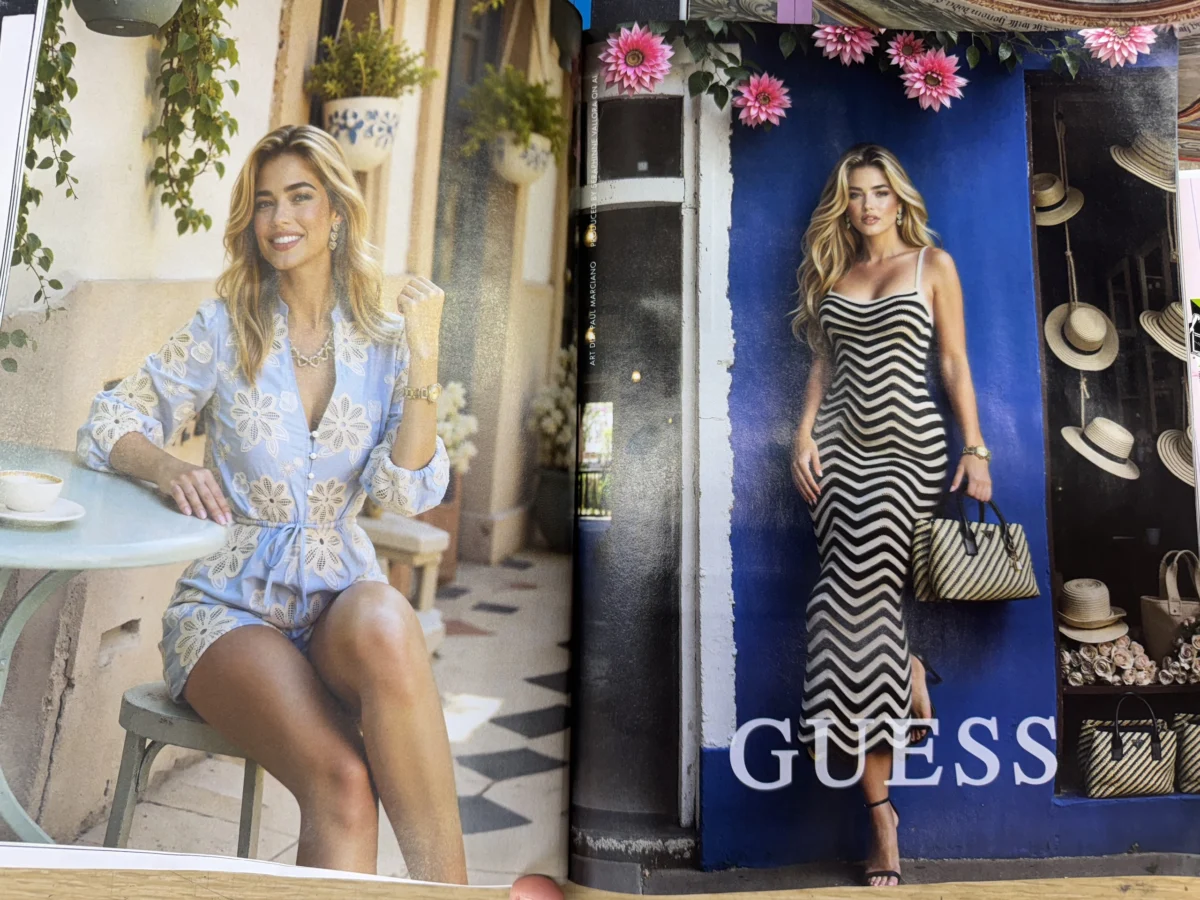
The global fashion industry is currently navigating a profound structural transformation as generative artificial intelligence moves from experimental curiosity to a primary tool for commercial advertising. This shift, while promising unprecedented efficiency and cost savings for brands, has ignited a fierce debate over the ethics of "artificial diversity," the erosion of human labor, and the setting of unattainable beauty standards. The controversy reached a new peak following the July print edition of Vogue, which featured an advertisement for the brand Guess utilizing a model that appeared to be a traditional blonde, North American beauty, but was in fact entirely AI-generated. This event has served as a catalyst for a broader investigation into how the world’s most influential fashion publications and brands are legitimizing technology that could fundamentally displace the human workforce.
The inclusion of an AI model in Vogue—often regarded as the industry’s "fashion bible"—marks a significant departure from previous years when digital models were relegated to niche social media campaigns or experimental "metaverse" projects. While Vogue clarified that the image was a paid advertisement and not an editorial selection, industry experts argue that the distinction is negligible to the average consumer. The presence of silicon-generated perfection within the pages of a high-fashion authority suggests a quiet endorsement of a future where human models, photographers, and stylists are no longer the default requirements for a high-impact campaign.
A Chronology of the Digital Shift
The integration of non-human entities into fashion retail is not a new phenomenon, but the sophistication of the technology has accelerated rapidly. As early as 2013, the French retailer Veepee began utilizing virtual mannequins to showcase clothing, a move designed to streamline the high-volume world of e-commerce. However, these early iterations were clearly digital and lacked the photorealistic nuance of contemporary AI.

The first major flashpoint of public controversy occurred in early 2023 when the iconic denim manufacturer Levi Strauss & Co. announced a partnership with the AI studio Lalaland.ai. The goal was to create "diverse" digital fashion models to supplement human talent and create a more inclusive shopping experience. The backlash was immediate. Critics and industry professionals, including New York Magazine, labeled the move "artificial diversity." The core of the criticism rested on the irony of a multi-billion-dollar corporation choosing to generate diverse "people" through algorithms rather than hiring the thousands of diverse human models who remain underrepresented in the industry.
By 2024 and 2025, the technology had moved beyond the "uncanny valley" and into a state of hyper-realism. Major global retailers including H&M, Mango, and Calvin Klein began incorporating AI-generated imagery into their digital catalogs and social media feeds. The Guess advertisement in Vogue represents the latest stage of this evolution: the migration of AI from the high-volume, low-prestige world of e-commerce into the high-gloss, prestigious world of print advertising.
The Economic Imperative: Scale and Savings
From a corporate perspective, the transition to AI modeling is driven by an inescapable economic logic. Traditional fashion photography is a labor-intensive and expensive endeavor. A single high-end shoot requires a fleet of professionals: models, photographers, lighting technicians, set designers, makeup artists, hair stylists, and creative directors. When factoring in travel, equipment rentals, and post-production, the costs for a single campaign can reach hundreds of thousands of dollars.
Paul Mouginot, an art technologist who consults for luxury brands, notes that AI allows companies to bypass these logistical hurdles. "AI now lets you start with a flat-lay product shoot, place it on a photorealistic virtual model, and even position that model in a coherent setting," Mouginot explains. This capability is particularly vital in the era of social media, where the demand for content has scaled exponentially.

PJ Pereira, co-founder of the AI ad firm Silverside AI, points out that the traditional marketing system was designed for an era when a brand might produce four major campaigns a year. Today, a brand might need 400 to 400,000 pieces of content annually to satisfy the algorithms of TikTok, Instagram, and global e-commerce platforms. For small and mid-sized brands, hiring human talent for this volume of work is financially impossible. In this context, AI is seen not just as a cost-cutting measure, but as a survival tool for scaling content in a digital-first economy.
The Human Toll and "Robot Cultural Appropriation"
For the humans who populate the fashion industry, these economic efficiencies represent a direct threat to their livelihoods. Sarah Murray, a professional commercial model, expressed a sentiment shared by many in her field: a sense of exhaustion and sadness. Murray argues that the profession is already hyper-competitive, and the introduction of digital "perfection" creates a standard that no human can realistically meet.
The threat is most acute for e-commerce models. While "supermodels" and high-fashion editorial stars may retain their value due to their personal brands and celebrity status, the "bread and butter" of the modeling industry—the thousands of models who pose for online catalogs—are the most vulnerable to automation. Sinead Bovell, a model and founder of the WAYE organization, warns that this automation often targets the very groups that the industry has historically marginalized.
Bovell has coined the term "robot cultural appropriation" to describe the practice of brands generating diverse digital identities to tell a brand story without actually employing people from those backgrounds. This allows companies to check a "diversity" box while keeping the financial benefits within a closed loop of technological development, often led by demographics that do not reflect the diversity they are simulating.

Furthermore, there is a growing concern regarding "likeness rights." Models are increasingly finding clauses in their contracts that allow brands to use their physical likeness to train future AI systems. This effectively means a model could be paid once for a shoot, only to have their digital twin used in perpetuity for thousands of future ads without further compensation.
Legal Responses and the Path to Regulation
In response to these concerns, advocacy groups are pushing for legislative guardrails. Sara Ziff, a former model and founder of the Model Alliance, is currently championing the Fashion Workers Act in New York. This landmark legislation would require brands and agencies to obtain clear, written consent from models before creating or using their digital replicas. It also seeks to ensure that models are fairly compensated for the use of their digital likeness.
The goal of such regulation is not necessarily to ban AI, but to create a framework where human talent can coexist with technology. Some technologists suggest that AI could actually provide a new revenue stream for models. If a model can license their digital twin, they could "appear" at multiple shoots across the globe simultaneously, generating passive income. However, as Mouginot points out, this benefit would likely only accrue to the top 1% of the industry, while the vast majority of working models would see their opportunities vanish.
The "AI Artisan" and the Quest for Imperfection
Despite the surge in AI usage, there remains a significant segment of the market that craves human authenticity. Critics of the Guess ad in Vogue noted that the AI model possessed a "homogenous" quality—symmetrical lips, a perfect jawline, and a lack of the "charming imperfections" that often define iconic human models.

This has given rise to a new class of "AI artisans." Sandrine Decorde, CEO of the creative studio Artcare, argues that the future of the medium lies in fine-tuning AI to include the nuances of humanity. Her firm uses advanced tools like Flux to create digital models that possess the "sensual reality" of human beings, including slight asymmetries and distinctive traits.
Interestingly, Decorde’s firm has found success in creating AI-generated children and babies for fashion brands. This application carries a unique ethical argument: the fashion industry has a long history of child labor exploitation and grueling hours for minors. By using AI-generated children, brands can fulfill the market demand for children’s fashion photography without subjecting real children to the pressures of a professional set.
Industry Outlook: Testing the Waters
The fashion world is currently in a state of high-tension experimentation. While some brands are embracing full automation, others are treading carefully, fearful of alienating a consumer base that increasingly values transparency and social responsibility.
The data on consumer reaction is mixed. PJ Pereira notes that while AI-generated ads often attract negative comments on social media, the actual engagement and conversion rates frequently tell a different story. In one test, an AI-generated product video saw a 30x increase in click-through rates compared to traditional content, despite a vocal minority of critics in the comments section. This suggests a "silent majority" of consumers may be more accepting of AI than the online discourse indicates.

Ultimately, the future of AI in fashion will likely depend on how the industry’s gatekeepers—publications like Vogue and heritage luxury brands—choose to integrate the technology. If Vogue begins featuring AI models in its editorial spreads, it will signal a permanent shift in the definition of "aspiration." As fashion historian Amy Odell observed, the industry often resists change until a major authority legitimizes it. Just as Vogue once signaled the mainstream acceptance of reality TV stars, its handling of AI will determine whether the silicon model becomes a permanent fixture of the fashion landscape or remains a controversial experiment in the pursuit of profit.