









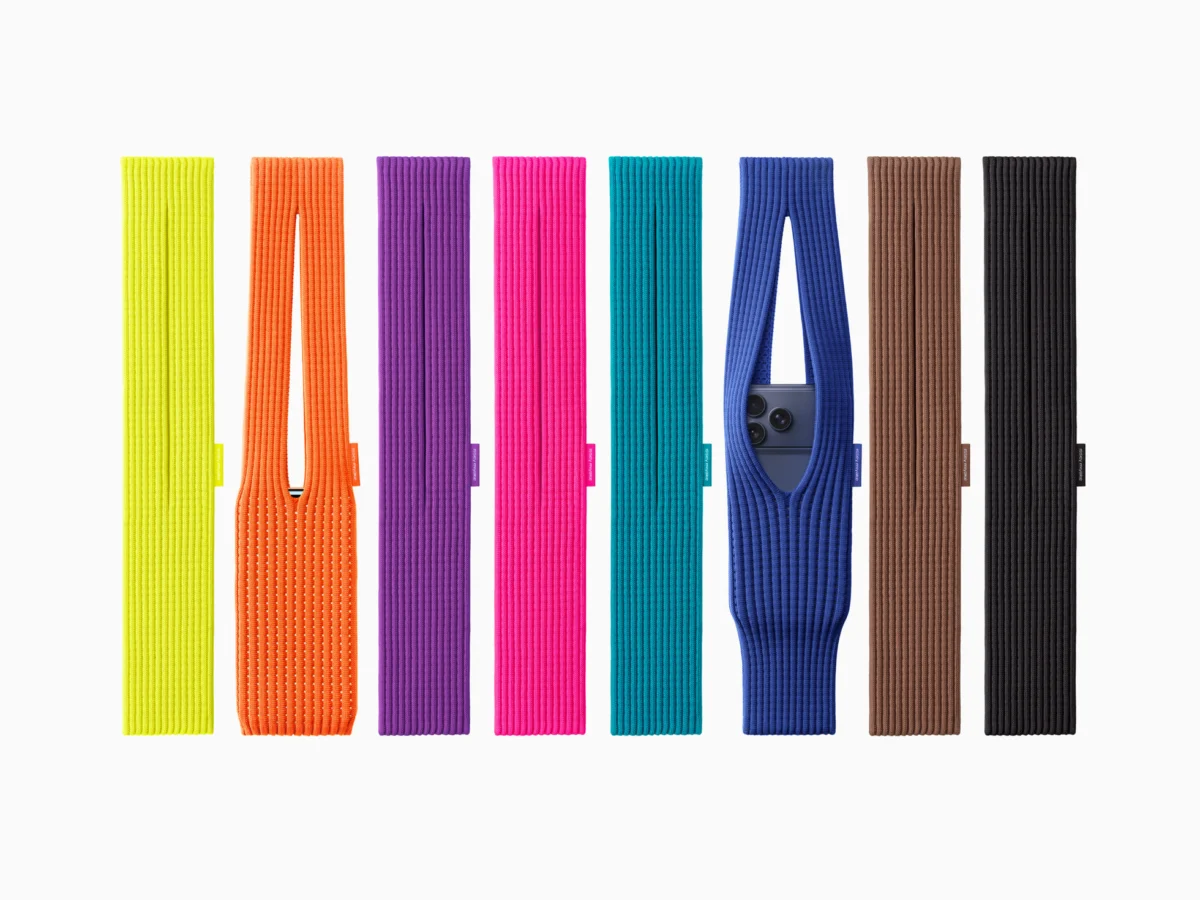
Apple has officially expanded its premium accessory ecosystem through a collaboration with the renowned Japanese fashion house Issey Miyake, introducing a minimalist fabric carrier known as the iPhone Pocket. The product, which debuted on the Apple Store this week, is available in two distinct configurations: a "short" handheld version retailing for $149.95 and a "long" crossbody version priced at $229.95. This launch marks a significant intersection between high-concept textile engineering and consumer electronics, further positioning Apple within the luxury lifestyle market.
The iPhone Pocket is constructed using a specialized ribbed mesh structure inspired by the "A Piece of Cloth" (APOC) concept, a design philosophy pioneered by the late Issey Miyake. According to product specifications, the accessory is manufactured from a single continuous piece of fabric, eliminating traditional seams and reducing material waste. Apple describes the textile as an "open textile" that subtly reveals the device’s display when the fabric is stretched, allowing users to check notifications without removing the phone from its enclosure.
Technical Design and the APOC Philosophy
The engineering behind the iPhone Pocket is rooted in textile innovations that date back to 1997. Issey Miyake and his associate Dai Fujiwara developed the APOC system to challenge conventional garment manufacturing. Unlike traditional methods where fabric is cut and sewn into shapes, APOC uses computer-controlled knitting or weaving machines to create finished products from a single thread.
The iPhone Pocket utilizes a variation of this technology. The ribbed mesh is designed to be highly elastic yet durable, providing a snug fit for various iPhone models while maintaining its structural integrity over time. The "short" model is intended to be used as a protective sleeve or a decorative attachment for larger bags, while the "long" model serves as a dedicated crossbody sling. The short version is available in a wider array of vibrant colors, including "Lemon," whereas the long version is offered in a more curated, neutral palette.
A Historical Chronology of the Apple and Issey Miyake Relationship
The collaboration between the Silicon Valley giant and the Japanese fashion house is a culmination of a relationship that spans over three decades. The connection began in the early 1980s when Apple co-founder Steve Jobs visited Sony’s headquarters in Japan. Jobs observed that Sony employees wore uniforms designed by Issey Miyake—a practice intended to foster a sense of corporate identity and professional focus.
Inspired by this model, Jobs commissioned Miyake to design a uniform for Apple employees. However, when Jobs presented the samples to his team in Cupertino, the idea was met with significant resistance. While the corporate uniform project was abandoned, the professional bond between Jobs and Miyake deepened. Jobs requested that Miyake create a personal uniform for him, specifically a black turtleneck.

Miyake subsequently produced hundreds of identical black mock-neck shirts for Jobs, which became a central element of the CEO’s iconic public persona. This uniform came to symbolize Apple’s commitment to minimalism, functionality, and the removal of "decision fatigue." Although Issey Miyake passed away in 2022, the Miyake label has continued to operate under his design principles, eventually leading to this formal product partnership with Apple.
Market Positioning and Supporting Financial Data
The pricing of the iPhone Pocket—ranging from roughly $150 to $230—has drawn comparisons to Apple’s 2021 release of a $19 polishing cloth. However, industry analysts suggest that the iPhone Pocket is aimed at a different market segment: the luxury "entry-level" consumer. In the luxury goods sector, items like keychains, small pouches, and phone accessories often serve as accessible entry points for brands like Hermès, Gucci, or Prada.
Apple’s "Wearables, Home, and Accessories" segment has become a critical driver of the company’s revenue. In the 2023 fiscal year, this category generated nearly $40 billion in net sales. By partnering with a high-fashion label like Issey Miyake, Apple is tapping into the "premiumization" trend, where consumers are willing to pay a significant markup for brand-name collaborations and specialized design.
Comparative pricing for luxury phone accessories supports Apple’s positioning:
- Hermès Apple Watch Straps: $339 – $539
- Gucci Ophidia iPhone Cases: $350 – $500
- Prada Saffiano Leather Phone Slings: $600 – $900
By comparison, the $229.95 iPhone Pocket is priced competitively within the luxury tier, even as it remains significantly more expensive than standard silicone or leather cases offered by third-party manufacturers.
The Rise of the "Accessory for an Accessory" Trend
The launch of the iPhone Pocket aligns with broader cultural and fashion trends involving "micro-bags" and the accessorization of everyday items. Over the past several years, the market for "accessories for accessories" has seen exponential growth. This includes the popularity of "blind box" collectibles like Labubu—monster-themed plush charms that can retail for $30 at base price but reach thousands of dollars in the secondary market—which are frequently attached to designer handbags.
Similarly, the trend of "Stanley Cup accessorizing," where users add pouches and charms to their insulated water bottles, demonstrates a consumer desire to personalize utilitarian objects. The short version of the iPhone Pocket is designed to function in this capacity, allowing users to tether their phones to larger bags (such as the popular Telfar shopper or Lululemon belt bags) as a stylistic statement.

Furthermore, the shift toward a "cashless" society has reduced the need for traditional handbags. With the integration of Apple Pay and digital car keys, the iPhone has become the only essential item for many consumers. This has led to the rise of the "phone-only" carry, popularized by brands like Bandolier, which specialize in crossbody phone cases. Apple’s entry into this space with a high-fashion partner suggests they intend to capture a larger share of the "functional jewelry" market.
Broader Implications for Apple’s Brand Identity
The introduction of the iPhone Pocket signals a strategic move by Apple to further bridge the gap between technology and high fashion. For years, the company has positioned itself as more than a hardware manufacturer, leaning into its status as a curator of taste and design.
From a sustainability perspective, the use of Miyake’s APOC-inspired knitting technique allows Apple to market the product as a low-waste alternative to traditional leather or plastic accessories. The single-piece construction minimizes offcuts, aligning with Apple’s stated goal of reaching carbon neutrality across its entire product lifecycle by 2030.
However, the product also serves as a test of brand loyalty. By releasing a high-priced fabric "sock" for a device that is already considered a luxury item, Apple is gauging the extent to which its customer base will invest in "non-essential" luxury goods. If the iPhone Pocket succeeds, it could pave the way for more frequent collaborations with international design houses, potentially expanding into apparel or home textiles.
Conclusion and Future Outlook
While the iPhone Pocket may be viewed by some as an extravagant niche product, its roots in textile history and its connection to the legacy of Steve Jobs provide a narrative that resonates with the brand’s core enthusiasts. As the holiday shopping season approaches, analysts will be monitoring the adoption rates of the accessory to see if it becomes a status symbol among tech-forward urban professionals.
Whether the iPhone Pocket becomes a mainstay of the Apple Store or remains a limited-edition curiosity, it represents a clear evolution in Apple’s accessory strategy: moving away from purely protective gear and toward high-concept, wearable design. For now, the "A Piece of Cloth" philosophy has found a new canvas in the form of a smartphone sling, proving that even in the digital age, the tactile and historical weight of a well-designed fabric can still command a premium price.