









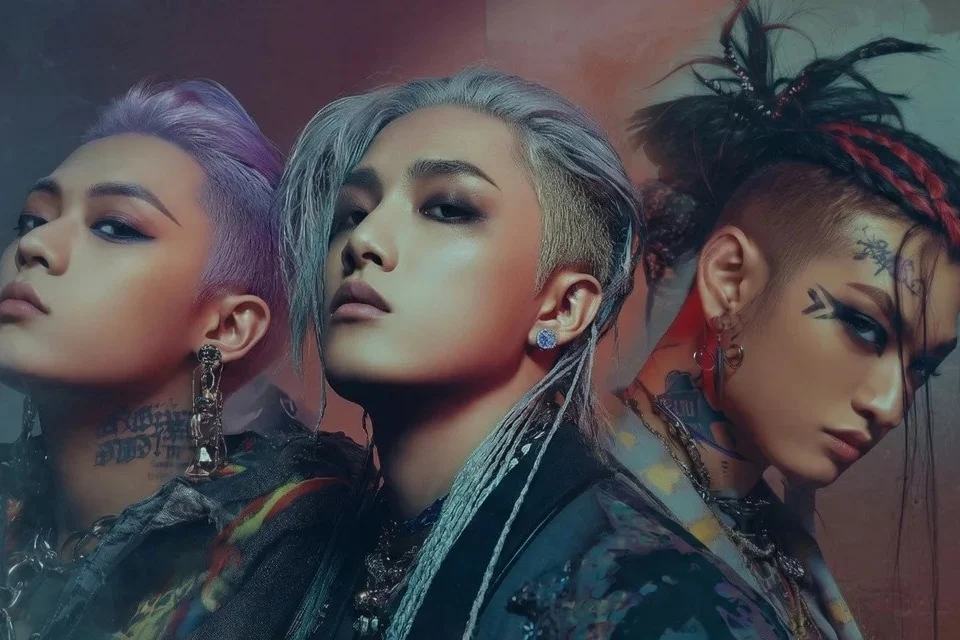
Last December, a K-pop trio named GLXE (pronounced ‘galaxy’) emerged onto the global music scene, notably devoid of the extravagant marketing typically associated with idol debuts. Eschewing the traditional fanfare of lavish photoshoots and intricately orchestrated teaser campaigns, the three male singers made their initial appearance directly on TikTok, presented as a fully formed act complete with epic musical build-ups and cinematic visuals. Their unconventional introduction quickly piqued curiosity, signaling a departure from established industry norms.
The Rise of Synthetic Stardom: GLXE and the AI Frontier
It takes only a fleeting moment for discerning viewers to realize that GLXE are not human artists but sophisticated generative AI creations, rendered with impressive fidelity. However, the more profound revelation lies in the fact that their voices and entire musical compositions are also entirely AI-generated, crafted using Suno, a generative music platform that boasts over two million paid subscribers. This platform, trained on an immense dataset of millions of songs, is capable of producing a complete musical track from just a few text prompts. Suno is currently at the center of multi-million dollar lawsuits initiated by some of the world’s largest music labels, alleging widespread copyright infringement—a legal battle that underscores the burgeoning tensions between traditional music creation and algorithmic innovation.
Despite their artificial origins, GLXE meticulously adheres to the established K-pop playbook. They have cultivated a dedicated fandom, dubbed "Stars," actively engage in popular dance challenges, release albums in rapid succession, host listening parties, and conduct interactive livestreams. Their growing, albeit niche, fanbase appears largely unconcerned by the escalating criticism surrounding AI’s infiltration of K-pop. One fan, commenting on a TikTok video featuring the silvery-grey-haired virtual singer Manilla, effusively wrote, "Thank you for giving us three wonderful people whose voices convey the most beautiful feelings. Thank you for creating songs that say so much, and melodies that invite us to dream." This sentiment highlights a segment of the audience that prioritizes the artistic output and emotional connection, irrespective of the creators’ nature.
A Shifting Perception: From Innovation to Existential Threat
Among the broader K-pop fan community, however, dissent against AI is mounting. The technology first entered K-pop’s lexicon with groups like aespa, who debuted in 2020 featuring human-designed virtual avatars (also known as AI counterparts), and MAVE:, a group that utilized AI to communicate in multiple languages. These early integrations were largely perceived as symbols of forward-thinking creativity and technological prowess, aligning with K-pop’s reputation for innovation.
However, the landscape began to shift dramatically. The introduction of Supertone’s short-lived AI girl group Syndi8 in 2024 and the subsequent proliferation of AI-driven aspiring idols like GLXE this year have transformed the perception of "AI" within fandom circles. It has increasingly become shorthand for large language models (LLMs) and generative AI, evolving into a symbol of a world perceived as spiraling out of control—a reflection of late-stage capitalism, climate crisis anxieties, and, most critically for many fans, a looming death knell for genuine creativity and human artistry.
Hyd, a member of the popular fan account ENHYPEN ASIA, voiced these concerns to Dazed, stating, "It sparks serious concerns about authorship and authenticity. As fans, we do not simply consume finished songs or performances; we witness the years of training, discipline, and exhaustion. That’s why AI sparks serious concerns about authorship and authenticity." This perspective underscores the deep-seated value K-pop fans place on the human journey, effort, and vulnerability of their idols, elements that AI-generated acts inherently lack.
K-Pop’s Enduring Affinity for Technology: A Historical Context
The fusion of K-pop and technology is not a new phenomenon; it is, in fact, foundational to the genre’s global ascent. There is a direct correlation between K-pop’s rise in the West and the ubiquitous adoption of social media, digital music platforms, and livestreaming throughout the 2010s. The industry has consistently been an early adopter of new technologies, swiftly embracing NFTs and blockchain in 2022 as potential new avenues for fan engagement and revenue.
This proactive stance on technology is deeply embedded within South Korea’s national identity. The nation’s modern economic success is intrinsically tied to technological advancement, fostering an environment where innovation is not just accepted but actively pursued. In 2023, South Korea was notably the biggest consumer worldwide of AI "slop" videos, indicating a broad public appetite for AI-generated content. Recognizing the rapid proliferation and potential challenges, the AI Basic Act was passed in January 2026, a pioneering legislative effort aimed at curbing misuse and protecting consumers in the burgeoning AI landscape. A 2025 South Korean survey further revealed that 70 percent of the population believed AI would have a positive effect on society. It is, therefore, unsurprising that K-pop industry executives largely share this optimistic outlook.
Industry Giants Lean into AI: A Vision for the Future
Prominent figures within the K-pop creative ecosystem have publicly embraced AI. Renowned video director Rima Yoon and Min Hee-jin, the former CEO and creative director of NewJeans, have expressed their support for integrating AI tools into their work. JYP Entertainment’s subsidiary, Blue Garage, explicitly states its mission to "create a new kind of IP using AI technology." SM Entertainment’s co-CEO, Daniel Jang, has announced strategic plans to integrate AI within their A&R (Artists and Repertoire) systems, aiming to streamline talent discovery and development. Further demonstrating this commitment, SM Entertainment released a fully AI-generated video for aespa’s "Rich Man (Yellow Claw Remix)" in September of last year.
The future envisioned by some industry leaders is even more radical. In December 2025, Choi Yong-ho, CEO of Galaxy Corporation (the agency behind G-Dragon), declared that generative AI in K-pop music videos, at least, is becoming the new normal. He predicted, "Most music videos will be created by artificial intelligence except for lead singles. Costs will come down, and efficiency will go up." This perspective underscores a strategic move towards leveraging AI for operational efficiency and cost reduction, potentially reshaping production models across the industry.
The Transparency Gap: A Core Fandom Grievance
For many K-pop fans, the fundamental issue extends beyond the mere utilization of generative AI to the alarming lack of transparency with which companies are implementing it. Dr. Sarah Keith, a senior lecturer in music and media at Sydney’s Macquarie University and an extensive scholar of fandoms, highlights a telling Reddit post within the K-pop community. The post, made by an AI video effects artist, claimed to have worked on numerous K-pop videos where the use of AI was deliberately undisclosed.
"K-pop fans want to make sure that artists are not exploited, so when they see AI being used, it’s seen as a sign of management cutting corners or underinvesting," Dr. Keith explains, detailing the outrage sparked by such revelations. "Why couldn’t management pay a little more to get something that didn’t look like AI slop? It comes down to humanism and authenticity, but also, ‘Don’t lie to us as fans. Don’t act like you’re investing in this photoshoot but actually it was mostly AI-generated’." This demand for honesty and ethical conduct from labels is a critical aspect of fandom’s evolving relationship with AI.
AI as a Tool: A Creator’s Perspective
Oh Jaewon, the AI artist Dr. Keith referenced, founded his own AI-based VFX studio, Oloid, in 2025. He offers an alternative perspective, viewing AI not as a replacement for human creativity but as another powerful tool in an artist’s arsenal. "I think the concerns that fans have are understandable," he communicates via email. "The common perception is that AI is used as a low-cost replacement, but in many cases, we’re asked for visuals that have a specific AI-driven aesthetic." He further clarifies a common misconception: "There’s also a misconception that AI VFX is always cheaper than traditional 3D VFX when, in practice, aligning AI-generated imagery with real footage can be technically demanding and time-consuming. AI changes what creatives do, rather than removing the need for them altogether."
Brian Jenkins, former VP of business development, Asia-Pacific, for Warner Chappell Music, extends this logic to the realm of music creation itself. "There’s this line of thinking that AI fits in the same world as Pro Logic, Pro Tools, and all of those creation tools that exist to help songwriters develop and create new music," he tells Dazed. "We’re still coming to grips with it. Every label is looking at AI and trying to figure out how to use it in different ways. AI music, AI idols, they become their own genre, and there are people who like those idols." This suggests that AI-generated content might carve out its own niche, appealing to different segments of the audience.
The Moral and Legal Labyrinth: Copyright, Authorship, and the Future of IP
However, Dr. Keith argues that this evolving usage of AI in music introduces significant moral and ethical questions. "Do artists need to disclose it if they get AI to tweak the instruments?" she probes. The complexity deepens with platforms like Suno and Udio, which offer integrated digital audio workstations, allowing for the creation of songs that are a blend of AI and human input. "You can create a song, start to finish, and it could be part-AI and part-human generated, but [that ratio] might be 99:1 or 1:99. It’s only going to get more nebulous on what is AI and what isn’t." This blurring of lines poses immense challenges for establishing clear authorship and intellectual property rights. Currently, generative AI music largely cannot secure publishing or performance rights, but Jenkins warns that this "is a fight that’s going to come soon," foreshadowing significant legal battles over ownership and remuneration in the digital age.
The Cultural Imperative: "K-Pop Without Korea"
Beyond the technical and legal challenges, Dr. Keith identifies a profound cultural question at stake. "The threat is K-pop without Korea," she asserts. "Is the future of K-pop AI-generated idol groups by Chinese or Russian creators? That will be a huge headache for the Korean government, which has put so much money into cultivating K-pop as the cornerstone of Korea’s public image and economy." K-pop is not merely a music genre; it is a vital component of South Korea’s soft power, a global cultural export that significantly contributes to the nation’s brand and economy. The prospect of its dilution by non-Korean, AI-generated content represents a significant threat to this carefully constructed identity. "For that reason, K-pop will be quite interested in maintaining the human and the Korean connection. At its core, Korea will not move far from the training system. It may experiment with generative AI but not so much that it actually dilutes the whole market." This suggests that while innovation is welcome, the industry will likely seek to protect the core "K-ness" of K-pop.
Democratization and Vision: The Creator’s Drive
Orion, the mastermind behind the AI K-pop group GLXE, remains largely unperturbed by these complex moral and ethical questions. He argues that the majority of his burgeoning fanbase shares his indifference. "There are people who are gonna be anti-AI until they die," he tells Dazed. "Some are on the fence, like, ‘Oh, I wish they weren’t AI, but I love the music’. But 90 percent say, ‘I don’t care that it’s AI, I just love them’, or that they like them better because they’re AI and not being manipulated or taken advantage of by a label." This latter point introduces a fascinating counter-narrative: for some fans, AI idols represent a perceived escape from the often-harsh realities and exploitative practices of the traditional K-pop industry.
Orion has grown accustomed to his work being labeled "AI slop," even finding humor in the criticism ("Someone called me a ‘slopperator’, which I found quite funny"). However, he strongly contends that critics underestimate the immense energy and creative input he invests in the GLXE project. "Yes, AI makes everything easier and possible, but it takes a person managing it, directing it, curating it. You have to have a creative vision of what you want to accomplish. You can’t ask AI for a hot guy doing a Blackpink dance, and it’ll just do it. That’s not how it works." This highlights the human element of curation, direction, and artistic vision that remains crucial even when leveraging generative AI.
For Orion, AI software like Veo3 (a video generation tool) and Suno are powerful tools for democratization, enabling him to enter an industry that is otherwise notoriously difficult to penetrate. "I tried reaching out to producers on my favorite K-pop songs saying, ‘How do I start? I’ve got this idea for a group’ but I didn’t hear back, so I decided to make it happen myself," he explains, detailing the project’s genesis. "I write lyrics. I don’t pretend to be a musician but I’ve got these ‘advanced samples’ [Orion’s term for songs made in Suno] that I’ve worked on. I want GLXE to not be AI, that’s my dream." His ambition reveals a desire to transcend the AI label, perhaps evolving towards a hybrid or human-driven future.
The Power of the Fandom: Shaping K-Pop’s AI Future
While Orion and his online counterparts may not currently pose an existential threat to the multi-billion dollar idol industry, their emergence serves as a potent warning shot. Like it or not, the role of AI in K-pop music is rapidly becoming unavoidable, forcing fans, artists, and labels alike to collectively decide what kind of future they are willing to invest in.
For the remaining members of the ENHYPEN ASIA fan account, the answer is unequivocally clear. "Innovation itself is not the enemy, but the future of K-pop depends on protecting the human touch," stresses group member Mitch. "Without it, the genre risks becoming technically flawless but emotionally distant." Their fellow moderator, Cha, concurs: "It’s about the choices the idol makes, and the moments where their personalities and creativity shine through. That’s what makes their work feel alive and irreplaceable. Technology should support their artistry, not overshadow it, because the heart of their music and performances comes from them, and that is what keeps fans engaged and inspired." These statements articulate a core belief that genuine human connection and expression are irreplaceable elements of K-pop’s appeal.
As K-pop companies continue to integrate AI in various forms, it is crucial to remember that inevitability does not equate to acceptance. If fandoms genuinely do not want generative AI permeating their idols’ content—whether it be ChatGPT for lyrics, Suno for music, or Nano Banana for video—then they must articulate this stance beyond merely expressing anger on social platforms.
The K-pop machine, for all its perceived invincibility, is not unbreakable. Brian Jenkins emphasizes that even the seemingly indomitable "Big 4" labels (YG Entertainment, SM Entertainment, JYP Entertainment, and HYBE) are not immune to failure when fandoms collectively disengage. "It’s happened to all of them. As much success as they’ve had, they’ve also had quite a few duds. If fans don’t like AI and don’t engage with it, it’s not going anywhere," Jenkins concludes. "K-pop puts out tons of music every year, and a very small portion of it succeeds, and a lot of it doesn’t because fans decide they didn’t like the group, whether it’s the music or look, whatever it might be. AI will be judged by the same harsh glare that everything else is in K-pop." Ultimately, the discerning power of the K-pop fandom will be the ultimate arbiter of AI’s enduring place in the industry.