










In 2026, Thomas Crapper & Co., a company synonymous with revolutionary advancements in sanitation and domestic comfort, commemorates its 165th anniversary. Founded in 1861 by the pioneering plumber and entrepreneur Thomas Crapper, the company has etched its name into history not by inventing the modern toilet, but by transforming its perception and accessibility for the average Briton and, subsequently, the world. Crapper’s genius lay in his understanding of public perception and his innovative approach to product demonstration. Facing considerable societal inertia and apprehension towards pressurized running water within homes, he established what is widely recognized as the world’s first toilet showroom boutique. In 1870, this bold initiative took shape in London’s Chelsea district, where Thomas Crapper & Co. unveiled a space featuring fully functional toilets, offering the public a tangible experience of their operation. This audacious move, initially met with skepticism, ultimately proved instrumental in catalyzing a significant revolution in personal hygiene and domestic architecture, fundamentally altering the standards of civilized living.

A Legacy Reimagined: From Sanitation Pioneer to Lifestyle Brand
The enduring legacy of Thomas Crapper & Co. extends far beyond its historical significance. Still a vibrant entity today, the company has recently undergone a strategic management transition and a comprehensive brand refresh. Remaining steadfastly British, it continues to uphold its founding principles while producing an array of premium toilets and sophisticated bathroom accessories. In 2016, the company transitioned into family ownership, acquired by the Mosley family. Under the leadership of Managing Director Paul Dwyer, Thomas Crapper & Co. has embarked on a mission to evolve into a distinguished lifestyle brand. A testament to this vision is the recent introduction of a commemorative wristwatch, "The Venerable Watch," conceived to introduce the company’s rich heritage to a new generation of enthusiasts who appreciate the enduring impact of historical innovations on contemporary life.
The Unexpected Symbiosis: Timepieces and Toilet Technology
The decision to venture into horology might seem unconventional, yet it is rooted in a fascinating historical connection between the precision of watchmaking and the ingenuity of sanitary engineering. The fundamental flushing mechanism of a toilet, a critical component for its functionality, was originally patented in 1775 by Alexander Cummings, a Scottish watchmaker. Cummings, a contemporary of the renowned navigator and clockmaker John Harrison, was involved in evaluating the effectiveness of ship chronometers for navigational purposes during his work with King George III’s government. His invention of the S-shaped trap and valve system proved pivotal in modernizing toilet design, effectively mitigating the pervasive issue of noxious odors emanating from plumbing systems and entering households. While Cummings’ technological advancements were significant, toilets remained a luxury, an esoteric item for the affluent until visionary figures like Thomas Crapper employed sophisticated marketing and secured installations for esteemed clientele, including British royalty at Buckingham Palace.

This historical link underscores a profound parallel in the concept of regulation systems, a cornerstone in both watchmaking and toilet design. The escapement in a wristwatch meticulously governs the release of energy from a wound mainspring, ensuring the precise and consistent movement of gears that display time. Similarly, a toilet’s flushing system is engineered to regulate the flow of pressurized water, ensuring adequate volume and force for effective waste removal while maintaining controlled operation throughout the system. Both mechanisms are designed to manage and release stored energy in a functional, reliable, and consistent manner. Furthermore, the intrinsic nature of time, like water, is its ceaseless flow. This shared poetry between the reliance on regulation-based daily tools, such as timepieces and toilets, inspired Thomas Crapper & Co. to categorize its new wristwatch offerings as the "Flow Of Time Collection."
"The Venerable Watch": A Tribute to Heritage and Engineering
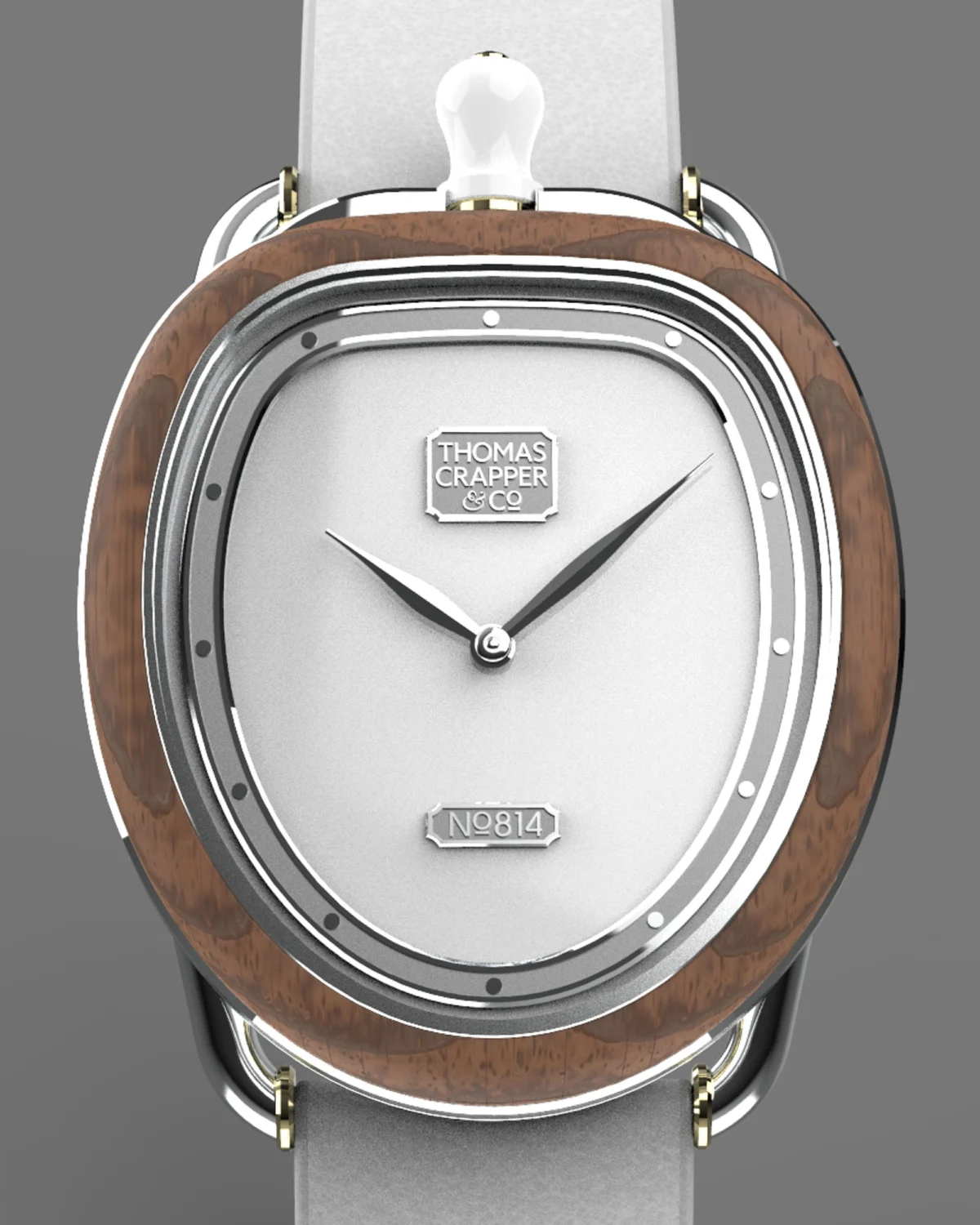
The inaugural piece in this collection, "The Venerable Watch," is a deliberate homage to the company’s classic Victorian-era toilet, also known as "The Venerable," a product line that continues to be manufactured and sold to this day. The term "Venerable" itself is a recurring motif in numerous Thomas Crapper & Co. logos, lending historical depth and resonance to the wristwatch’s nomenclature. Adding another layer of historical detail, the "No. 814" designation prominently displayed on the watch dial corresponds to the reference number of classic Thomas Crapper & Co. cistern components, further cementing the timepiece’s connection to its illustrious past.

Design Elements: A Fusion of Form and Function
The design of "The Venerable Watch" is a meticulous tribute to the craftsmanship and iconic forms that have characterized Thomas Crapper & Co. products for over a century and a half. The watch’s case and dial are conceived to evoke the legacy equipment that defined the brand. The dials, in particular, are crafted from sanitary-grade enamel porcelain, featuring a subtle concave curvature to mimic the aesthetic of a toilet bowl. The unique "water cyclone" effect on these dials is achieved through a complex texturing process initiated before the porcelain firing, followed by a secondary polishing stage to simulate the dynamic motion of water. This innovative approach extends to the luminous material, which is designed to echo historical practices. While some Victorian-era toilet bowls were reportedly treated with phosphorescent paints to aid visibility in dim light, "The Venerable Watch" will utilize modern, non-radioactive luminous compounds for safety and efficacy.
Measuring 37mm in width and 41mm from lug to lug, the case of "The Venerable Watch" embodies a design philosophy deeply rooted in the brand’s heritage. The case, primarily constructed from steel, draws inspiration from the brass used in plumbing fixtures and the distinctive elongated shape of toilet bowl seats. This connection is further emphasized by an optional solid mahogany wood bezel, a nod to the original material used for toilet seats. The crown, strategically positioned at the 12 o’clock mark, is a direct reference to the porcelain-ended pull-handles used to operate classic Thomas Crapper & Co. cisterns. On the watch, this pull-handle-style crown is rendered in white ceramic, a material that also finds its way into modern flush lever handles, thus bridging historical design with contemporary relevance.

The caseback of "The Venerable Watch" continues this thematic exploration and incorporates a significant symbol from the Thomas Crapper & Co. archives: the bee. While many public toilets of the past featured a fly motif as a target to improve aim and minimize spillage, Thomas Crapper & Co. adopted the bee as its emblem. This choice symbolized not only a practical solution to reduce sanitary issues and enhance the shared user experience but also represented broader values of shared human interests and mutual cooperation in meeting collective needs – principles that have been central to the company since its inception in 1861.
Internal Mechanics and Future Aspirations
Beneath the elegantly designed caseback lies the reliable Swiss automatic Sellita SW300 movement, a respected caliber in its own right and a fitting engine for this debut timepiece. The visual design of "The Venerable Watch" was entrusted to Thomas Funder, a professional timepiece designer, ensuring a harmonious blend of brand identity and horological excellence.

Looking ahead, Thomas Crapper & Co. harbors ambitious plans for future watchmaking endeavors. These include the development of models featuring fluidic indicators and an innovative automatic winding system that employs liquid as a kinetic brake. Distribution of these timepieces will be strategically limited to existing Thomas Crapper & Co. boutiques and retail partners where the company’s broader product range is available. This deliberate approach, according to Managing Director Paul Dwyer, is intended to draw attention to the company’s extensive offerings and foster meaningful conversations. Dwyer further elaborates on the brand’s unique positioning, drawing a parallel to Rolex, often referred to as "the crown" due to its logo. He points out that Thomas Crapper & Co. utilized a crown motif long before Rolex, a consequence of its historical installations for royalty. The company’s association with "porcelain thrones" further solidifies its connection to the elite, suggesting that discerning individuals drawn to the prestige of high-end watches will appreciate the brand’s authentic ties to royalty and its commitment to unparalleled quality.
The Thomas Crapper & Co. The Venerable Watch is launching with a retail price of £5,400. Further details and information can be found on the official Thomas Crapper & Co. website. This venture marks not just an anniversary celebration but a bold step forward, demonstrating that a company with a legacy as foundational as Thomas Crapper & Co. can elegantly merge its historical roots with contemporary luxury and innovation.